Section
Archery Equipment for Bowhunting
Archery equipment for bowhunting is a system, not a shopping list: one bow, the arrows or bolts that match it, a point on the front, and the parts that help you aim and carry it. Pick the bow first, because its draw weight and style decide almost everything else. The short version: bow, then arrow, then broadhead, then the accessories. (Uncle Walt does it in the reverse order and then wonders why nothing fits.)
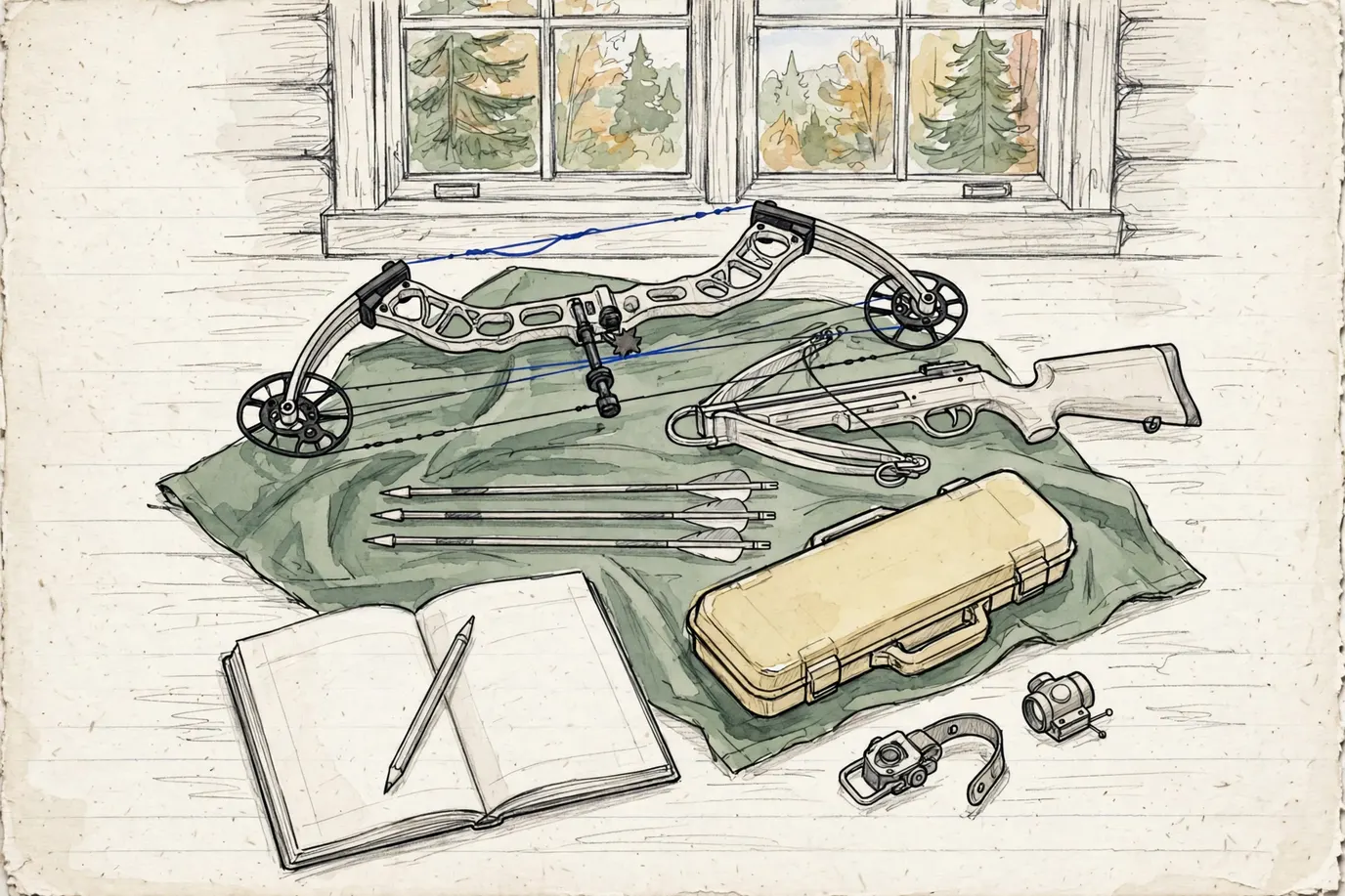
Gear in this section
Best-of lists
Best Lighted Nocks
Lighted nocks whose maker or Amazon listing states battery life and how the light switches on, longest battery life first.
Best Hunting Arrows
Hunting arrows with a stated straightness of ±.003 inch or tighter, straightest first.
Best Crossbow Bolts
Crossbow bolts whose maker or Amazon listing states straightness, length and nock type, straightest first.
Best Compound Bow for Beginners
Ready-to-hunt compound bows whose draw weight and length adjust without a bow press, as stated by the maker or the Amazon listing.
Best Crossbow for Deer Hunting
Crossbows with at least 65 ft-lb of kinetic energy as stated by the maker or the Amazon listing — a deliberately high floor, well above what deer require — highest energy first, two per brand at most.
Best Crossbow
Crossbows whose maker or Amazon listing publishes speed, kinetic energy and weight, fastest first, with no more than two per brand. Weights are the maker's own figures.
Brands in this section
Archery equipment starts with the bow
Every other piece of archery gear hangs off the bow. Its draw weight decides your arrow spine. Its style decides whether you need a rest, a release or a cocking rope. So the first choice on this whole section is which of three bows you're building around.
Compound bows: let-off and a fixed draw
A compound bow uses cams or wheels to ease the pull at full draw. Archery 360 says let-off can reach 90%, so a 70-lb compound can hold at about 7 lb. That's why compound hunters can wait at full draw for a deer to step clear. Compounds also have a built-in draw stop, so every draw ends in the same place.
Here's what actually changes with a compound: you're buying into a set of parts. Archery 360 notes that compounds are built to take sights, rests and stabilizers, and most compound archers shoot with a mechanical release. If you're building that kind of setup, compound bow arrows, a compound bow arrow rest and a bow release are your next three stops.
Left-handed archers need a left-hand compound, not a right-hand bow turned around. The riser, rest side and cam timing are mirrored. The same goes for left-hand sights.
Recurve bows: simple, quiet, and no let-off
A recurve bow has no cams and no let-off. You hold the full draw weight for as long as you're at full draw. Archery 360 says recurve hunters commonly shoot 40 to 50 lb and have a shorter effective range than compound hunters. Most shoot with fingers, protected by a glove or tab.
Recurves come in two build styles. A one-piece recurve is a single unbroken bow. A takedown splits into a riser and two limbs, so you can change draw weight by swapping limbs and pack it in a smaller case. ILF is a limb-fitting standard you'll see on many takedown risers. Some recurves take a stabilizer and a sight; many are meant to be shot bare.
Crossbows: a different kit entirely
A crossbow is crossbow hunting gear, not bow gear with a stock on it. It shoots crossbow bolts, usually aims with a crossbow scope, and stays cocked until you shoot or uncock it.
TenPoint sorts crossbows into three styles:
- Recurve crossbows: the oldest design, no let-off, high draw weights, hardest to cock by hand
- Forward-draw compounds: the most common style, cams and cables for more speed at the same draw weight
- Reverse-draw compounds: a longer power stroke, high speed at lower draw weights, and a balance point closer to your hand
Pistol crossbows are a small separate class, mostly for targets and small game, and they take their own short bolts. Check your state's rules before you think about one for deer.
Speed is the number every crossbow box leads with. "Fastest crossbow" is a fine search but a poor plan. Speed comes with draw weight, noise and cocking effort, and the bolt your crossbow's maker recommends matters more than the last few FPS (feet per second, the unit for arrow and bolt speed).
My one opinion: pick draw weight you can pull 30 times
Most beginners should pick a draw weight they can pull smoothly 30 times, not the number they want to brag about. The reason is on the spec sheet: a recurve has no let-off, so you hold every pound, and even a compound has to be drawn all the way through its peak before it eases off. You'll be doing that sitting down, in a coat, with cold hands, slowly enough that a deer doesn't notice. Archery 360 puts many states' minimum for deer around 35 lb. Start there, check your state's actual number, and work up.
How bowhunting equipment fits together
Once you have the bow, the rest of your bowhunting equipment is a chain. Each link has to match the one before it.
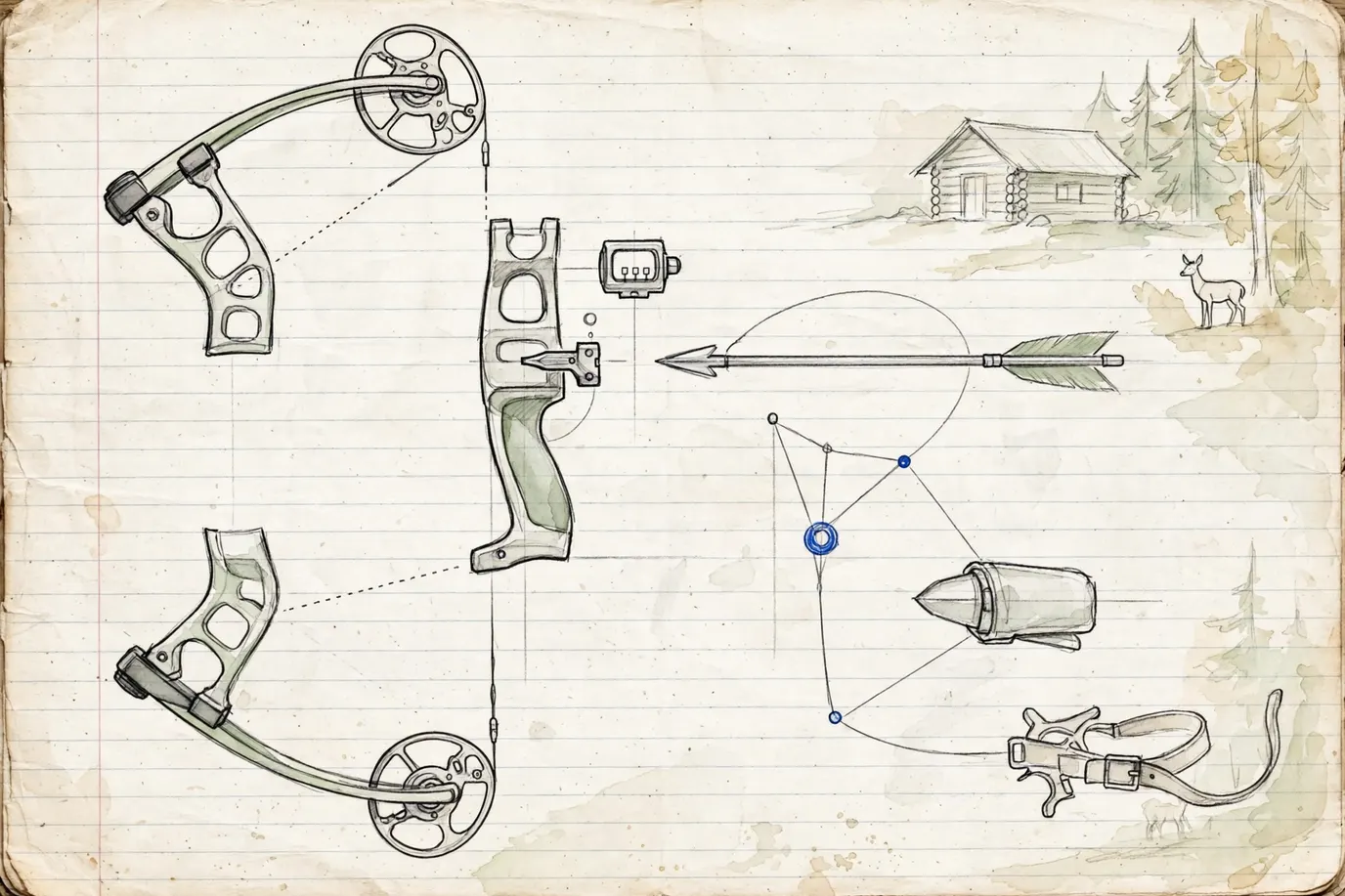
Arrows and bolts match the bow, not the box
Hunting arrows are chosen by spine (stiffness), length and weight, and all three come from your draw weight and the point you screw on the front. Oregon's wildlife department lists "make sure arrows match the bow's draw weight" as a basic safety rule, not just a tuning tip.
Shaft material sorts itself out fast. Carbon is the usual hunting arrow. Aluminum arrows still show up on beginner bows and in some traditional setups; they bend rather than crack, and a bent one gets retired. Fletching (vanes or feathers) steers the arrow, and nocks clip it to the string.
Lighted nocks turn on at the shot so you can follow the arrow. GPS and Bluetooth arrow nocks are a newer, much smaller category; check your state's rules on electronics before you shop for one. On the crossbow side, bolts often come with lighted nocks already fitted, and bolt length and weight (20-inch, 22-inch, heavier 400-grain builds) have to match what the crossbow maker lists. A grain is a small weight unit: 437.5 grains make one ounce.
Broadheads: fixed, mechanical and the in-between
Broadheads are the hunting point. The big split is fixed blades against mechanicals that open on impact. Inside those two, you'll see:
- 2-blade: two cutting edges, often in a single-bevel or fixed design
- 3-blade: three edges evenly spaced around the ferrule
- Hybrid: fixed blades plus blades that open on impact
- Weights: 100 grain is the common default, 125 grain adds weight up front
Your broadhead weight should match your field point weight so your sight marks don't move. Practice heads go into a separate broadhead target, not your foam block of field-point practice.
Broadhead rules (minimum width, number of edges, mechanicals allowed or not) vary by state. Check your state wildlife agency before the season.
Sights, peeps and rests do the aiming
A bow sight puts a reference in front of your eye. You'll see these setups:
- Single-pin: one pin you move for each distance
- 3-pin and 5-pin: fixed pins, each set for one yardage
- Multi-pin (7-pin): more fixed yardages, more clutter
- Pendulum: swings to adjust for steep shots from a tree stand
- Red dot and magnified: a dot or lens instead of pins
- Sight light: a small light so the pins show at dawn and dusk
A peep sight is the small ring in the string your eye looks through, so your eye and pin line up the same way every shot. Some peeps use rubber tubing to turn the peep straight at full draw; others are tubeless. A clarifier is a small lens for archers who can't get the pin sharp.
The arrow rest holds the arrow until the shot. Drop-away rests fall clear as you release; brush-style containment rests hold the arrow all the way around. Recurves often shoot off the shelf or a simple stick-on rest.
Releases, strings and stabilizers
A bow release trips the string for you. Wrist releases strap on, handheld releases (thumb, hinge and trigger styles) sit in your palm. Oregon's wildlife department warns not to draw a compound with your fingers, because it can roll the string off a cam.
The bow string wears out. Custom bow strings are built to your bow's exact length and material. You'll also run into D-loop pliers (for opening and closing the rope loop your release clips to), a bow square (for setting nocking point height) and a string stopper (a rubber bumper that quiets the string after the shot).
A bow stabilizer is a weighted rod off the front of the riser that steadies the aim. Kits add weights and a side or rear bar. A rear bar, or back bar, balances the weight of a front stabilizer and sight. Recurve stabilizers do the same job on a takedown riser.
Quivers, cases and carry
A bow quiver bolts to the bow and covers the broadheads. A field quiver rides on your hip or back; a leather quiver is mostly traditional archery. Wisconsin DNR says to protect yourself and your points with a covered quiver.
A bow case keeps sights and cams from getting knocked around. Oregon's wildlife department prefers a hard case for storage and transport. If you fly with a bow, look for a travel case built for it and check your airline's rules before you pack. Recurve cases fit a takedown in pieces. For crossbows, a soft case is light for the walk in and a hard case is for the truck and the plane.
Crossbow hunting gear beyond the bow
Crossbows have their own short list of accessories:
- Cocking rope or crank: cuts the effort to cock it and keeps the string centered
- Rail lube: keeps the string sliding on the rail, per the maker's interval
- String wax: protects the string and cables
- Decocking bolt: a blunt bolt to uncock into a safe target
- Bipod or shooting stick: a rest for long sits on the ground
Wisconsin DNR says the safest way to uncock a crossbow is to fire a bolt into a safe target, and to carry, transport and raise a crossbow into a stand uncocked. Keep your fingers below the rail and out of the string path every time.
Targets and practice
An archery target is the cheapest accuracy upgrade you'll buy. Bag and foam targets stop field points; broadhead targets are made for cutting heads; crossbow targets are rated for crossbow speed. A backstop net behind the target catches misses. (I've used one. It was not, strictly speaking, needed for my misses. It was needed for Uncle Walt's.)
How to choose archery gear across the section
Build the setup in this order
- Bow or crossbow: style first, then draw weight you can control
- Arrows or bolts: spined for that bow, or the maker's recommended bolt
- Points: field points and broadheads at the same grain weight
- Aiming: sight, peep and rest, or a crossbow scope
- Release: wrist or handheld, matched to your compound
- Carry: quiver and case
- Target: before the season, not after
Keep the paperwork with the bow
Write down your draw weight, draw length, arrow length, spine and point weight, and keep it in the case. Quick math: if any one of those five changes, at least one other probably needs to. Walt's take: "That's why I keep shooting the same bow." He's had it since before I was in middle school, so I can't argue with the consistency.
Archery gear for youth hunters
Kids need a bow sized to their draw length and a draw weight they can pull without straining, plus arrows spined for that weight. Hand-me-down adult arrows cut short won't do it. Check your state's minimum draw weight for hunting before the first season.
Safety rules for archery and crossbows
These are the plain ones, from state wildlife agencies:
- Treat every bow and crossbow as loaded. Wisconsin DNR's first rule.
- Point it in a safe direction, and be sure of your target and what's beyond it.
- Keep your finger off the release or trigger until you're ready to shoot.
- Never dry-fire. No arrow, no shot. If it happens, get the bow inspected before you shoot it again.
- Inspect before you shoot. Oregon lists strings, cables, cams, limbs and riser, and says don't shoot a suspect bow.
- Check every arrow. Don't shoot one that's nicked or split.
- Cover broadheads in the quiver and the case.
- Never shoot an arrow straight up, over a ridge you can't see past, or into thick brush.
If you hunt from a tree, use a haul line to raise an unloaded bow or uncocked crossbow; the stand rules are on the Blinds & Tree Stands page.
That's the whole map. Bow first, arrow second, broadhead third, and write every number down. Your future self, standing in a shop with a broken string, will thank you.
Related
Questions people ask
What archery equipment do I need to start bowhunting?
A bow or crossbow at a draw weight you can handle and your state allows, arrows or bolts spined or recommended for it, field points for practice and broadheads for the hunt, a sight, an arrow rest on a compound, a release or finger tab, a quiver that covers the broadheads, and a target to practice on. Add a case for transport.
Is crossbow hunting gear different from bow gear?
Mostly, yes. A crossbow shoots bolts, not arrows, usually uses a scope instead of a pin sight, and needs its own cocking device, rail lube and string wax. Wisconsin DNR's advice is to use the bolts or arrows your crossbow's maker recommends. Broadheads overlap, but check the crossbow maker's guidance on weight and type.
What draw weight do I need for deer?
Many states set a minimum draw weight for deer, around 35 pounds according to Archery 360. It notes recurve hunters commonly shoot 40 to 50 pounds and compound hunters 50 to 70. Check your state's rule, then pick a weight you can draw smoothly and hold steady, cold and sitting down.
Can I dry-fire a bow to test it?
No. Dry-firing means releasing the string with no arrow on it, and the stored energy goes back into the bow. Archery 360 says it can crack limbs and cams, snap the string and throw parts toward your face. If it happens, don't shoot the bow again until an archery shop has inspected it.
Sources
- Archery 360 (Archery Trade Association): Compounds vs. recurve bows — accessed 2026-10-22
- Archery 360 (Archery Trade Association): Archery Lingo: Dry-Fire — accessed 2026-10-22
- TenPoint: Crossbow style, what to consider before you buy — accessed 2026-10-22
- Wisconsin DNR: Archery and crossbow safety tips — accessed 2026-10-22
- Oregon Department of Fish and Wildlife: Bow shooting safety — accessed 2026-10-22