Section
Hunting Optics and Trail Cameras
Hunting optics do three jobs: binoculars find the deer, a rangefinder tells you how far it is, and a trail camera tells you it was there while you weren't. Buy them in the order your hunting needs them, and remember that one well-placed trail camera tells you more than three badly placed ones. (Uncle Walt's scouting system is a pencil and a porch. It works better than it should.)
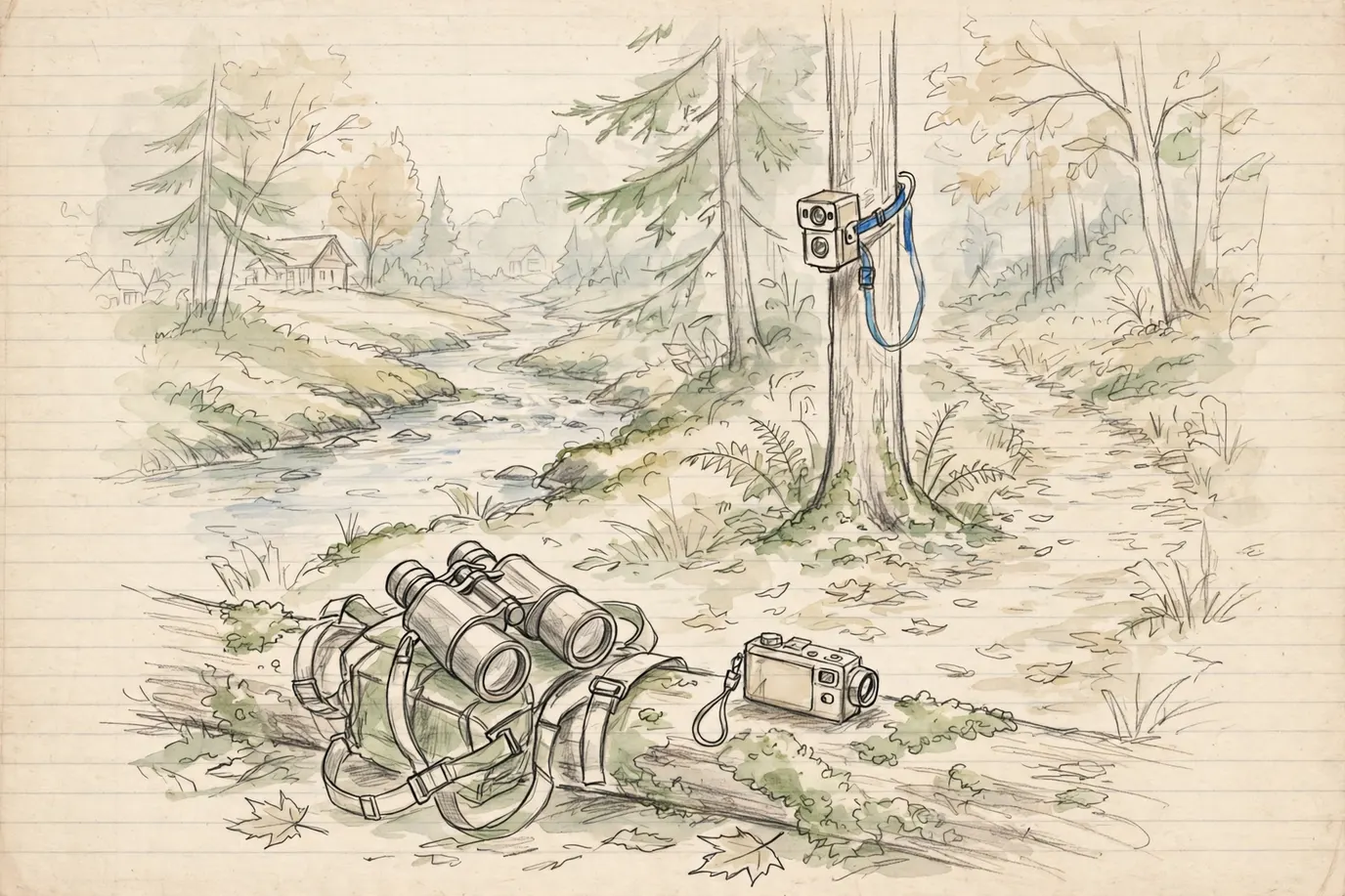
Gear in this section
Best-of lists
Best Trail Camera
Trail cameras whose maker or Amazon listing states photo resolution, trigger speed and flash type, fastest trigger first, mixing cellular and non-cellular models.
Best Cellular Trail Camera
Cellular trail cameras whose maker or Amazon listing states trigger speed and carrier support, fastest trigger first.
Brands in this section
Three tools, three questions
Hunting optics answer three different questions, and it helps to keep them apart before you shop.
- Where are the deer? Trail cameras answer it over days and weeks.
- What is that? Hunting binoculars answer it in the moment.
- How far is it? A hunting rangefinder answers it right before the shot.
A binocular harness is the fourth page in this section, and it's not an afterthought. Glass you can't get to quietly is glass you don't use.
Here's what actually changes from one tool to the next: trail cameras are about placement and patience, binoculars are about light and steadiness, and rangefinders are about one number you need to be right. The rest of this page goes through each, then how to put them together.
Trail cameras: the scouting you do while you're at work
How a trail camera decides to take a picture
Most trail cameras use a passive infrared (PIR) sensor. NatureSpy explains that it fires when something moves and is warmer than the air around it, which is why waving grass usually doesn't set it off. The sensor's detection zone is shaped by a lens into an arc, and it mostly ignores the top of the frame.
Two speeds matter more than the megapixel number on the box:
- Trigger speed: the delay between detection and the photo. Outdoor Life calls half a second or less acceptable.
- Recovery time: how long before it can shoot again. Outdoor Life puts good cameras at 5 seconds or less.
A slow trigger gets you the back half of a deer. (A very slow trigger gets you a nice photo of the place where a deer was. On paper that's still a trail camera.)
Outdoor Life also points out that most trail cams have a native resolution of 3 to 5 MP, and setting a higher number mostly makes files bigger. Detection angle and field of view should be close, so whatever trips the sensor is actually in the frame.
Flash types: no-glow, low-glow and white
At night trail cameras use infrared LEDs. Low-glow LEDs give off a faint red glow when they fire. No-glow LEDs (no-glow IR) are invisible to people and, NatureSpy says, are the pick for security use. White flash gives color night photos and is anything but subtle. If your camera faces a trail other people walk, no-glow is the one that doesn't advertise itself.
Cellular, Wi-Fi, solar and satellite
- Standard cameras store photos on a memory card you collect in person
- Cellular cameras send photos over a phone network, usually on a data plan
- Wi-Fi and Bluetooth cameras send to your phone from close range only
- Satellite cameras send without cell coverage, for places with none
- Solar panels top up the battery between visits
Every visit to a camera leaves scent and noise. Sending cameras cut visits; that's the main reason people pay for them. Outdoor Life notes that alkaline batteries lose power in freezing weather, while lithium batteries hold voltage in the cold.
My one opinion: placement beats settings
A trail camera is only as good as where you hang it. Settings matter less than placement. The reason is in how the sensor works and in Purdue Extension's survey method. Purdue mounts cameras about 2.5 to 3 feet off the ground and faces them north or south so the sun doesn't wash out the photos. NatureSpy says sun dappling and plants moving close to the sensor cause false triggers. Every one of those is a placement choice, not a menu setting.
Angle the camera across a trail, not straight down it, so a deer crosses the detection zone instead of walking straight at it. Clear branches out of the first few feet. Then leave it alone.
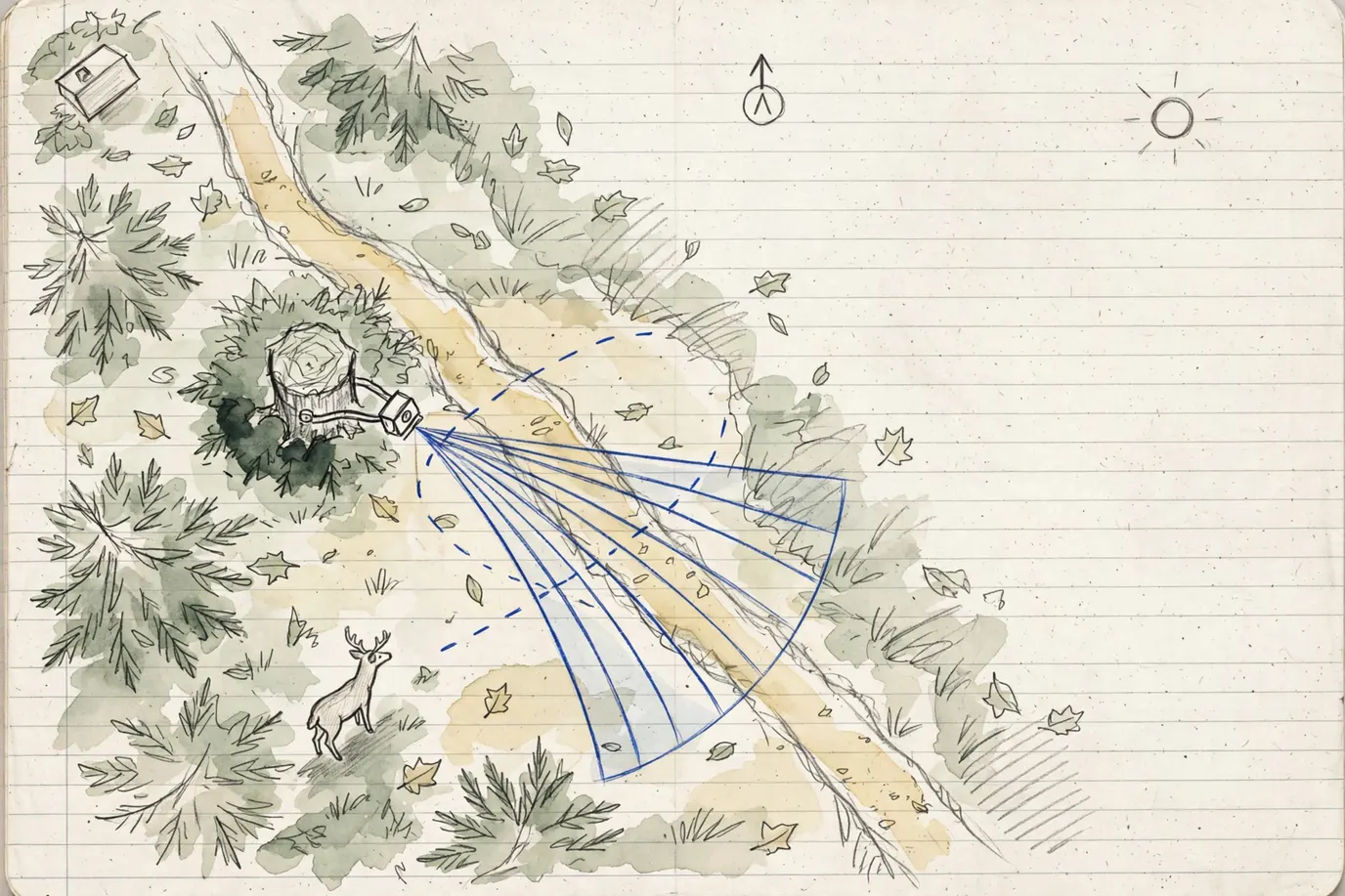
Running a camera survey
Purdue's white-tailed deer survey uses about one camera per 100 acres, runs them 10 to 14 days, and checks them every 4 to 5 days. It turns burst mode off, uses a 5 to 10 minute delay, and runs in late summer before season or late winter after it. Baited surveys put bait 10 to 15 feet from the camera, and Purdue's first instruction there is to check your state's baiting and feeding laws.
Walt's take: "The logbook never needed batteries." True. It also never told him a buck crossed at 2:14 a.m.
Binoculars: brightness, magnification and the shake
What 8x42 and 10x42 mean
Fujifilm explains the two numbers: the first is magnification, the second is the objective (front) lens diameter in millimeters. 8x42 binoculars make things look 8 times closer through 42 mm lenses. 10x42 make them 10 times closer through the same lens size.
Higher magnification narrows the field of view and makes shake more visible, per Fujifilm. Bigger front lenses gather more light but add size and weight.
Exit pupil decides low-light brightness
Quick math: exit pupil equals lens diameter divided by magnification. Celestron gives the example: 42 ÷ 8 = 5.25 mm. On a 10x42, it's 4.2 mm. Celestron says your pupil opens to about 5 to 7 mm in the dark, and a larger exit pupil gives a brighter image in low light.
That's why 8x42 binoculars for hunting in timber are such a common pick. Dawn and dusk are when deer move, and those are the minutes when exit pupil matters. Fujifilm adds a fair warning: these formulas don't count lens coatings or glass quality, so two binoculars with the same numbers can differ.
Eye relief if you wear glasses
Eye relief is how far your eye can sit from the eyepiece and still see the full view. Celestron recommends at least 10 mm, about 15 mm for comfort, and more if you wear eyeglasses.
Big glass for open country
12x50 and larger binoculars suit open fields and long glassing sessions from a seat or tripod. Thermal binoculars see heat instead of light; check your state's rules on using them while hunting. Rangefinding binoculars combine both tools in one housing.
Rangefinders: one number, right every time
Why bowhunters need one
Arrows drop fast. A misjudged distance puts the wrong pin on the deer, and guessing gets worse in the half light, which is exactly when deer move. A rangefinder turns the guess into a number. That's why a bowhunter's optics list starts here, before binoculars.
Angle compensation for tree stands
Shooting down from a stand, the straight-line distance is longer than the horizontal distance your arrow's drop depends on. Nikon describes its mode as switching between a horizontal distance display, adjusted for slope, and the actual distance. An angle-compensating rangefinder earns its keep on steep ground and high stands; on flat ground, the numbers match anyway.
Ballistic rangefinders go a step further and calculate holdover for a specific load. They're mostly for long-range rifle hunters; bowhunting rangefinders keep it to distance and angle.
First target and distant target modes
Nikon describes two modes. First target priority shows the closest object, useful when a deer stands in front of a busy background. Distant target priority shows the farthest object, useful when brush sits between you and the deer. In the woods, knowing which mode you're in matters more than how far the unit can reach.
Putting hunting optics together
For a whitetail bowhunter
- Rangefinder first, with angle compensation if you hunt high
- Binoculars in 8x or 10x, carried in a chest harness
- One or two trail cameras on the trails you can hunt
For a rifle or open-country hunter
- Binoculars first, 10x and up, plus a way to steady them
- Rangefinder with ranges to match your rifle
- Trail cameras if you hunt the same ground every year
Carry it so you'll use it
A binocular harness keeps glass at your chest and out of the way of a bow string. Range the landmarks around your stand as soon as you sit down, and write the yardages somewhere you can read them. (The logbook works. So does the back of your hand, briefly.)
Rules and safety for cameras and optics
Trail camera rules differ by state. Game & Fish reported that Arizona banned cameras used to take or aid in taking wildlife, Nevada limits cameras on public land during season and bans cellular cameras part of the year, Utah bans them for aiding big game harvest in season, and Montana limits transmitting cameras during hunting seasons. Rules change; check your state wildlife agency before you hang one.
Identify with binoculars, not through your sight or scope. Know your target and what's beyond it before any shot.
Lithium batteries and solar packs: charge them with the maker's charger and keep damaged packs out of the truck.
That's the whole kit. Find them, identify them, range them. In that order, every time.
Related
Questions people ask
What is the difference between a trail camera and a security camera?
A trail camera is built to sit alone in the woods on batteries: a motion and heat sensor wakes it, it takes a photo or clip, then goes back to sleep. Night shots use infrared, and no-glow models hide the flash from people too. A home security camera usually expects mains power and Wi-Fi. A security trail camera is a trail cam sold for watching a gate, cabin or driveway.
What do the numbers on binoculars mean?
The first number is magnification and the second is the front lens diameter in millimeters. On 8x42 binoculars, objects look 8 times closer through 42 mm lenses. Divide the second number by the first to get the exit pupil: 42 ÷ 8 = 5.25 mm. A bigger exit pupil means a brighter image in low light.
Do I need an angle-compensating rangefinder for bowhunting?
If you hunt from a tree stand or steep ground, it helps. On a steep shot the straight-line distance is longer than the flat distance your arrow's drop depends on. Angle-compensating rangefinders show a slope-adjusted, horizontal distance next to the actual one, so you pick the right pin. On flat ground the two numbers match.
Are trail cameras legal everywhere?
No. Some states limit them. Game & Fish reported rules in Arizona, Nevada, Utah and Montana, ranging from bans on cameras used to aid the take of wildlife to seasonal bans on cellular cameras. Rules change, so check your state wildlife agency before you hang one, especially on public land.
Sources
- Fujifilm: Binoculars basic knowledge — accessed 2026-10-22
- Celestron: What is exit pupil and eye relief for sport optics? — accessed 2026-10-22
- Nikon: First Target Priority and Distant Target Priority modes — accessed 2026-10-22
- NatureSpy: How camera traps work — accessed 2026-10-22
- Outdoor Life: Technical aspects of trail cameras — accessed 2026-10-22
- Purdue Extension, Forestry and Natural Resources: Trail camera survey for white-tailed deer — accessed 2026-10-22
- Game & Fish: Trail cam impact on big game (state rules) — accessed 2026-10-22