Brand · Trail Cameras & Optics
Stealth Cam Trail Cameras
Stealth Cam makes trail cameras, and on this site its lineup splits into two kinds: SD-card cameras you walk in to check (Browtine, GMAX, Prevue) and cellular cameras that send photos to your phone (Deceptor, Fusion, Revolver). The short version: decide cellular or SD card first, then the flash type, then trigger speed. Megapixels come last, even though they're printed biggest on the box. (Uncle Walt reads the box from the top down. That's how he ended up with opinions about megapixels.)
We earn a commission if you buy through our links, at no cost to you. Disclosure
Stealth Cam on Amazon US
16 models- Trail camera
Stealth Cam G42NG 24MP No-Glow
- Connectivity
- None sd card
- Photo resolution
- 24 MP
- Trigger speed
- 0.5 s
- Trail camera
Stealth Cam GMAX32 No Glo
- Photo resolution
- 32 MP
- Video
- 1080p
- Trigger speed
- 0.4 s
- Trail camera
Stealth Cam Browtine 14MP 4-Pack Bundle
- Units in pack
- 4
- Connectivity
- None sd card
- Photo resolution
- 14 MP
- Trail camera
Stealth Cam Fusion X 26MP
- Connectivity
- Cellular
- Photo resolution
- 26 MP
- Video
- 1080p
- Trail camera
Stealth Cam Deceptor No-Glo 40MP
- Connectivity
- Cellular
- Photo resolution
- 40 MP
- Video
- 1440p 2k
- Trail camera
Stealth Cam Browtine 16MP Bundle
- Units in pack
- 2
- Connectivity
- None sd card
- Photo resolution
- 16 MP
- Trail camera
Stealth Cam Fusion Max 36MP 2-Pack
- Units in pack
- 2
- Connectivity
- Cellular
- Photo resolution
- 36 MP
- Trail camera
Stealth Cam Revolver Pro 2.0 360
- Connectivity
- Cellular
- Photo resolution
- 40 MP
- Video
- 1440p 2k
- Trail camera
Stealth Cam Browtine 16MP 3-Pack Combo
- Units in pack
- 3
- Connectivity
- None sd card
- Photo resolution
- 16 MP
- Trail camera
Stealth Cam Browtine 20MP 2 Pack
- Units in pack
- 2
- Connectivity
- None sd card
- Photo resolution
- 20 MP
- Trail camera
Stealth Cam Browtine 18MP 2 Pack Bundle
- Units in pack
- 2
- Connectivity
- None sd card
- Photo resolution
- 18 MP
- Trail camera
Stealth Cam Fusion X-Pro 2 Pack
- Units in pack
- 2
- Connectivity
- Cellular
- Photo resolution
- 36 MP
- Trail camera
Stealth Cam Revolver Pro 2.0 360 Bundle
- Units in pack
- 2
- Connectivity
- Cellular
- Photo resolution
- 40 MP
- Trail camera
Stealth Cam GMAX32 Bundle 5-Pack
- Units in pack
- 5
- Connectivity
- None sd card
- Photo resolution
- 32 MP
- Trail camera
Stealth Cam GMAX32 Bundle 2-Pack
- Units in pack
- 2
- Connectivity
- None sd card
- Photo resolution
- 32 MP
- Trail camera
Stealth Cam Prevue 30MP Bundle
- Connectivity
- None sd card
- Photo resolution
- 30 MP
- Video
- 720p






What Stealth Cam makes for hunters
Stealth Cam is a trail camera company, and that's all it makes on this site: trail cameras, sold one at a time or in multi-packs. The maker's own catalog also lists accessories (solar and battery packs, mounts, memory cards, card readers and security boxes), which this site doesn't list.
The cameras fall into two groups:
- SD-card cameras: the Browtine, GMAX, G42NG and Prevue lines, which save to a memory card you collect by hand
- Cellular cameras: the Deceptor, Fusion and Revolver lines, which send photos over AT&T or Verizon to an app
The grid above filters by type and changes as listings come and go. So I'll write about the lines and what separates them, not about how many are listed this week. Most of the values in the grid come from Amazon listings, and the grid marks those. Where a maker page states something different, I'll say which number came from where.
How to read a Stealth Cam name
Stealth Cam names are mostly a line name plus a number. On the SD-card side the number is usually the advertised megapixels (Browtine 16MP, GMAX32, Prevue 30MP). On the cellular side, "Max," "Pro," "X" and "2.0" or "3.0" mark the version. The maker's cellular page sorts its current cameras into Max 3.0, Pro 3.0 and 2.0 models.
So a Deceptor No-Glo 40MP and a Deceptor Max 2.0 can be different versions of the same line. Read the version on the listing before you compare specs, because flash range and trigger speed move between versions.
Lineup notes: Stealth Cam SD-card cameras
Browtine: the multi-pack line
The Browtine cameras in the grid are mostly sold in two-, three- and four-packs. Per their listings, they run from the mid-teens to about 20 MP, with trigger speeds around three-quarters of a second and flash ranges from 60 to 80 ft. Several list 8 AA batteries.
The maker's page for the Browtine 18MP adds the details a listing usually skips: 480p video, an 850nm infrared flash with 18 LEDs, burst mode of one to three photos per trigger, recovery time you can set from 5 to 120 seconds, and SD cards up to 32GB. It also stamps each photo with time, date and moon phase.
Here's what actually changes with a Browtine: you get more cameras for the same walk in, and you give up some trigger speed and night range. That trade suits a buyer who wants to watch several spots at once and doesn't need video.
GMAX and G42NG: the no-glow SD-card cameras
The GMAX32 is the SD-card line built around a hidden flash. The maker's GMAX Vision page lists 32 MP photos, 1080p video, a 0.4-second trigger, 80 ft detection and flash range, 42 no-glow LEDs at 940nm, a 2.4-inch color screen, 8 AA batteries and a 12V jack. The single GMAX32 No Glo in the grid matches that on its listing; the 2-pack and 5-pack bundles list a low-glow flash instead, so read the bundle listing for the flash type.
The G42NG is an older no-glow model. Its listing gives 24 MP, a half-second trigger and a 100 ft flash range.
Prevue: the camera with a viewer
The Prevue 30MP's selling point is the screen. The maker's Prevue 30 Combo page lists a color TFT screen for reviewing photos and video in the field, 30 MP photos, 720p video, a trigger under 0.4 seconds, 80 ft infrared range, 8 AA batteries, a 12V external power jack and a temperature sensor. The combo includes the batteries and a 16GB card, per the maker.
A screen lets you check the aim before you leave the tree, instead of finding out two weeks later that the camera spent the season watching a sapling sway. (Physics: a sapling in wind is a warm-ish moving object to a cheap sensor, and also to a good one.)
Lineup notes: the Stealth Cam cellular trail camera
Deceptor: the no-glow cellular line
The Stealth Cam Deceptor is the line people search for by name. For the Deceptor Max 2.0, the maker lists:
- Photos: up to 40 MP, as many as nine per burst
- Video: 1440p at 30 frames per second, with audio
- Trigger: under 0.3 seconds
- Flash: 36 No-Glo LEDs at 940nm, out to 100 ft
- Network: two SIM cards, AT&T and Verizon, connects to the stronger signal
- Power and storage: 16 AA batteries, 16GB internal memory
The Deceptor No-Glo 40MP in the grid lists 1440p video, a 0.3-second trigger and an 80 ft flash range on its Amazon listing. That's why the version matters. The cellular trail camera page covers how cellular cameras work across brands.
Fusion: the AT&T/Verizon workhorses
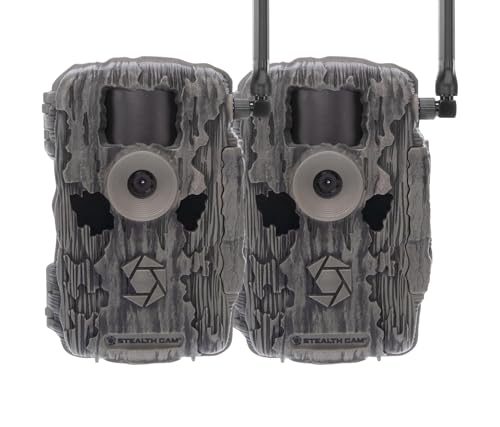
The Fusion cameras in the grid list AT&T/Verizon connectivity, photos from the mid-20s to the mid-30s in megapixels, and 1080p or 720p video, depending on the model. The Fusion X-Pro 2-pack lists 8 AA batteries and a jack for an external solar panel. The Fusion Max comes as a 2-pack as well.
On paper, the Fusion line sits a step below the Deceptor on the listings: lower photo resolution and lower video resolution. The Fusion listings in the grid don't state a flash type, so the grid shows a dash there rather than a guess.
Revolver: the 360-degree camera
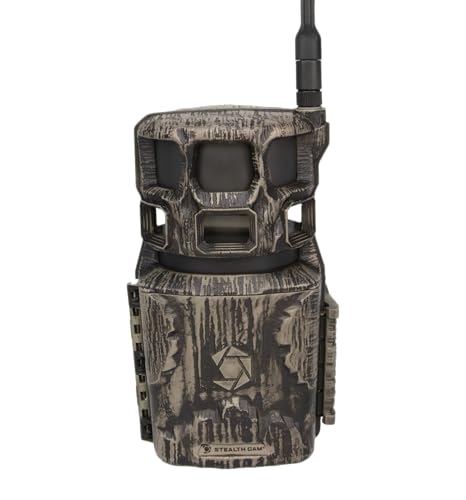
The Revolver Pro 2.0 is the odd shape in the lineup. The maker describes 360-degree coverage, "six cameras worth," with photos you can take as a single zone, a 180-degree set or a full 360-degree set. Its page lists up to 40 MP, 1440p video, a trigger under 0.4 seconds, 100 ft detection, 16 AA batteries and 32GB of internal memory, plus a live view of up to five minutes.
The Revolver bundle in the grid lists a solar panel in the box. Think of it as a lazy Susan with a lens: one camera turning to look at a whole food plot instead of one trail.
How to choose within the Stealth Cam lineup
Cellular or SD card first
This decision sets everything else. A cellular camera needs a signal where you hang it, a data plan and more batteries (16 AA on the Deceptor Max 2.0 and Revolver Pro 2.0, per the maker, against 8 AA on the Browtine and GMAX). An SD-card camera needs you to walk in.
Field & Stream's placement advice puts it simply: field edges, where you can check a card with little disturbance, suit standard SD-card cameras, and spots you want to leave alone for weeks suit a cellular camera set to upload once a day. Background is on the trail camera page.
Some states restrict trail cameras or cellular cameras during hunting seasons; Game & Fish reports rules in Arizona, Nevada, Utah and Montana among others. Check your state wildlife agency before you hang one.
Then the flash type
My one opinion on this page: pick the flash by where the camera hangs, not by the photo on the box. Browning's explanation of night images lays out the trade:
- Low-glow (about 850nm): a faint red glow you can see if you look at the camera, brighter and crisper night photos
- No-glow (about 940 to 950nm): no visible glow, grainier night photos with more blur risk
Stealth Cam spells it "No-Glo" on its own pages. The Deceptor, GMAX Vision and G42NG list no-glow flashes. The Browtine 18MP page lists an 850nm flash. If the camera hangs where people walk, I'd take the grain. If it hangs on a back corner nobody visits, I'd take the brighter picture.
Then trigger speed
Trigger speed is how long the camera takes to fire after it senses motion. In the grid it runs from about a third of a second on the Deceptor to around three-quarters of a second on several Browtines. Quick math: on a trail where deer walk across the frame, the slower camera gets more rumps. On a feeder or a scrape where deer stand still, the gap matters much less.
Recovery time (how soon the camera can fire again) is a separate setting. The Browtine 18MP lets you set it from 5 to 120 seconds, per the maker.
Megapixels last
Here's the nerd aside. Spartan Camera explains that many trail cameras advertise interpolated megapixels: software adds pixels by estimating what goes in the gaps, and no new detail gets captured. A higher MP number doesn't guarantee a sharper photo. Kitchen version: adding water to soup makes more bowls, not more flavor.
Stealth Cam's own pages list several resolution settings per camera (the GMAX Vision offers 32, 16, 8 and 4 MP), so you can pick a smaller file and save card space or data.
Setup and care notes
Aim it right
Field & Stream recommends aiming the lens slightly north or south so the rising and setting sun doesn't wash out the photos. On a travel trail, angle the camera to view the trail on a diagonal instead of straight across it. That gives a slower camera more frames of the same deer.
Batteries and power
The Prevue, GMAX Vision and Fusion X-Pro list a jack for 12V or solar power, per the maker or the listing. That's worth having on a cellular camera, which sends every photo it takes. Field & Stream's advice for cellular cameras is to upload once a day and cut back multi-shot and delay settings to save data and battery.
Uncle Walt's position on cellular cameras is that he already gets notifications: they're called "Jess texted."
Warranty basics
The maker's return and warranty policy lists a two-year limited warranty on cellular trail cameras and one year on every other Stealth Cam product. Coverage starts the day the original buyer receives the camera. It doesn't cover misuse, normal wear, unauthorized modifications, extreme weather, animal damage or cellular network problems. Claims start from the warranty page on the maker's site. The maker also notes it only accepts returns of products bought directly from its own store.
Who's behind Stealth Cam
The maker's about page says GSM launched Stealth Cam in 2000, and the site footer lists GSM Outdoors in Irving, Texas. The same page dates the Wildview brand to 2004 and TRIAD, a mode that combines stills, video and time-lapse, to 2010. The maker also says it released its first high-definition trail camera in 2009 and holds several camera patents.
Its cellular cameras run on the maker's Command Pro app, which the Deceptor and Revolver pages say offers on-demand photos, camera sharing and a HuntStand connection.
Before you hang a new camera, take one test photo of your own hand with the date written on it. Next September, the first file on the card tells you which camera, which spot and which season, before you've finished your coffee.
Where Stealth Cam shows up
Questions about Stealth Cam
Is Stealth Cam a good trail camera brand?
What can be checked is what the maker states. Its cellular pages list trigger speeds under 0.4 seconds, 100 ft detection on the Deceptor Max 2.0 and Revolver Pro 2.0, and automatic switching between AT&T and Verizon. The maker backs cellular cameras with a two-year limited warranty and other products with one year. Whether a model suits you depends on signal, flash type and how often you'll walk in.
What is the Stealth Cam Deceptor?
The Deceptor is Stealth Cam's no-glow cellular trail camera. For the Deceptor Max 2.0, the maker lists up to 40 MP photos, 1440p video with audio, a trigger under 0.3 seconds, a 940nm No-Glo LED array with a 100 ft range, two pre-installed SIM cards and 16 AA batteries. The Deceptor in the grid lists an 80 ft flash range on its Amazon listing, so check the exact version.
Who makes Stealth Cam?
Stealth Cam's about page says GSM launched the brand in 2000, and the site footer lists GSM Outdoors in Irving, Texas. The same page says the company introduced its Wildview brand in 2004 and its TRIAD photo-video-time-lapse mode in 2010.
Do Stealth Cam cellular cameras need a data plan?
Yes. The maker's cellular pages list monthly data plans per camera, set up through its Command Pro app, with tiers by the number of photos a month. The cameras carry two SIM cards and connect to whichever of AT&T or Verizon has the stronger signal, per the maker. SD-card models like the Browtine and GMAX need no plan.
What warranty do Stealth Cam trail cameras have?
The maker's policy page lists a two-year limited warranty on cellular trail cameras and a one-year limited warranty on all other Stealth Cam products, starting the day the original buyer receives the camera. Exclusions include misuse, normal wear, modifications, extreme weather, animal damage and cellular network problems.
Sources
- Stealth Cam: About us — accessed 2026-10-28
- Stealth Cam: Cellular trail cameras — accessed 2026-10-28
- Stealth Cam: Deceptor Max 2.0 cellular trail camera — accessed 2026-10-28
- Stealth Cam: Revolver Pro 2.0 360° cellular trail camera — accessed 2026-10-28
- Stealth Cam: Digital trail cameras — accessed 2026-10-28
- Stealth Cam: Browtine 18MP trail camera — accessed 2026-10-28
- Stealth Cam: GMAX Vision trail camera — accessed 2026-10-28
- Stealth Cam: Prevue 30 combo — accessed 2026-10-28
- Stealth Cam: Return and warranty policy — accessed 2026-10-28
- Browning Trail Cameras: Nighttime trail camera images, putting light on the subject — accessed 2026-10-28
- Spartan Camera: Photo interpolation, what it is and how it works — accessed 2026-10-28
- Field & Stream: Where to mount a trail camera — accessed 2026-10-28
- Game & Fish: Trail cams' impact on big game — accessed 2026-10-28