Knives & Tools · Gear type
Whittling Knife
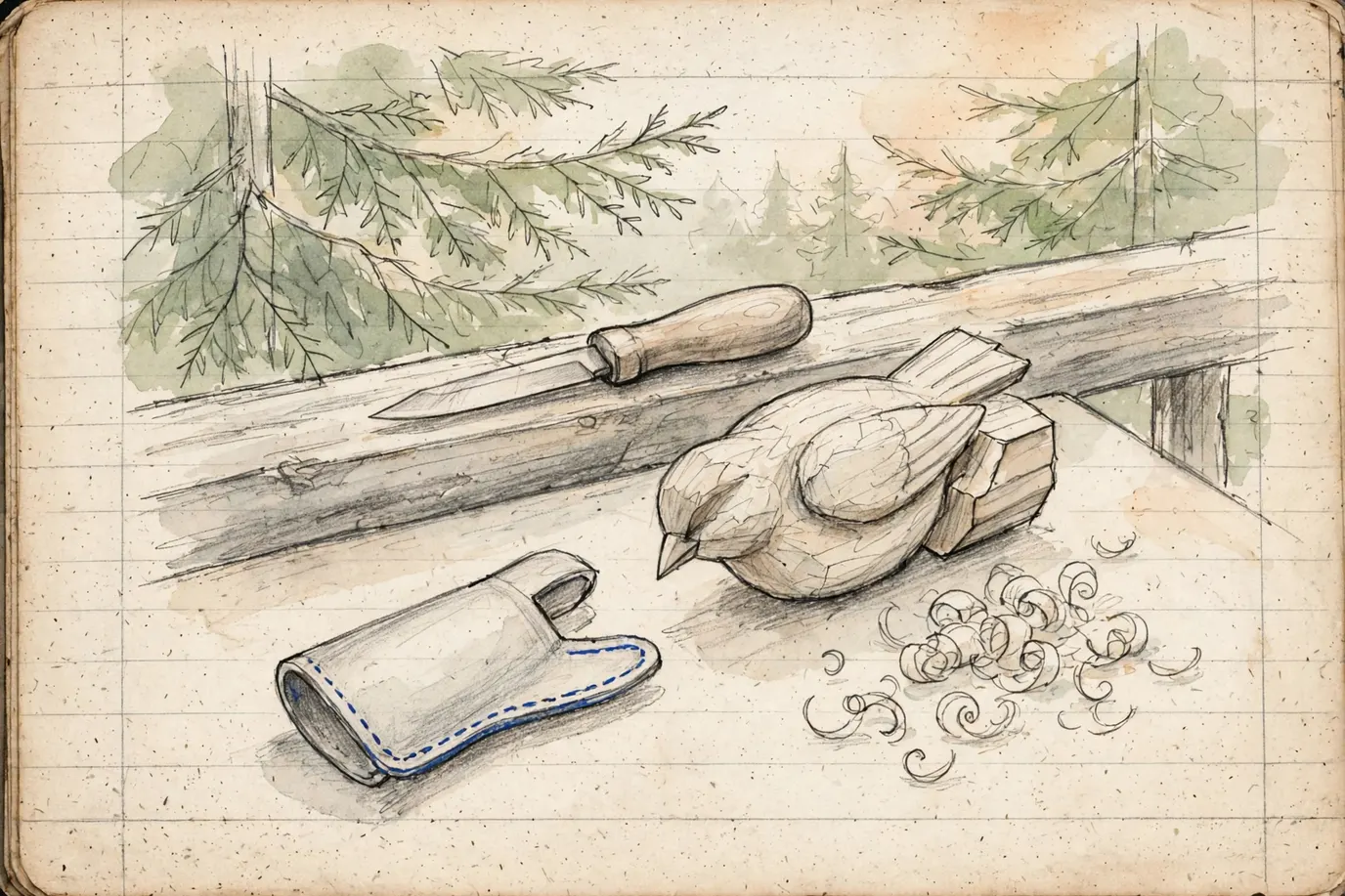
A whittling knife is a short, fixed blade made for taking thin shavings off a block of wood. Short is the whole point: a blade of an inch or two puts your hand right next to the edge, where control lives. Look for a straight edge, a thin grind that's very sharp, and a handle you can hold for an hour. Then buy gloves and a strop. I taught high-school shop for a long time, and I can tell you the knife is the cheap part of the lesson.
We earn a commission if you buy through our links, at no cost to you. Disclosure
| Model | Blade thickness | Blade length | Overall length | Blade steel | Steel type | Amazon |
|---|---|---|---|---|---|---|
ESEE Pinch Neck KnifeFixed blade knife More specs
| — | 1.3 inlisting | 3.4 inlisting | 1095listing | Carbonlisting | Check price |
BeaverCraft C15 Detail Whittling KnifeFixed blade knife More specs
| — | 1.4 inlisting | — | — | Carbonlisting | Check price |
KA-BAR Last DitchFixed blade knife More specs
| — | 1.6 inlisting | — | 9Cr18listing | Stainlesslisting | Check price |
CRKT Scribe 2425KFixed blade knife More specs
| — | 1.74 inlisting | — | D2listing | Tool steellisting | Check price |
Camillus Heater II 4.25"Fixed blade knife More specs
| — | 1.75 inlisting | 4.25 inlisting | 420listing | Stainlesslisting | Check price |
BÖKER Cop ToolFixed blade knife More specs
| 0.2 inlisting | 1.8 inlisting | 6 inlisting | 440Clisting | Stainlesslisting | Check price |
Kershaw BraceFixed blade knife More specs
| — | 2 inlisting | — | 8Cr13MoVlisting | Stainlesslisting | Check price |
Knives Ranch Dandy 2006C-BFixed blade knife More specs
| 0.125 inlisting | 2 inlisting | 5.5 inlisting | 5160listing | Carbonlisting | Check price |
Mtech USA Neck Knife StonewashedFixed blade knife More specs
| 0.11 inlisting | 2 inlisting | 4.75 inlisting | — | — | Check price |
Ontario Knife Company NonaFixed blade knife More specs
| 0.154 inlisting | 2 inlisting | 7 inlisting | 420listing | Stainlesslisting | Check price |
Smith & Wesson 5 in False EdgeFixed blade knife More specs
| — | 2 inlisting | 5 inlisting | 8Cr13MoVlisting | Stainlesslisting | Check price |
Smith & Wesson 5 in 2 in 1 False EdgeFixed blade knife More specs
| — | 2 inlisting | 5 inlisting | 8Cr13MoVlisting | Stainlesslisting | Check price |
Kizer Whiskey JackFixed blade knife More specs
| — | 2.06 inlisting | — | — | Damascuslisting | Check price |
CRKT Minimalist Bowie 2387Fixed blade knife More specs
| — | 2.12 inlisting | — | — | — | Check price |
Hogue EX-F03 2.25-Inch HawkbillFixed blade knife More specs
| — | 2.25 inlisting | — | 154CMlisting | — | Check price |
Hogue EX-F03 2.25-Inch Hawkbill PiranhaFixed blade knife More specs
| — | 2.25 inlisting | — | 154CMlisting | — | Check price |
CIVIVI TyphoeusFixed blade knife More specs
| — | 2.27 inlisting | 6.25 inlisting | 14C28Nlisting | Stainlesslisting | Check price |
Condor OtziFixed blade knife More specs
| — | 2.3 inlisting | — | 1095listing | Carbonlisting | Check price |
KA-BAR TDI 1477CBFixed blade knife More specs
| — | 2.3 inlisting | — | AUS-8Alisting | Stainlesslisting | Check price |
Morakniv EldrisFixed blade knife More specs
| — | 2.3 inlisting | — | — | Stainlesslisting | Check price |
Morakniv Eldris Light DutyFixed blade knife More specs
| — | 2.3 inlisting | — | — | Stainlesslisting | Check price |
NedFoss Vulture Neck KnifeFixed blade knife More specs
| — | 2.3 inlisting | — | 14C28Nlisting | Stainlesslisting | Check price |
SOG SnarlFixed blade knife More specs
| — | 2.3 inlisting | 4.3 inlisting | 9Cr18MoVlisting | Stainlesslisting | Check price |
SOG Instinct NB1012-CPFixed blade knife More specs
| — | 2.3 inlisting | 5.9 inlisting | — | — | Check price |
KA-BAR TDI Law EnforcementFixed blade knife More specs
| — | 2.3125 inlisting | — | AUS-8listing | Stainlesslisting | Check price |
CRKT Razel Compact 4036Fixed blade knife More specs
| — | 2.32 inlisting | — | D2listing | Tool steellisting | Check price |
Huaao 6.3-Inch Fixed Blade KydexFixed blade knife More specs
| — | 2.36 inlisting | 6.34 inlisting | 8Cr13Movlisting | Stainlesslisting | Check price |
Huaao 6.3-Inch Fixed Blade Leather SheathFixed blade knife More specs
| — | 2.36 inlisting | 6.34 inlisting | 8Cr13Movlisting | Stainlesslisting | Check price |
United Cutlery Bushmaster MarajoFixed blade knife More specs
| — | 2.375 inlisting | 6.375 inlisting | 1095listing | Carbonlisting | Check price |
CRKT Testy 7524Fixed blade knife More specs
| — | 2.38 inlisting | — | 420J2listing | Stainlesslisting | Check price |
CIVIVI Baby Banter Fixed Blade 2.39"Fixed blade knife More specs
| — | 2.39 inlisting | — | Nitro-Vlisting | Stainlesslisting | Check price |
BÖKER M.U.K.Fixed blade knife More specs
| — | 2.4 inlisting | 6.7 inlisting | 14C28Nlisting | Stainlesslisting | Check price |
Huaao Full Tang 8Cr13Mov Kydex Fixed BladeFixed blade knife More specs
| — | 2.4 inlisting | 6.22 inlisting | 8Cr13Movlisting | Stainlesslisting | Check price |
Huaao Full Tang Leather Sheath Hunting KnifeFixed blade knife More specs
| 0.14 inlisting | 2.4 inlisting | 6.22 inlisting | 8Cr13MoVlisting | Stainlesslisting | Check price |
Knives Of Alaska SureGrip Cub Bear CapingFixed blade knife More specs
| — | 2.4 inlisting | — | D2listing | Tool steellisting | Check price |
ESEE CR2.5Fixed blade knife More specs
| 0.13 inlisting | 2.5 inlisting | — | — | — | Check price |
Gerber DIBSFixed blade knife More specs
| — | 2.5 inlisting | 5.96 inlisting | — | — | Check price |
Gerber StoweFixed blade knife More specs
| — | 2.5 inlisting | 5.96 inlisting | — | — | Check price |
Huaao Spear Point EDC Fixed BladeFixed blade knife More specs
| 0.15 inlisting | 2.5 inlisting | 6.7 inlisting | 440Clisting | Stainlesslisting | Check price |
Knives Ranch Damascus EDC Utility RosewoodFixed blade knife More specs
| 0.125 inlisting | 2.5 inlisting | 6 inlisting | — | Damascuslisting | Check price |








Outdoor Edge Pivot Drop PointFixed blade knife More specs
| — | 2.5 inlisting | — | — | — | Check price |
|---|---|---|---|---|---|---|
Outdoor Edge Razor APX 2.5 inFixed blade knife More specs
| — | 2.5 inlisting | — | — | — | Check price |
Puma SGB Caping POMFixed blade knife More specs
| — | 2.5 inlisting | 5.75 inlisting | 1.4116listing | Stainlesslisting | Check price |
Puma SGB Caping JacarandaFixed blade knife More specs
| — | 2.5 inlisting | 5.75 inlisting | 1.4116listing | Stainlesslisting | Check price |
United Cutlery Combat Commander Mini Boot KnifeFixed blade knife More specs
| — | 2.5 inlisting | — | AUS-6listing | Stainlesslisting | Check price |


What’s in this listFixed blades 2.5 inches or shorter, as stated by the maker or the Amazon listing — the short, controllable blade used for whittling. “—” means neither the maker nor the Amazon listing states it.
What makes a whittling knife different
Most knives are built to cut through things. A whittling knife is built to take very thin shavings off wood, one at a time, with your hand only an inch or two from the edge. That changes the blade length, the edge shape, the grind and the handle all at once.
Here's the thing. A hunting knife has a curved belly for long strokes through hide. A bushcraft knife has to split kindling and strike a ferro rod. A whittling knife does neither. It's short, straight-edged and thin behind the edge, and it would be a poor choice for dressing a deer.
The general fixed-blade basics (tang, steel classes, sheaths) live on the fixed blade knife page. This page sticks to what matters when the work is a block of basswood on your knee.
The table under this page lists fixed blades 2.5 inches or shorter, as the maker or the Amazon listing states the length. It shows blade length, blade shape, grind, steel type, handle and the other fields, the maker's numbers first and the listing's where the maker is silent (marked as listing values). If neither states a value, the cell shows a dash. A short blade alone doesn't make a carving knife, so read the shape and grind columns too.
What to look at in a whittling knife
These are the deciding fields, in the order I'd read them at the hardware-store counter.
Keep the blade short, about an inch to two and a half
Blade length is the first filter, and short wins. A woodcarver quoted by the Bangor Daily News suggests starting with a blade about 1 to 1.5 inches long. Popular Woodworking's whittling author says his favorite carving knives carry a 2-3/8 inch blade.
Why short? Whittling is mostly small, controlled cuts with your thumb working against the back of the blade. A long blade puts the tip out where you can't steer it, and it tempts you to choke up on the steel itself. The table's 2.5-inch limit keeps you inside the range those carvers describe.
Shorter blades also feel slow at first. That's not a defect. That's the knife doing its job, which is keeping you out of the emergency room. (I've watched a lot of fifteen-year-olds learn this about table saws.)
Pick a straight edge with a fine point
Blade shape shows in the table as wharncliffe, sheepsfoot, straight back, drop point and a few others. For wood, straight edges rule.
- Straight bench-style blade: the classic. A carving-supply owner in the Bangor Daily News piece likes it because a straight edge is easier to sharpen than a curved one.
- Wharncliffe: the spine slopes gradually down to a fine tip. Montana Knife Company's blade guide says this shape started as a whittling blade.
- Sheepsfoot: straight edge, blunt rounded tip. The same guide rates it good for whittling and carving.
- Drop point: workable for rough shaping, though the curved belly is harder to keep flat on the wood.
A fine point gets into corners and detail. A blunt one is more forgiving if it slips. Pick based on what you carve. Birds and figures want the point; spoons and spatulas need it less.
The grind should be thin and easy to sharpen
The grind column tells you how the blade thins to the edge. Morakniv's grind guide puts its dedicated carving knives on a "zero" Scandi grind: the same single wide bevel as its outdoor knives, but with no small secondary bevel at the very edge.
Morakniv is honest about the trade. The zero grind is sharper and more aggressive in wood, and also more delicate and more demanding to maintain. A Scandi grind with a micro bevel holds up better and shaves a little less freely. A flat grind carves well too.
One practical point: a single wide bevel is easy to sharpen, because you can lay the whole bevel flat on a stone or strop and feel when it's seated. Measure twice, cut once, and sharpen at the angle the maker ground.
Carbon or stainless steel changes how often you strop
The steel-type column reads carbon, stainless and a few others. Outdoor Life's knife guide gives the usual split. Carbon takes an edge back fast and rusts when it's left wet; stainless shrugs off rust and keeps its edge longer, but fights you at the stone.
For whittling, the edge gets touched up so often that easy sharpening counts for a lot. Morakniv sells its carving knives in both carbon and stainless versions, which tells you both work. If your carving sits on a damp porch or rides in a tackle box, stainless is the low-maintenance pick. If you'll wipe the blade dry and strop it every session anyway, carbon is a pleasure.
The handle has to suit an hour, not a minute
The handle column lists wood, polymer, rubber and so on. What the table can't show is shape, so look at the photos. Rounded and a little oval is the shop-class favorite, because you'll hold it in two or three grips and switch often.
Knifemaking.com's tang guide lists carving and precision cutting among the jobs where a hidden tang, covered by the handle, does fine, along with long sessions where lower fatigue matters. So the tang column matters less here than on a chopping knife. Morakniv's beginner page also mentions carving knives with a larger handle and a finger guard, which is worth looking for on your first one.
Check what protects the edge in storage
The sheath column shows leather, plastic, molded polymer or other, when a sheath comes with it. Many carving knives ship with a simple guard instead of a belt sheath. Either is fine, as long as the edge is covered in the toolbox. NRA Family's knife-safety guide notes that most knife cuts happen while the blade goes into or comes out of its sheath, so slow down for that part.
Weight barely matters, balance does
The weight column is mostly a curiosity on a knife this small. What you'll notice instead is where it balances. A slightly handle-heavy knife sits steady in the palm, and a light one is easy to hold for a long session.
The rest of the whittling kit
The knife is maybe half of it. The other half keeps your fingers where they belong.
Gloves and thumb guards come first
Popular Woodworking's whittling author suggests two gloves, or at least a glove on the hand holding the wood plus a thumb protector on the knife hand. He prefers all-fabric cut-resistant gloves like the ones used in food prep. The Bangor Daily News carvers recommend Kevlar-type carving gloves and add a warning worth repeating: denim and leather work gloves are not cut-proof.
One instructor in that piece wraps students' thumbs so they don't use the thumb as a stop for small cuts. That's a shop-teacher trick if I ever heard one.
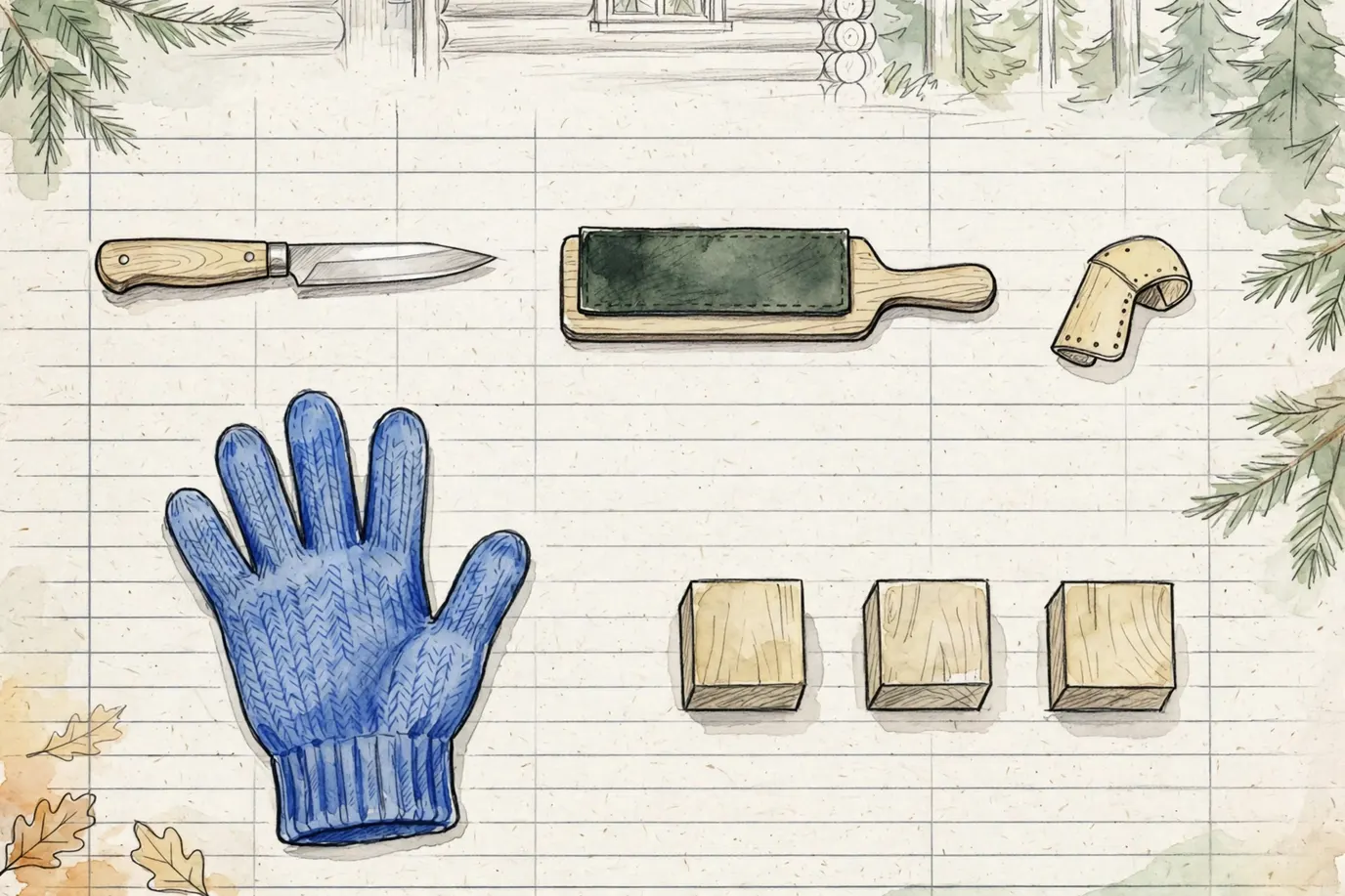
Pick soft, straight-grained wood
Basswood is the standard answer. Popular Woodworking calls it soft, fairly inexpensive and predictable, with no wandering grain. The Bangor Daily News carvers add that butternut has a slightly nicer grain, pine is easy to find but splinters, cedar dulls knives quickly, and hickory is hard going.
Morakniv's beginner page adds two notes: fresh "green" wood is often easier to carve, while dry wood holds its shape better. A 1-inch by 1-inch block is a good first size, per the Bangor piece, and a project that takes 20 minutes or less keeps a beginner coming back.
The cuts a whittling knife is made for
You don't need a long list of techniques. You need three or four, done slowly.
- Push cut: the blade moves away from you. Morakniv recommends carving away from the body for beginners, with small, controlled strokes.
- Thumb push: your other thumb presses the back of the blade while the knife hand steers. Popular Woodworking calls this safer than shoving with the knife hand.
- Peel cut: like peeling an apple, blade toward the thumb, which stays below the blade's path. Wear the thumb guard.
- Stop cut: a straight cut into the wood that marks where the next shaving should end.
- Pull cut: the blade moves toward you. The Bangor carvers save it for detail work, once you've got control.
Popular Woodworking's rule is to whittle "downhill", with the grain. If a cut starts to pull or tear, turn the piece and come at it from the other direction. Keep shavings thin. The Bangor carvers say big slabs put too much pressure on the wood and cause slips, and Popular Woodworking warns that a blade plunged too deep can lodge in the wood.
Jess's take, and she's a physical therapist, so I let her have this one: "Stop when your hand gets tired, not when the bird is done." The Bangor carvers say the same thing in less bossy words.
Keep the edge sharp with a strop
A whittling knife lives on a strop. A strop is a strip of leather, often glued to a paddle, that polishes the edge and takes off the thin wire of steel (the burr) left by sharpening. Sharpening Supplies' strop FAQ explains the basics:
- Direction: edge trailing, never leading, or you'll slice the leather
- Pressure: about the weight of the knife itself
- Angle: the same as your sharpening angle, or slightly lower
- Compound: on the suede side, the side often recommended for carving tools
- Limits: a strop makes a sharp edge sharper; a dull edge needs a stone first
The Bangor carvers point out why it matters: a dull knife makes you push harder, and pushing harder is how knives slip. A sharp knife is the safe one. NRA Family's safety guide says the same thing about knives in general.
Knife sharpeners have their own list on the knife sharpener page.
Who should skip a dedicated whittling knife
If you want one knife for the deer, the camp and the occasional walking stick, skip this page. A short fixed blade from the hunting knife page or the bushcraft knife page will whittle a little and do everything else too.
If you whittle twice a year on the porch, a pocket knife you already own will do. Those are on the pocket knife page. And if you want to carve spoons and bowls, a straight knife is only part of the job. Morakniv's beginner page points to a hook knife for the hollowing.
Whittle safely
Whittling knives are very sharp and very close to your hands, and you will likely get nicked at least once while learning. The Bangor carvers say to keep bandages within reach. Sit steady with your feet flat, cut away from your body when you can and wear a cut-resistant glove on the hand holding the wood.
Short blade, sharp edge, soft wood, thin shavings. Then make a few hundred more of them.
Brands in this list
Related
Questions people ask
What size whittling knife should a beginner start with?
Short. A woodcarver quoted by the Bangor Daily News suggests a blade about 1 to 1.5 inches long, and a carving-supply owner in the same piece recommends a straight bench knife of about 1.5 inches. Popular Woodworking's whittling author favors carving knives with a 2-3/8 inch blade. Every one of those is shorter than most hunting knives.
Can you whittle with a pocket knife?
Yes, and plenty of people start that way. A carver quoted by the Bangor Daily News says a pocket knife can be used but recommends a fixed blade designed for carving, which he calls much safer than a folder. A fixed blade can't close on your fingers, and its handle is usually shaped for long carving sessions.
What is the best wood for whittling?
Basswood. Popular Woodworking calls it soft, inexpensive and predictable in grain, and the carvers in the Bangor Daily News call it the best and most common choice. Butternut works too. Pine splinters along the grain, cedar dulls knives quickly, and hardwoods like hickory are hard going for a beginner.
Do I need gloves for whittling?
Wear them while you learn. Popular Woodworking suggests a cut-resistant glove on the hand holding the wood and a thumb protector on the knife hand. The carvers in the Bangor Daily News recommend Kevlar-type carving gloves and warn that denim and leather work gloves are not cut-proof.
How often should I strop a whittling knife?
Little and often. A strop polishes a sharp edge and removes the burr, but it won't restore a dull one; that's a job for stones. Sharpening Supplies says to strop with the edge trailing, at your sharpening angle or slightly lower, with about the knife's own weight as pressure.
Sources
- Bangor Daily News: If you need a new craft, here are the basics of whittling — accessed 2026-10-22
- Popular Woodworking: Whittling basics, part 1 — accessed 2026-10-22
- Popular Woodworking: Whittling basics, part 2 — accessed 2026-10-22
- Morakniv: Whittling for beginners — accessed 2026-10-22
- Morakniv: Grinds and edge angles — accessed 2026-10-22
- Montana Knife Company: Knife blade types — accessed 2026-10-22
- Knifemaking.com: Full tang blades vs. hidden tang blades — accessed 2026-10-22
- Sharpening Supplies: Strop FAQs — accessed 2026-10-22
- Outdoor Life: Choosing a hunting knife — accessed 2026-10-22
- NRA Family: Stay sharp, knife safety basics — accessed 2026-10-22