What Morakniv makes for hunters and campers
On this site, Morakniv covers two product types: fixed-blade knives and one axe. No folders, no multi-tools. The knives are sheath knives, and most ride in a molded plastic sheath that clips to a belt.
The knives split into a handful of families:
- Companion: the all-round outdoor knife, in carbon or stainless
- Craftline and Basic: thin, plain work knives
- Bushcraft: a thicker carbon blade with a black coating
- Garberg: the full-tang knife, the heaviest-built of the bunch
- Kansbol: a mid-size outdoor and hunting knife
- Eldris: a small knife that fits in a pocket or on a neck cord
- Risberg: a newer all-round outdoor knife
Morakniv's own site also lists kitchen, woodcarving and trade knives. This site doesn't list those. Most specs in the grid come from Amazon listings, and the grid marks them. A dash means nobody wrote it down, not zero.
Steel first: what the (C) and the (S) mean
Morakniv puts a letter in parentheses after most model names. (C) is carbon steel. (S) is stainless. It's the most useful letter on the whole label.
Morakniv's steel page says its carbon steel is C100S from a German mill, with about 1% carbon. The maker says it's easier to resharpen than stainless, rusts more readily in humid weather, and needs careful drying and oiling after use. Over time it grows a dark patina that the maker says helps protect it.
The stainless is Swedish 12C27, per the same page and per several listings in the grid. Morakniv says it resists corrosion well, takes an edge easily in the field on a whetstone, and is used in its hunting and fishing knives.
My one opinion on this page: pick carbon steel only if you'll actually dry the knife the same day you use it. The reason is right there in the maker's own words. Carbon wants drying and oil after every use, and stainless doesn't ask for that. A carbon blade left wet in a plastic sheath in the truck over a rainy weekend will tell you about it on Monday.
Lineup notes: the Morakniv Companion
Companion in carbon and stainless
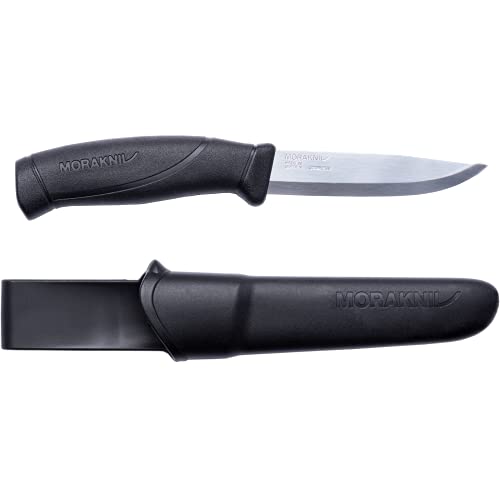
The Companion is the knife most people mean when they say "a Mora." Morakniv describes the Companion (C) as an all-round outdoor knife in German carbon steel for hunting and camping, with a soft friction grip and a finger guard.
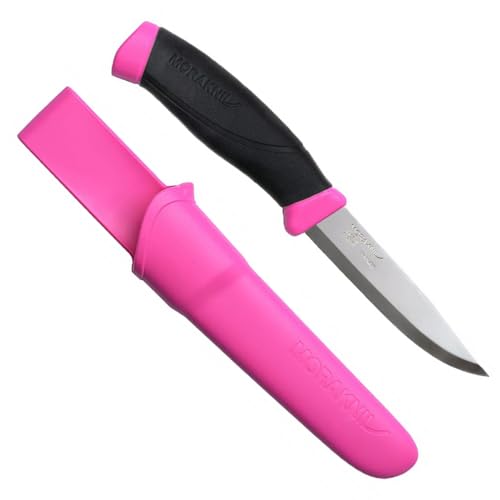
In the grid, the Companion shows up in both steels and several handle colors. The listings describe a thin blade, a polymer handle and a plastic sheath. The color versions share a blade; the difference is what you can find when you drop it in the leaves. (I've lost exactly one knife in thirty-some Novembers. It was green. I'm still looking.)
Companion Heavy Duty
The Heavy Duty is the same idea with more steel. Morakniv describes it as a sturdy wilderness knife with a thick blade and an extra-large handle. Its listing in the grid names a thicker blade than the standard Companion's, a high-carbon steel, a plastic sheath and a limited lifetime warranty.
Thicker steel takes more abuse and slices a little less cleanly. That's what thickness does.
Companion Spark
The Spark adds a fire starter. Its listing names 12C27 stainless and a fire starter included with the sheath. If your camp kit already has a ferro rod, you're paying for a second one. If it doesn't, this puts the knife and the spark in one place.
Lineup notes: Craftline and Basic
The Craftline and Basic knives are the plain ones. Short blades, thin steel, a simple handle and a plastic sheath. Morakniv calls the Basic 511 (C) a craft knife with a 2 mm blade of German carbon steel, and the Basic 546 (S) a craft knife with a 2.0 mm Swedish stainless blade, friction grip and finger guard.
In the grid:
- Basic 511 and Craftline Basic 511: carbon steel, the plainest of the lot
- Craftline Basic 546: stainless, plastic handle and sheath
- Craftline Pro S Allround: stainless, rubber handle, plastic sheath
These are the knives I'd hand to a shop class. Light, thin, and you don't mourn one if it goes missing. For whittling tent stakes and shaving feather sticks, thin steel is a help, not a weakness. The whittling knife page covers that job across brands.
Lineup notes: the Bushcraft and the Garberg
Bushcraft Black
The Bushcraft Black Carbon steps up in thickness. Morakniv describes the Bushcraft Black Blade (C) as a carbon steel knife with a black DLC coating, a 3.2 mm blade, a spine made to strike a ferro rod, and a sheath with a belt clip and a belt loop. The listing in the grid names a rubber handle.
Morakniv's steel page says the black DLC coating covers the whole blade and cuts reflection and glare. It's still carbon steel under the coating, so the edge still wants drying.
Garberg
The Garberg is the one people ask about when they want "the tough Mora." Morakniv describes the Garberg (S) as a bushcraft knife with a full-tang blade, meaning the steel runs the full length of the handle. The maker says it's tough enough for batoning (splitting wood by striking the knife's spine with a stick) and that its spine works with a ferro rod.
The grid shows the Garberg in a few forms:
- Garberg: stainless, full tang, sheath included
- Garberg Carbon MOLLE: carbon steel with a MOLLE-compatible sheath
- Garberg Survival Kit: a kit with a fire starter
The Garberg is heavier-built than a Companion. That's the trade. More steel, more handle, more weight on your belt. The bushcraft knife page and the survival knife page compare thick fixed blades across brands.
Lineup notes: Kansbol, Eldris and Risberg
Kansbol
Morakniv describes the Kansbol (S) as an outdoor knife in Swedish stainless steel with a spine that strikes a ferro rod, made for the forest, the trail, the hunt or the water. The grid has the plain Kansbol and a version sold with a fire starter. The listings describe a polymer handle and a blade a bit thicker than the Companion's.
For field dressing, the hunting knife page covers blade shapes across brands.
Eldris
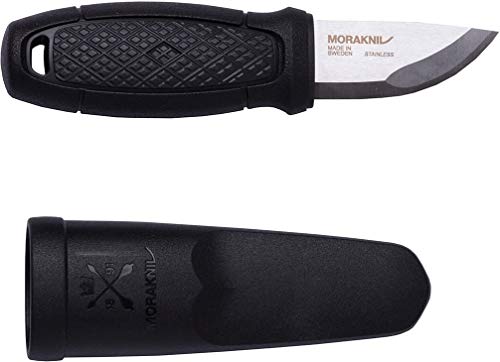
The Eldris is the small one. Morakniv calls the Eldris (S) a small outdoor knife in Swedish stainless with a ferro-rod-compatible blade, handy for everyday tasks, carving, cutting branches and starting a fire. The grid lists the Eldris and the Eldris Light Duty, both with short blades.
A short blade is good for careful work and easy to carry. It's not the knife for splitting kindling. Keep that job for something thicker, or for the axe below.
Risberg
The Risberg C Cloudberries rounds out the grid. Morakniv describes the Risberg (C) as a versatile outdoor knife for hiking, fishing, camping and lighter tasks. The listing names C100S carbon steel, a Scandi grind and a polypropylene handle.
The Morakniv Lightweight Axe
Morakniv's one axe in the grid is the Lightweight Axe. Its listing calls it a camping hatchet and names a boron steel head, a nylon/polymer handle, a leather sheath and a limited lifetime warranty. It's short, about a foot long, so it's a one-hand tool for kindling, tent stakes and the branch across the trail, not for splitting rounds.
That fits the rest of the lineup. A thin Companion does the fine work, and the axe takes the chopping it wasn't built for. Rutgers Extension says to sheath an axe when it isn't in use and to chop on the ground or a large, stable log. Hatchets across brands are on the hatchet page, and camp axes on the camping axe page.
The Scandi grind, and why it matters at the stone
Most Morakniv knives use what the maker calls a Scandi grind. Morakniv's grind page describes it as a flat bevel ground all the way down to the edge, finished with a small micro bevel to make the edge sturdier.
The maker lists the edge angles:
- Blades up to 2.5 mm thick: 23 degrees total, 11.5 per side
- Blades thicker than 2.5 mm: 27 degrees total, 13.5 per side
- The micro bevel: about 35 to 45 degrees total, very small
Morakniv names the Garberg, Companion, Bushcraft and Basic as Scandi-ground. It lists the Kansbol and Eldris as profile-ground instead, a different shape at the edge.
Rule of thumb for a Scandi edge: lay the wide bevel flat on the stone and let it guide the angle. Morakniv says to finish by stropping to remove the burr, and suggests the back of a leather belt with polishing paste if you don't own a strop. (A belt that sharpens knives is the only belt in my closet that earns its keep twice.)
How to choose within the Morakniv lineup
Pick the job
- Whittling, feather sticks, light camp chores: Companion or a Basic
- Batoning and heavy camp work: Garberg or Companion Heavy Duty
- Fire starting from the spine: Garberg, Kansbol, Eldris or Bushcraft Black
- Small and easy to carry: Eldris
- Kindling and stakes: the Lightweight Axe
- Field dressing: start with the skinning knife page and the hunting knife page, then compare
Then the steel
Carbon if you'll dry and oil it. Stainless if it's going to live in a wet tackle box or the truck door pocket. The (C) and (S) on the label save you reading the fine print.
Then the blade thickness
The grid's thickness column does most of the sorting. Thin blades in the Companion and Basic lines slice and carve cleanly. Thicker blades on the Heavy Duty, Bushcraft, Garberg and Risberg take more prying and pounding. Here's the thing: the maker's grind page already tells you this. It sharpens the thicker blades at a steeper angle on purpose.
Then the sheath
Most Morakniv knives ride in a molded plastic sheath with a belt clip. The Garberg comes with a MOLLE mount in some versions, and the Bushcraft Black's sheath has both a clip and a loop, per the maker. Try the sheath on the belt you actually wear in the woods. The fixed blade knife page covers sheath styles across brands.
Care that applies to the whole lineup
A fixed blade is a simple tool. It still wants care. AKTI's maintenance guide recommends:
- Dry the blade after use; water and salt can damage even stainless
- A toothpick for dirt where the blade meets the handle
- A light coat of oil on the blade before storage
- A cool, dry place to store it, not a damp basement or garage
For carbon steel, Morakniv adds the same thing in plainer words: dry it carefully and oil it after use. Morakniv's warranty also excludes damage from failing to clean and maintain the knife. Take the hint.
Cut away from your body, and keep the knife sheathed when you're walking or climbing. AKTI warns against carrying an unsheathed straight knife or climbing with an open knife.
Mora vs Buck
Both brands make fixed-blade knives, and both get searched together. On this site the differences are in the mix:
- Morakniv's grid: fixed blades plus one axe, light sheath knives, polymer or rubber handles, mostly Scandi-ground, in carbon or stainless steel
- Buck's grid: fixed blades plus folding knives led by the 110 lockback, with the fixed blades mostly in 420HC stainless and leather or nylon sheaths
Buck's history is on the Buck Knives brand page. The Coeur d'Alene Area Economic Development Corporation says Buck moved its factory to Post Falls, Idaho, in 2005. If you want a folder from the same brand, that's Buck's side of the grid. If you want a thin Scandi blade in a plastic sheath, that's Morakniv's.
Morakniv facts
Here's what I could verify from the maker's own pages:
- Founded: Morakniv dates itself to 1891 and calls itself a family-owned company, run today by a board with an external CEO
- Where made: all its knives are made in Östnor, outside Mora, Sweden
- Steels: German C100S carbon and Swedish 12C27 stainless, per its steel page
- Factory: its how-it's-made page says over 90% of grinding is done in robotic grinding cells, and most handles are injection-molded polymer
Warranty details are in the FAQ, with a pointer to the maker's own terms.
Dry it, oil it, put it back in the sheath. Three steps, every time.