What Core makes for campers and hunters
On this site, Core covers five product types. Tents are most of the grid above, and the rest is the gear that goes around a family campsite:
- Tents: instant cabin tents, straight-wall cabin tents and dome tents
- Canopies: center-push canopies, instant screen houses and a party tent
- Soft coolers: magnetic-lid can coolers, FlipBack coolers and soft cooler totes
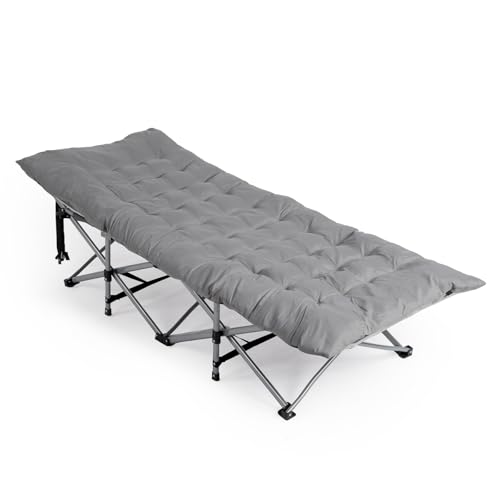
- A cot: the Locking Outdoor Camp Cot
- A lantern: a 1000-lumen rechargeable lantern
Core's own site also lists chairs, other furniture, hammocks and replacement parts. The grid shows what's listed on Amazon right now, filtered by type. It changes as listings come and go, so I'll write about the lines and what separates them, not about how many are listed this week.
Most of the specs in the grid come from Amazon listings, and the grid marks those values. Where a listing doesn't say, you'll see a dash. Rule of thumb: a dash means nobody told us, not zero.
Lineup notes: the Core tent
Instant cabin tents: the Core instant cabin tent
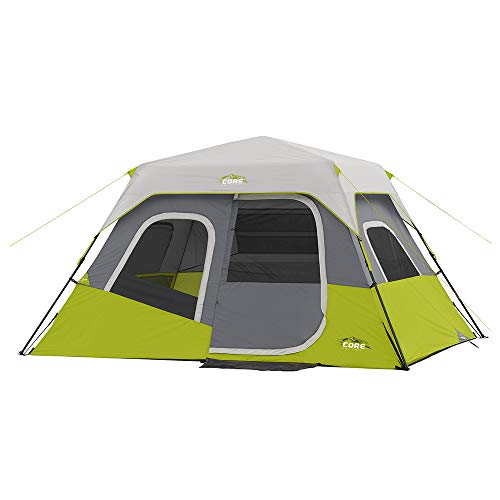
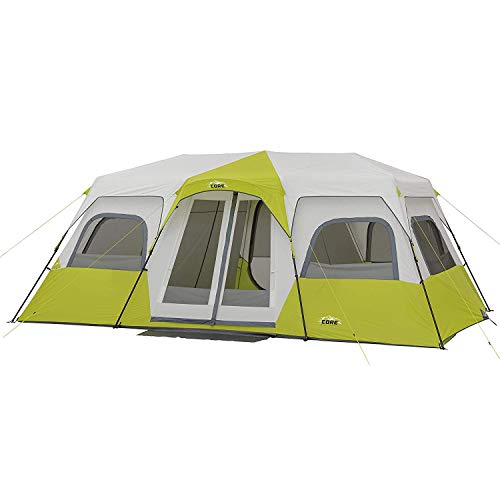
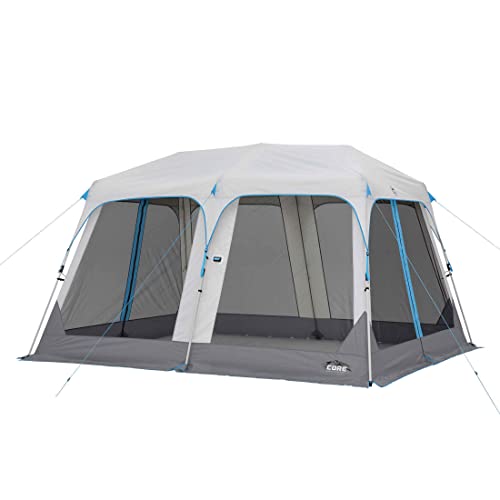
This is the group most people mean when they search "Core tent." The maker's cabin tent page says its instant tents use a pre-attached pole system and are ready in about 2 minutes. You unfold the tent, extend the poles that are already fixed to it, and lock them.
In the grid, the instant cabin tents run from 6 people to 12. Their listings give center heights from 72 inches on the 6-person models up to 80 inches on the 12-person ones. That's standing room for most adults in the middle, and less near the walls, the way a cabin tent always works.
The versions you'll see in the grid:
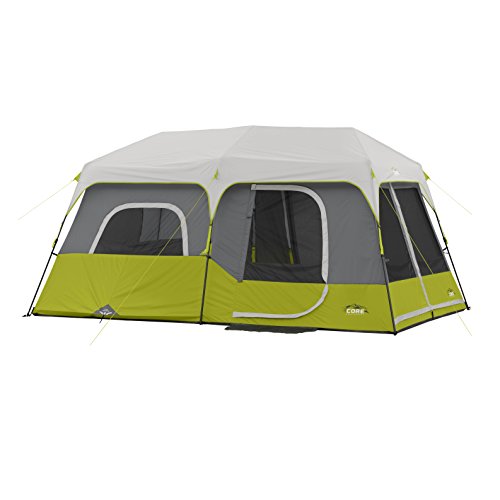
- Standard instant cabin tents: 6, 9, 10 and 12 people
- Lighted instant cabin tents: 6, 9, 10 and 12 people, with built-in LED lights
- Blackout instant cabin tents: 6 and 9 people
The maker's page says the 12-person instant cabin tent includes two room dividers, and that cabin tents can be split into two or three rooms. The instant tent page explains pre-attached-pole tents across brands, and the cabin tent page covers straight-wall designs.
Straight-wall cabin tents
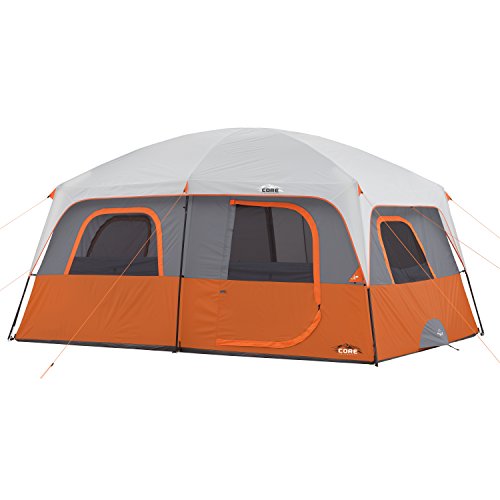
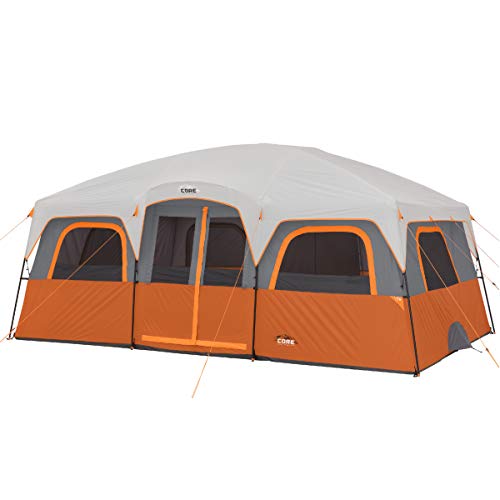
The second cabin group is the kind you put together with separate poles. The maker's page says its straight-wall tents use color-coded poles. It takes longer than an instant tent, but you get more height. The listings in the grid give 86 inches at the center on the 10, 11 and 12-person straight-wall models.
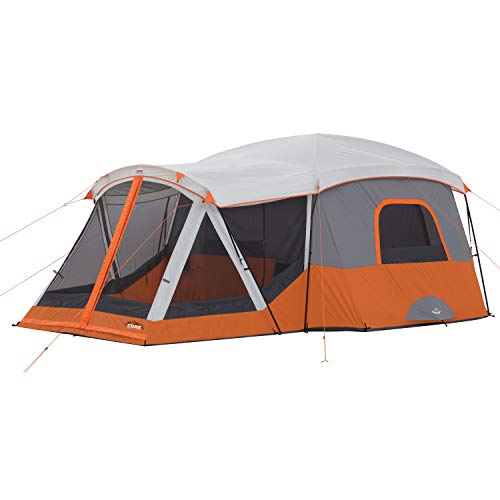
The 11 Person Cabin Tent with Screen Room stands out. Its listing gives a 17 by 12-foot floor, two rooms and that 86-inch center height. A screen room is a porch with bug netting. On a September bow hunt, that porch is where the boots, the wet coats and the arguments go.
Color-coded poles are a Saturday-afternoon fix the first time and a 15-minute job after that. Practice in the yard before the trip, not in the dark at the campsite. (I've done it in the dark. The tent won, and it didn't even have to try.)
Dome tents
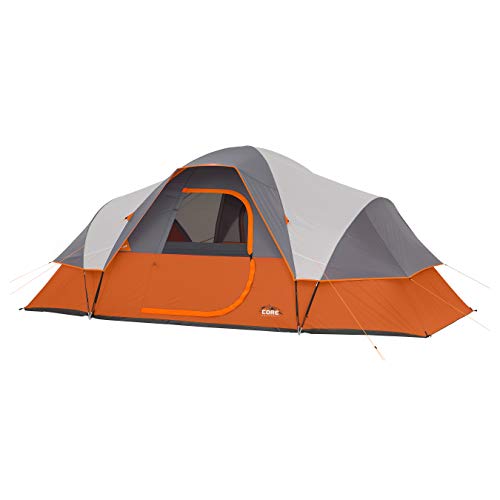
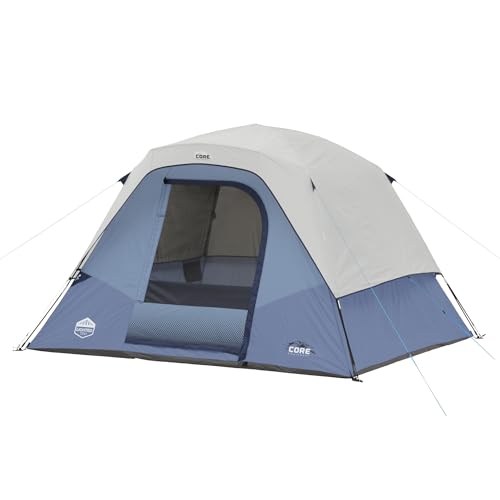
Core's dome tents in the grid are the smaller and lower side of the lineup. The listings give:
- 3 and 4 Person Dome Tents: center heights of 42 and 54 inches
- 6 Person Lighted Dome Tent: built-in lights
- Blackout 6 Person Dome Tent: 72 inches
- 9 Person Dome Tent: 72 inches, fiberglass poles per its listing
- 9 Person Dark Room Tent: a dome at 72 inches
A dome tent sheds wind better than a tall cabin tent, because there's less flat wall for the wind to push on. You trade headroom for that. If you're the only one in camp who stands up straight, it matters less. The dome tent page compares them across brands.
Blackout and lighted tents
Two features run across the cabin and dome lines, so they're worth a short section.
Blackout and Dark Room: the maker's Blackout listing says the tent blocks 90% of sunlight. That's for sleeping past sunrise, which in a deer camp is a feature only the guy who drove in at midnight appreciates.
Lighted: the lighted models are named in the grid and on the maker's page. The maker's cabin page doesn't detail the lighting, so I won't either. Read the listing for how it's powered before the trip.
Core canopies and screen houses
Center-push canopies: the Core canopy
The maker says its center-push canopies open like an umbrella and lock with a push from the center. In the grid, there are two:
- 10 x 10 Center Push Instant Canopy: a top vent, per its listing
- 13 x 13 Center Push Eaved Canopy: a top vent and extended eaves for more shade
The maker's canopy page says its canopies use steel frames, a UV-coated fabric and adjustable feet for uneven ground, and that the 10x10 has 15 leg-height settings. It calls the canopies water-resistant for light rain and recommends sun walls, or moving gear into a tent, for heavier weather. A canopy isn't a tent. It's a roof with ambition. More on that type is on the canopy tent page and the 10x10 canopy page.
Instant screen houses
The 12 x 10 Instant Screen House and its lighted version list mesh walls and an 84-inch peak. A screen house is a canopy with bug netting all the way around. It's where you put the camp kitchen in mosquito season. The screen tent page covers them across brands.
The 10 x 30 party tent
The grid also has a 10' x 30' Party Tent, listed with polyethylene fabric and 8 sidewalls. That's a backyard or event shelter more than a hunting-camp one. If you need that much roof, the 10x20 canopy page is the closest type on this site.
Core soft coolers
The cooler side of the grid is all soft coolers. The maker sorts them into three lines:
- Climakeep magnetic soft coolers: 12, 18 and 36-can sizes and a 24-can backpack, with a magnetic lid and waterproof zippers. The maker says they can hold ice for up to three days.
- FlipBack coolers: zipperless, with what the maker calls a MagSnap magnetic lid. The maker says they hold ice for 24 hours or more.
- Performance soft coolers: 10, 20 and 22-liter totes and bags, which the maker calls leakproof
In the grid, the Magnetic Leak Proof coolers are the Climakeep line, by size. Ice claims are the maker's, made in the maker's conditions. Danny can tell you the rest at length, and will. More is on the soft cooler page and the backpack cooler page.
The cot and the lantern
The Locking Outdoor Camp Cot is listed as a single cot with a steel frame and a packed size of 41 x 7 x 7 inches. Check the listing's weight rating against you plus what you'll be wearing when you sit down on it, boots included, since nobody takes them off the first time. The camping cot page compares cots across brands.
The 1000 Lumen Rechargeable Lantern lists a rechargeable battery. Core's lighting page says its rechargeable lanterns have USB output ports to charge small electronics, like phones. More is on the rechargeable lantern page.
How to choose within the Core tent lineup
Instant or straight-wall first
My one opinion on this page: pick the setup style by when you'll pitch it, not by how fast the box says it goes up. The reason is the maker's own numbers. Instant tents go up in about 2 minutes with pre-attached poles, and straight-wall tents take longer with color-coded poles but give more height, 86 inches against 72 to 80 on the instant cabins. If you pull in after dark on a Friday, the 2 minutes matter. If you set up camp once for a week, the headroom does.
Then the people count, divided by two
Rule of thumb: a tent's people rating counts sleeping bags laid side by side. It doesn't count cots, duffels or the cooler. If you sleep on cots or bring gear inside, look one size up. The 6 person tent, 10 person tent and 12 person tent pages compare sizes across brands.
Then center height
Center height decides whether you change clothes standing up or lying down. The grid gives it for most Core tents: 42 to 54 inches on the small domes, 72 on the larger domes and 6-person cabins, and up to 86 on the straight-wall cabins.
Then the extras
Room dividers, a screen room, built-in lights, Blackout fabric: each one solves one problem. Pick the one that matches your problem, not all four.
Setup and care that apply to the whole lineup
Every tent, instant or not, needs stakes and guy lines. MSR's guide to pitching in wind says to stake the windward side first, point the narrow end of the tent into the wind, and guy it out tight, because a loose tent flaps and gets damaged. A tall cabin tent is a sail with a zipper. Treat it like one.
Core's warranty page excludes damage from wind, rain or hail, and UV fading. That's one more reason to stake it out and take the canopy down before a storm.
For care, MSR's tent care guide says:
- Dry it before you store it. Mildew can start in as little as 24 hours on a wet, crumpled tent.
- Clean only when needed, by hand, with warm water and a mild, non-detergent soap
- No washing machine, dryer, bleach or dish soap. They can strip the waterproof coating.
- Store it loose in a cool, dry place out of the sun, not in its stuff sack
Core's site also sells replacement parts and lists product manuals, so check there before you replace a whole tent over one broken pole.
Core vs Coleman instant tents
Both brands sell instant tents with pre-attached poles alongside conventional tents, and both come up in the same searches. On this site:
- Core's instant tents: mostly cabin tents, 6 to 12 people, center heights from 72 to 80 inches per the listings, some with lights or Blackout fabric
- Coleman's grid: instant and conventional tents, plus coolers, chairs, cots, tables and shelters
Read the center height and the floor size of the exact tents you're comparing. The Coleman brand page has its lineup.
Core facts
Here's what I could verify from the maker's own site:
- Office: Overland Park, Kansas, per Core's about page
- Design claim: the maker says its tents and shelters are designed to be set up by two people
- Warranty: 1 year limited on tents, shelters, furniture, sleep and lighting; 1 year on FlipBack coolers and 3 years on Climakeep coolers, for the original purchaser
I couldn't verify a founding year, a parent company or where the tents are made, so those are left out.
Stake it, guy it, dry it before it goes back in the bag. A tent that's packed dry is a tent you'll want to set up again.