What Old Timer makes for hunters and campers
On this site, Old Timer covers two types: fixed-blade knives and folding knives. Inside those, the grid above sorts into a handful of families:
- The Sharpfinger family: small clip-point skinners in several handle and steel versions
- Classic sawcut hunters: the Deerslayer, Woodsman, Mountain Lion, Guthook Skinner and others, with leather sheaths
- Modern hunters: the Trail Boss trio, the Copperhead and the Frontier Series
- Traditional slip joints: the Senior, Middleman, Junior, Pal, Scout, Workmate, trappers and a canoe
- Lockbacks: the Bearhead, Bruin, Medium Lockback and Gunstock Trapper
- Heritage Series: D2 steel with laminate wood handles, fixed and folding
- A pair of assisted-opening folders with pocket clips
The grid changes as listings come and go, so I'll write about the families, not this week's count.
Most specs in the grid come from the Amazon listings, and the grid marks those values. Where the maker's page adds something, I say so. Where neither says, you'll see a dash. In shop class, a dash on the cut list beat a guess every time.
The Old Timer knife for hunting: fixed blades
The Sharpfinger family
The Sharpfinger is the knife most people mean when they say "an Old Timer knife." The maker's page calls it a full-tang fixed blade with a clip point skinner blade, sawcut handle slabs with a lanyard hole, and a brown leather belt sheath. Its listed blade is 3.3 inches, about 7.1 inches overall.
The grid has several versions:
- Sharpfinger and 152OTBC Pro Hunter Sharpfinger: the standard size, sawcut or camo-style Pro Hunter handle, leather sheath
- 152OTLCP Large Sharpfinger: a 4-inch blade, about 8.6 inches overall, leather sheath
- 152OTG Generational Sharpfinger: a 3.5-inch blade and a bone handle; the maker says 1095 high-carbon steel, a leather sheath and made in the U.S.A.
- Blaze-orange Sharpfinger: a 3.25-inch black oxide clip point with a polymer handle and a sheath, per its listing
The maker calls it a skinner blade, and it's small on purpose: skinning is careful work close to the hide. The skinning knife page covers that shape across brands.
The orange version is worth a second look for one plain reason: knives get set down in leaves. Blaze orange is easier to find than brown sawcut on brown leaves. (November leaves are the same color as most knife handles. That's not a coincidence I can prove, but I have my suspicions.)
Classic sawcut hunters with leather sheaths
This is the older-looking side of the fixed-blade grid. The listings describe high carbon stainless blades, black or brown sawcut handles and leather sheaths. They step up in size like a set of wrenches:
- 158OT Guthook Skinner: a 3.5-inch blade with a gut hook, full tang; a second version in the grid lists 7Cr17MoV steel
- PHW Pro Hunter: a 3.6-inch drop point with a desert ironwood handle
- 162OT Boot Knife: a 3.8-inch blade with a false edge, full tang
- 165OT Woodsman and 160OT Mountain Lion: 5-inch clip points, about 9.3 inches overall
- 15OT Deerslayer: the longest, a 5.6-inch clip point, about 10.5 inches overall
A gut hook is the notch on the spine you use to open the hide without cutting into what's under it. A clip point has the back of the blade cut away near the tip for a thinner point. The long ones, the Woodsman, Mountain Lion and Deerslayer, are camp knives as much as field-dressing knives. The hunting knife page has the across-brand view, and the boot knife page covers the 162OT's type.
A bowie-and-small-knife combo in the grid lists stainless steel, full tangs and sawcut handles, and little else.
Modern hunters: Trail Boss, Copperhead and Frontier
The second fixed-blade group trades wood and leather for rubber and molded sheaths:
- Trail Boss: a 3.7-inch drop point with a TPE grip (a soft, rubbery plastic); the maker's page names 8Cr stainless steel, a full tang and a custom-fit sheath
- Trail Boss Gut Hook: the same size with a gut hook
- Trail Boss Caping: the same handle with a caping blade, the small pointed shape for detail work around the head
- 2143OT Gut Hook Copperhead: a 3.7-inch drop point with a gut hook, 7Cr17MoV steel and a rubber handle, full tang
- Frontier Series: a 5-inch drop point in 7Cr17 steel with a synthetic wood composite handle and a sheath
Danny asked if the Trail Boss came with a trail. He's been told it comes with a sheath, and he should be grateful.
The Trail Boss trio is the closest thing in the lineup to a matched kit: one handle, one length, three blades.
The Heritage fixed blade
The Heritage Series 169OT lists a 5-inch drop point in D2 steel, a full tang, a laminate wood handle and a leather sheath. The maker's page for the 169OTH adds nickel silver bolsters and pommel and a gray laminate wood handle. D2 is a tool steel; it's the one steel in the Old Timer grid that isn't sold as "high carbon stainless," so read the care notes below.
The Old Timer pocket knife lineup
Traditional slip joints
A slip joint has no lock. A back spring holds the blade open and closed. Every one of these opens with a nail nick, the small groove you catch with a thumbnail. The patterns, by size:
- 108OT Junior: three blades, about 4.7 inches overall
- 104OTCP Small Canoe: clip point and drop point blades, about 4.7 inches overall
- 12OT Pal: a 2.2-inch clip point, about 5.1 inches overall
- 44OT Workmate: four blades, about 5.4 inches overall
- 34OT Middleman: a 2.4-inch clip point, about 5.7 inches overall
- 23OT Scout: four blades, about 6.1 inches overall
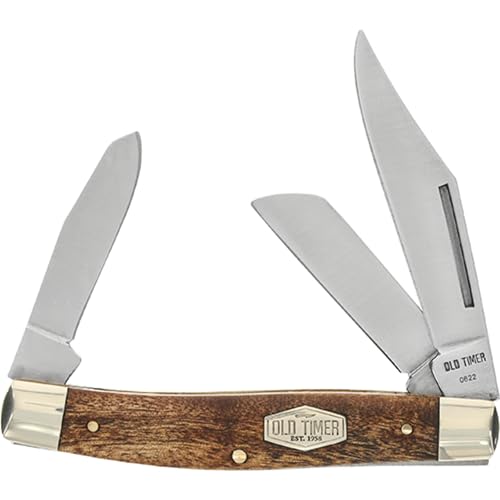
- 8OT Senior: clip, sheepsfoot and spey blades, about 6.9 inches overall
The Senior is the big three-blade knife of the family. The clip blade does the detail work, the sheepsfoot (a straight edge with a rounded back) does clean straight cuts, and the spey (a short, rounded blade) does the rest. The grid has it in sawcut, wood (8OTW), bone (8OTB) and yellow (8OTY) handles. Same knife, four suits.
The Scout and Workmate titles name four blades but not which four, so check the photos before you assume there's a can opener in there.
Trappers
A trapper has two long blades that hinge at the same end. The 96OT Bearhead Trapper lists two blades and tweezers in its title, about 7.4 inches overall. The 69OT Premium Trapper lists a 3.3-inch clip point and the same overall length. Trappers are long in the pocket and easy to hold in a gloved hand. The pocket knife page covers trapper, stockman and other patterns across brands.
Lockbacks
A lockback holds the blade open with a bar along the back of the handle; you press the bar to close it. The Old Timer lockbacks:
- 3OT Bearhead: a 2.2-inch drop point, about 5.1 inches overall, a small one
- 5OT Bruin: a 2.8-inch drop point, about 6.5 inches overall
- 31OTCP Medium Lockback: a 2.9-inch drop point, a wood handle, a thumb stud and a pocket clip
- 194OT Gunstock Trapper: a 3.1-inch clip point with nickel silver bolsters; its listing names a liner lock, so read the listing for the lock
The 5OT Bruin Heritage is the Heritage version of the Bruin: a lockback with a D2 drop point and a laminate wood handle. There's also a Heritage Clip Point folder in D2 with a wood handle, about 5.7 inches overall.
Assisted openers
The 900OT Assisted Opening lists a 2.9-inch drop point, a liner lock, a wood handle and a pocket clip. The Ti-Nitride Spring Assisted lists a 3-inch drop point and a wood handle. Assisted means a spring finishes the opening once you start it. They're the lineup's everyday carry knives.
How to choose within the Old Timer lineup
Fixed blade or folder
If the knife's main job is the deer, start with the fixed blades. If the job is everything else, start with the folders. Plenty of hunters carry one of each and stop arguing about it.
Then size by the job
The short skinners, around 3 to 4 inches, are for field dressing and skinning. The 5-inch-plus knives are camp knives for rope, kindling and the cutting board. For a pocket knife, the overall length matters more than the blade: under 5 inches vanishes in a pocket, around 7 inches fills a hand in gloves.
My one opinion on this page: a short skinner does more for a first-time deer hunter than a long knife. Here's the reason you can check: the work around a deer is mostly short, controlled cuts near the hide, and a short blade keeps the tip where your eyes are. Penn State's advice for field dressing also asks for a clean knife and rubber gloves, and recommends carrying sanitary wipes to clean knives in the field.
Then the steel
The Old Timer grid splits into three steel groups:
- High carbon stainless: most of the lineup, no grade named in the listings
- Named stainless grades: 7Cr17MoV on the Copperhead and one Guthook Skinner, 7Cr17 on the Frontier, 8Cr on the Trail Boss per the maker
- D2 and 1095: the Heritage knives in D2, the Generational Sharpfinger in 1095 per the maker
Stainless resists rust with ordinary care. D2 and 1095 want drying and oiling after a wet day. That's the trade.
Then the sheath or the clip
The classic hunters list leather sheaths. The Trail Boss lists a molded sheath. The modern folders use pocket clips. A knife that fights your harness strap gets taken off and left on the truck seat, so try the sheath on your hunting belt first.
Care and safe handling
AKTI's maintenance advice fits this whole lineup:
- Clean: pick dirt out of the handle and the blade slots every few months; a toothpick won't scratch the metal
- Oil: a light oil on a soft cotton cloth, and a drop at the joint of a folder you use often
- Sharpen: often, at the same angle on both sides
Sawcut grooves give grip and also hold whatever you cut. After field dressing, wash and dry the knife and handle, and let a leather sheath dry slowly, away from the stove. Penn State recommends cleaning residues from knives and equipment and then sanitizing them with a chlorine bleach solution.
Cut away from your body. On a slip joint or lockback, keep your fingers out of the blade's closing path; AKTI warns the spring can snap a released blade shut. A knife isn't a pry bar.
Knife carry rules vary by state and city. Check your state's rules before you carry one. Some knives may not ship to every address; Amazon shows that at checkout.
Old Timer and the Schrade name
"Schrade Old Timer" is a common search, and some Amazon titles still pair the two names. American Outdoor Brands lists Old Timer and Schrade as separate brands, each linked to its own site. Old Timer's own story page says the brand was founded in 1958 and describes knives built for working people first and outdoorsmen after. One Sharpfinger listing carries the Schrade brand on Amazon, so it shows up in the Schrade grid, but its title names it an Old Timer. The Schrade brand page covers Schrade's own lineup, which on this site is mostly modern fixed blades.
Old Timer vs Case
Both make traditional pocket knives and hunting knives. On this site the difference is in the mix:
- Old Timer's grid: fixed blades and folders both, with the Sharpfinger, sawcut hunters and the Trail Boss next to slip joints and lockbacks
- Case's grid: mostly traditional pocket-knife patterns, with a smaller set of hunters
Case says on its own site that it's based in Bradford, Pennsylvania, with knifemaking history going back to 1889. The Case brand page has its lineup.
Old Timer facts
Verified from the maker and its parent company:
- Founded: 1958, per Old Timer's story page
- Parent company: American Outdoor Brands lists Old Timer among its brands
- Made in USA: the 152OTG Generational Sharpfinger, per the maker; other listings don't say
- Warranty: the lifetime Generational Warranty for the original owner, per the maker
Wipe it, dry it, oil it, and put it back in the same pocket. That's how a knife gets old enough to earn the name.