What Case makes for hunters and campers
On this site, Case covers two product types: folding knives and fixed-blade knives. The folders are the bigger part of the grid above, and most of them are traditional patterns. Here's how the lineup splits:
- Trappers: two-blade jack knives in many handle materials
- Stockmans: three-blade patterns in small and medium sizes
- Small traditional folders: Peanut, Texas Toothpick, Barlow, Sod Buster
- Lockbacks: the CopperLock family and the Caliber lockbacks
- Fixed-blade hunters: Finn, Ridgeback, Lightweight Hunter and others
- A long fixed blade: the USMC knife
The grid filters by type and changes as listings come and go. So I'll write about the patterns and what separates them, not about how many of each are listed this week. Most specs here come from Amazon listings, and the grid marks those values. Many Case listings give only a closed length, so the grid shows a dash where they don't say.
Case is made in Bradford, Pennsylvania, per its product pages. That's the same state as Hemlock Run, which makes it local by my math. Jess says that isn't how distance works. She's welcome to drive it.
The Case pocket knife lineup
Trappers: the two-blade workhorse
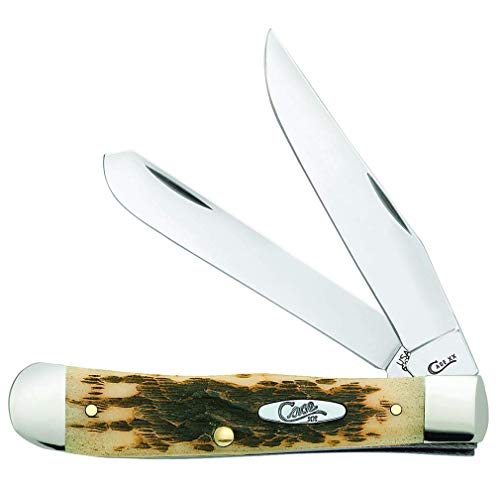
The Trapper is the pattern most of the grid is built on. Case's own page for its Yellow Synthetic Trapper describes it as a jack knife with two full-length blades, a clip and a spey. The clip is a slender blade for detail work. The spey is a long, rounded utility blade. Case says the pattern was built for small-game trapping.
In the grid, the Trappers share a closed length and differ by handle and steel:
- Bone handles: natural, smooth, peach seed jig and corn cob patterns
- Colored bone: the Caribbean Blue Trapper and a Mini Trapper
- Synthetic handles: the Sparxx Trapper
- Steel versions: stainless and carbon steel Trappers, marked in the model names
Two Peach Seed Trappers list a pocket clip, which is unusual on a traditional pattern. If a knife rides in a jeans pocket loose, the clip doesn't matter. If it rides in a jacket, it might. The pocket knife page covers patterns and locks across brands.
Stockmans: three blades, three jobs
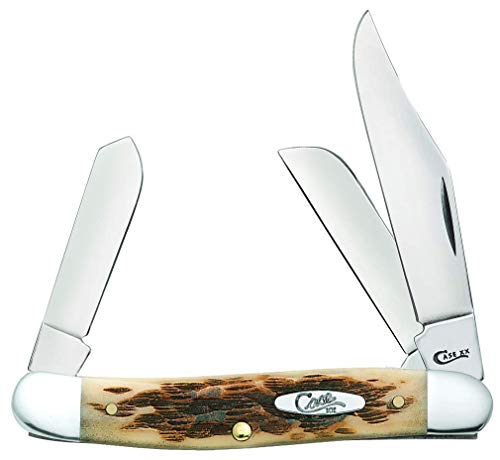
The Stockman is the three-blade pattern. The grid has a Small Stockman, several Medium Stockmans and a 3-Blade Stockman, with closed lengths running from small to mid-size per the listings. One Medium Stockman lists carbon steel. Three blades means three shapes for three kinds of cut, folded into one handle. It also means three blades to clean. Rule of thumb: a Stockman is a good pocket knife for a person who'll actually use the second and third blade.
Small traditional folders
The small end of the grid, per the listings:
- Peanut: a small two-blade knife, under 3 inches closed; one version lists CV steel
- Texas Toothpick: a slim folder with a short, narrow blade
- Barlow: a mid-size jack knife; one listing names stainless steel
- Sod Buster: a single long skinner-style blade with a curved handle
Case's Sod Buster page calls it a workhorse and says its skinner blade runs nearly the full length of the knife. That's a lot of edge for a simple folder. Small knives and whittling jobs are on the whittling knife page.
Lockbacks: CopperLock, Russlock and Caliber
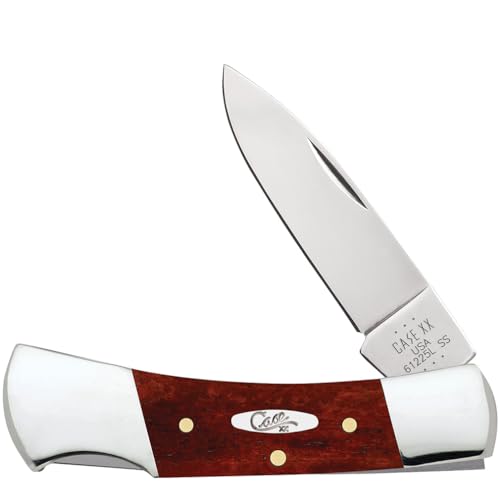
These are the Case folders that lock. Case's page for its Mini CopperLock calls it a fully locking clip blade and a lockback design. The grid lists the Mini CopperLock and the Russlock with clip points, and the Caliber lockbacks with drop points. Benchmade's mechanisms guide explains a lockback as a slip joint with a lock added: the blade stays open until you press the backspring to release it.
If you'll use a pocket knife for harder cuts, like trimming shooting lanes or cutting rope under tension, look here first. The traditional slip joints don't lock.
Slip joints: what doesn't lock
Most traditional Case patterns are slip joints. Benchmade's guide describes the slip joint as a backspring in the handle pressing on the blade's tang, so the blade snaps to open and closed stops. Nothing holds it open except that spring.
That's fine for whittling, opening feed sacks and cutting twine. It isn't fine for prying or stabbing cuts, and nothing in a pocket should be. Keep your fingers out of the closing path. Close it slowly with the edge facing away from your hand.
The Case hunting knife lineup
Finn and Mini Finn
The Finn knives in the grid are short fixed blades, the M3 Finn, the Leather Mini Finn, the Buffalo Horn Finn and the Twin Finn set, with leather sheaths on several, per their listings. A short blade suits small game and close work. A short blade with control beats a long blade with ambition.
Ridgeback, Lightweight Hunter and the CT1
The general hunting fixed blades:
- Ridgeback Hunter: one version with a nylon sheath, another with a mid-length blade
- Lightweight Hunter: a longer blade and a sheath, per its listing
- Fixed Blade 316 5 SS: a mid-length stainless blade
- Hunter CT1: Nitro V steel, a clip point and a Micarta handle
The CT1 is the modern one of the bunch, with a synthetic handle and a newer steel than the traditional patterns use. More on the type is on the hunting knife page, and skinning shapes are on the skinning knife page.
The USMC fixed blade
The USMC knife is the long one in the grid. Its listing names a 1095 carbon steel blade of about 7 inches and a leather sheath. It's a camp and utility knife more than a skinning knife. Camp-knife jobs are on the camping knife page.
How to choose within the Case lineup
Pattern first
The pattern decides what the knife can do. One long blade (Sod Buster), two blades (Trapper, Peanut), three blades (Stockman), or a locking blade (CopperLock, Caliber). If you can't name the job for the second blade, you probably want one blade.
Then lock or no lock
A slip joint folds under pressure on the spine. A lockback doesn't until you press the release. For a knife that rides in a hunting pack for real work, I'd take the lock. For a knife that lives in a pocket for twine and apples, a slip joint is fine.
Then the steel
Case's knowledge base describes its three steels:
- Tru-Sharp stainless: the most common Case blade steel; needs minimal care and resists rust and tarnish
- Chrome Vanadium (CV): not corrosion-resistant; darkens to a patina over time, even with care
- Carbon steel (CS): also tarnishes and rusts more readily than stainless; oil helps
Some model names in the grid carry SS, CV or CS. Read the listing of the exact knife for the steel, since naming isn't always the full story.
My one opinion on this page: buy Chrome Vanadium only if you'll oil it. Case's own page says CV needs a thin film of light oil to prevent rust, and that it'll darken even when well cared for. Some folks love that patina. Some folks find rust in April and blame the knife.
Then the handle
The handle is where Case gets colorful: bone in several jig patterns, colored bone, buffalo horn, wood, Micarta and synthetics. Case notes on its product pages that natural materials mean a knife may not look exactly like the photo. Bone and horn feel warm in the hand. Synthetics shrug off a wet day.
Reading a Case pattern number
Case's knowledge base explains the code stamped on a blade's tang: the first number is the handle material, the second is the number of blades, and the rest is the factory pattern code. So a two-blade Trapper has a 2 in the second place, and a three-blade Stockman a 3.
That's useful at a garage sale and at the kitchen table. It's measure twice, cut once, for pocket knives. The full handle-code chart is on Case's site.
Care that applies to the whole lineup
AKTI's maintenance guide recommends the same basics for any pocket knife:
- A toothpick for dirt in the handle and around the blades
- A light oil on a soft cotton cloth for the blades
- Oil on the joint of a folder you use often
- A cool, dry place for storage, not a damp basement
On a three-blade Stockman, that's three joints. Give each blade its own drop. For CV and carbon steel, wipe the blade dry the same day and leave a thin film of oil on it.
Case vs Buck Knives
Both brands make fixed-blade and folding knives, and both come up in the same searches. On this site the differences are in the mix:
- Case's grid: mostly traditional patterns, Trappers, Stockmans, Peanuts, in Tru-Sharp stainless or Chrome Vanadium, plus Finn and Ridgeback hunters
- Buck's grid: mostly fixed-blade hunters and lockbacks led by the 110, in 420HC stainless per the listings
Case says its knives are made in Bradford, Pennsylvania. The Coeur d'Alene Area Economic Development Corporation says Buck moved to Post Falls, Idaho, in 2005 and dates the first Buck knife to 1902. If you want a traditional multi-blade pattern, that's Case's side of the grid. If you want a big lockback with a sheath, that's Buck's. The Buck Knives brand page has its lineup.
Case facts
Here's what I could verify on the maker's own pages:
- Roots: in 1889 four Case brothers started making knives, per Case's knowledge base
- W.R. Case & Sons: launched around the turn of the 20th century by W.R.'s son, Russ Case
- Owner: Zippo Manufacturing Company, also of Bradford, formed W.R. Case & Sons Cutlery Company in 1993
- Where made: Bradford, Pennsylvania, from domestic and imported materials, per the product pages
- Warranty: limited lifetime, per the product pages
A drop of oil, a dry pocket and a blade you close slowly. A Case knife that gets those three tends to stay in the family.