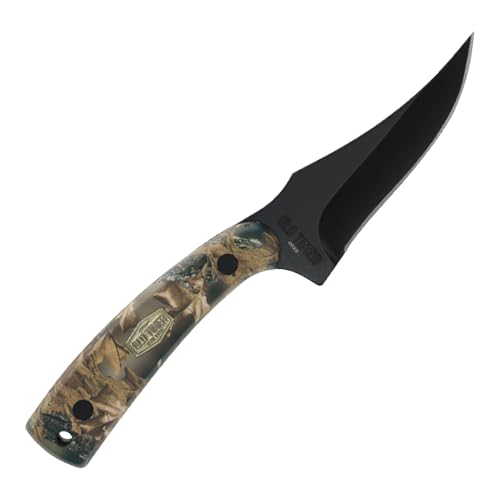
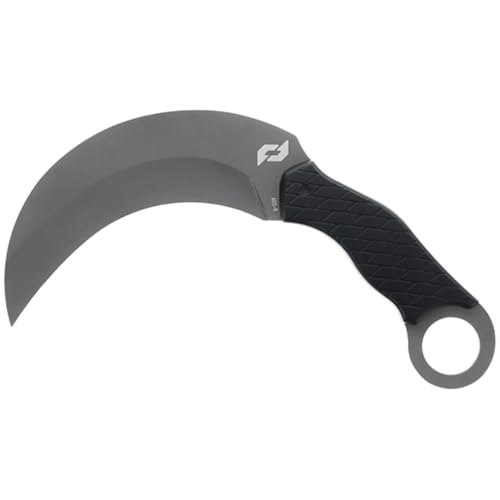
What Schrade makes for hunters and campers
On this site, Schrade covers fixed-blade knives first, then survival axes and machetes, plus a single folder, multi-tool and fire starter. The fixed blades sort into four rough groups by size and job:
- Big survival and bushcraft knives: the SCHF9, Frontier, Reckon Tini, Extreme Survival and Leroy
- Mid-size hunting and utility knives: the Wolverine, Isolate, Rigime, Outback Cleaver and Bedrock
- Small knives: the Adder, Wolverine Mini and Needle
- Odd shapes: the Needle Magnum, the Boneyard Karambit and the Decimate Kukri
The grid changes as listings come and go. I'll write about the groups and what separates them, not this week's count.
Nearly every spec in the Schrade grid comes from an Amazon listing, and the grid marks those values. Where Schrade's own page says something different or more, I say so. Where nobody says, there's a dash. I graded shop projects for a living, and the confident guesses were the crooked ones.
How Schrade sorts its own line: Alpha, Beta, Delta
Most Amazon titles in this grid start with "Delta Class." That's Schrade's own label. Its site splits the line into classes:
- Alpha Class: the top tier, high-end materials, made exclusively in the USA, per the maker
- Beta Class: made or assembled in the USA, with upgraded handles and blade steels such as D2
- Delta Class: described by Schrade as making up the bulk of the Schrade offering
Schrade's history page calls this a good, better and best assortment. On this site, the knives in the grid are almost all Delta Class by their titles. Rule of thumb: the class tells you the tier; the listing still tells you the steel.
Lineup notes: the Schrade survival and bushcraft knives
SCHF9 and Reckon Tini: the long 1095 blades
The SCHF9 lists a 6.4-inch blade, about 12.1 inches overall, in 1095 carbon steel with a TPE handle (a soft, rubbery plastic) and a sheath; its title calls the blade a kukri point. The Delta Class Reckon Tini lists the same blade and overall length in 1095, with a sheath and a limited lifetime warranty.
These are the biggest knives in the grid short of the machete. A blade this long is for camp work: splitting kindling with a baton, cutting brush, making feather sticks for the fire. It's more knife than most hunters want for field dressing. The survival knife page covers the type across brands.
Frontier: two handles, two steels
The Frontier comes in two versions in the grid, and they aren't the same knife in a different color:
- SCHF36CP Frontier: a 5-inch drop point in 1095 carbon steel, a full tang, a TPE handle and a sheath
- SCHF36M Frontier: a drop point in 8Cr13MoV stainless with a Micarta handle, full tang
Schrade's own page for the SCHF36M adds the details: a powder-coated 8Cr13MoV blade with a finger choil (a notch ahead of the handle for a choked-up grip), a picked Micarta handle with jimping (small grooves for the thumb), a lanyard hole, and a black polyester belt sheath that carries a ferro rod and a sharpening stone. A ferro rod is a sparking rod for starting fires. That's a camp kit on one belt loop.
The bushcraft knife page covers knives built for this kind of work.
Extreme Survival and Extreme Survival Slim
The Delta Class Extreme Survival lists a 6-inch drop point in AUS-10 steel with a G10 handle (a hard fiberglass laminate) and a sheath. Schrade's page says the line now features AUS-10 blade steel, non-slip grips and a heavy-duty design.
The Extreme Survival Slim lists a 4.5-inch blade, about 9 inches overall, a steel handle and a sheath. Its listing and the maker's page name different steels, so read the exact listing before you buy if the steel matters to you.
Leroy
The Delta Class Leroy lists a 9.5-inch clip point, about 15.6 inches overall, in AUS-8 stainless with a sheath. A second Leroy listing names AUS-8 steel, a full tang and a rubberized handle. A 9.5-inch blade is bowie territory. The bowie knife page covers that shape across brands.
Jess's take on any blade over 9 inches: "That's not a knife, that's a reach extension." She says it like it's a complaint. I'm not sure it is.
Mid-size hunting and utility knives
Wolverine and Isolate
These two sit in the size range most people think of as a hunting knife:
- Delta Class Wolverine: a 3.8-inch drop point, about 8.4 inches overall, AUS-10 steel, a G10 handle, a sheath and a limited lifetime warranty, per its listing
- Delta Class Isolate: a 4-inch drop point, about 8.5 inches overall, AUS-10 steel and a sheath
A second Wolverine listing in the grid names 65Mn steel instead, so check the listing, not just the name. The drop point (the back of the blade curves down to the tip) is the all-round hunting shape. The hunting knife page has the comparison across brands.
Rigime: a tanto in AUS-8
The Delta Class Rigime lists a 3.83-inch tanto blade in AUS-8 with a G-10 handle and a sheath. A tanto has an angular tip with a strong point, rather than a curved belly. It's a utility shape more than a skinning shape.
Outback Cleaver and Bedrock Sheepsfoot
Two knives in the grid have flat, blunt-tipped blades. The Delta Class Outback Cleaver lists a 4.25-inch 3Cr13 stainless blade coated in black oxide, a glass-fiber nylon handle and a hard polymer sheath. The Delta Class Bedrock lists a sheepsfoot blade (a straight edge with a rounded-down back) and a TPE handle. These are camp-kitchen and rope-cutting shapes, not skinning knives.
Small knives: Adder, Wolverine Mini and Needle
The small end of the Schrade grid:
- Delta Class Adder: a 2.9-inch drop point, about 6.4 inches overall, AUS-10, a sheath and a limited lifetime warranty; a second Adder lists 7Cr17MoV and a TPR handle
- Delta Class Wolverine Mini: a 2.6-inch drop point in 65Mn with a G10 handle and a sheath
- Delta Class Needle: a 3.6-inch blade in 7Cr17 stainless, a TPE handle and a leather sheath
Small fixed blades ride on a belt, in a pack strap or around the neck, and they're easier to keep track of than a folder in cold hands. Little Ricky is in the grid too, with no specs in its listing, so it gets a dash and no guesses.
Odd shapes: Needle Magnum, Boneyard Karambit and the Decimate Kukri
The Needle Magnum lists a 7.5-inch serrated blade in 7Cr17MoV, a TPE handle and a leather sheath. The Boneyard Karambit lists a 5.2-inch AUS-8 blade with a finger loop and a sheath; a karambit has a curved, claw-like blade. Neither is a field-dressing shape.
The Delta Class Decimate Kukri lists a 14.5-inch 3Cr13 blade with a sheath. A kukri has a forward-bent blade. A Decimate Bolo sits next to it in the grid with few specs in its listing. The machetes are for clearing shooting lanes and trimming around a blind, not for anything on a deer.
Schrade axes
Schrade's axes in the grid are short survival and camp tools, every one with a sheath per its listing. They sort into two families:
- SCAXE models: the SCAXE2 Small Axe, the SCAXE2L Large Survival Axe and the SCAXE9CP Axe Saw Combo, all listed as multi-tool axes with 3Cr13 heads and nylon or polymer handles; the Axe Saw Combo is the longest, and adds a saw, as its name says
- Delta Class Bedrock and Backdraft: the Bedrock Axe and Bedrock Magnum list 3Cr13MoV heads and a limited lifetime warranty, the Magnum being the longer of the two; the Backdraft lists a 3Cr13 head and names bushcraft among its uses
None of the listings gives a head weight, and I won't guess one.
They run from hatchet size down to something you'd strap to a pack. Read them as kindling and small-limb tools for a camp, not as woodpile splitters. The survival axe page, the survival hatchet page and the hatchet vs axe guide compare sizes across brands. Chop on a block with your free hand clear, and sheath the head when you set it down.
How to choose within the Schrade lineup
Size by the job
Under about 4 inches: a hunting or carry knife. Four to 6 inches: an all-round camp knife. Over 6 inches: chopping, batoning and brush work. Wood beyond that is the axes' job. Field dressing wants control more than reach, so most hunters start near the small end and add a big knife for camp only if they need one.
Then the steel
This is where Schrade's grid spreads out more than most:
- Carbon steels: 1095, 65Mn and SAE-1070 in the listings
- Mid stainless: 3Cr13, 7Cr17 and 7Cr17MoV, 8Cr13MoV
- Higher-end stainless: AUS-8 and AUS-10
My one opinion on this page: if you won't dry and oil a knife after a wet day, buy stainless. Here's the reason you can check. Morakniv's steel guide says carbon steel is more prone to rust in humid environments and needs careful drying and oiling after use, though it's easier to resharpen than stainless. A November deer camp is a humid environment that occasionally snows.
Then the handle and the sheath
TPE and rubberized handles grip when wet. G10 and Micarta are hard and stay put in the hand. Sheaths in the listings range from leather on the Needle to hard polymer on the Outback Cleaver to the polyester belt sheath with a ferro rod on the Frontier SCHF36M. Look at how the sheath carries before you look at the blade; you'll wear the sheath all day.
Care and safe handling
AKTI's advice covers the whole grid:
- Sharpen often: a dull blade takes more force and slips more
- Oil: a light oil on a soft cotton cloth protects against moisture
- Clean: a toothpick gets dirt out of handle seams without scratching
- Store: cool and dry, not a damp garage
AKTI also notes that even stainless steel can be harmed by water and that salt water is especially hard on blades. For 1095 and 65Mn, dry the blade before it goes back in the sheath, every time.
Cut away from your body. Never use a knife as a hammer or a pry bar; AKTI warns that chopping can send debris toward your eyes and that twisting a blade can make it slip or snap. Knife carry rules vary by state and city, so check your state's rules before you carry one, especially the long blades.
Schrade vs Buck
Both make fixed-blade knives and come up in the same searches. On this site the difference is in the mix:
- Schrade's grid: mostly fixed blades plus survival axes and machetes, largely survival, bushcraft and utility designs, steels from 1095 carbon to AUS-10
- Buck's grid: fixed blades and folders, classic hunters and lockbacks, mostly 420HC stainless per the listings
The Coeur d'Alene Area Economic Development Corporation says Buck moved to Post Falls, Idaho, in 2005 and manufactures there. Schrade says its Alpha Class is made in the USA. If you want a choice of folders, that's Buck's side; the Buck Knives page has its lineup.
Schrade facts
Verified from Schrade's own site and its parent company:
- The first patent: George Schrade designed and patented a push-button automatic knife in 1892, per Schrade's history page
- The company: he started the Schrade Cutlery Company in 1904
- Today: a rebrand, a good, better and best lineup, and some manufacturing back in the USA for the Alpha Class and select Beta Class knives
- Parent company: American Outdoor Brands lists Schrade among its brands
- Warranty: a limited lifetime warranty for the original owner, per the maker
One Sharpfinger listing carries the Schrade brand on Amazon and shows up in this grid, but its title names it an Old Timer. The Old Timer brand page covers that family of sawcut hunters and pocket knives.
Dry the blade, oil it, and let it ride in the sheath it came in. The knife that's where you left it is the one that gets used.