Camp Gear · Gear type
Battery Powered Cooler
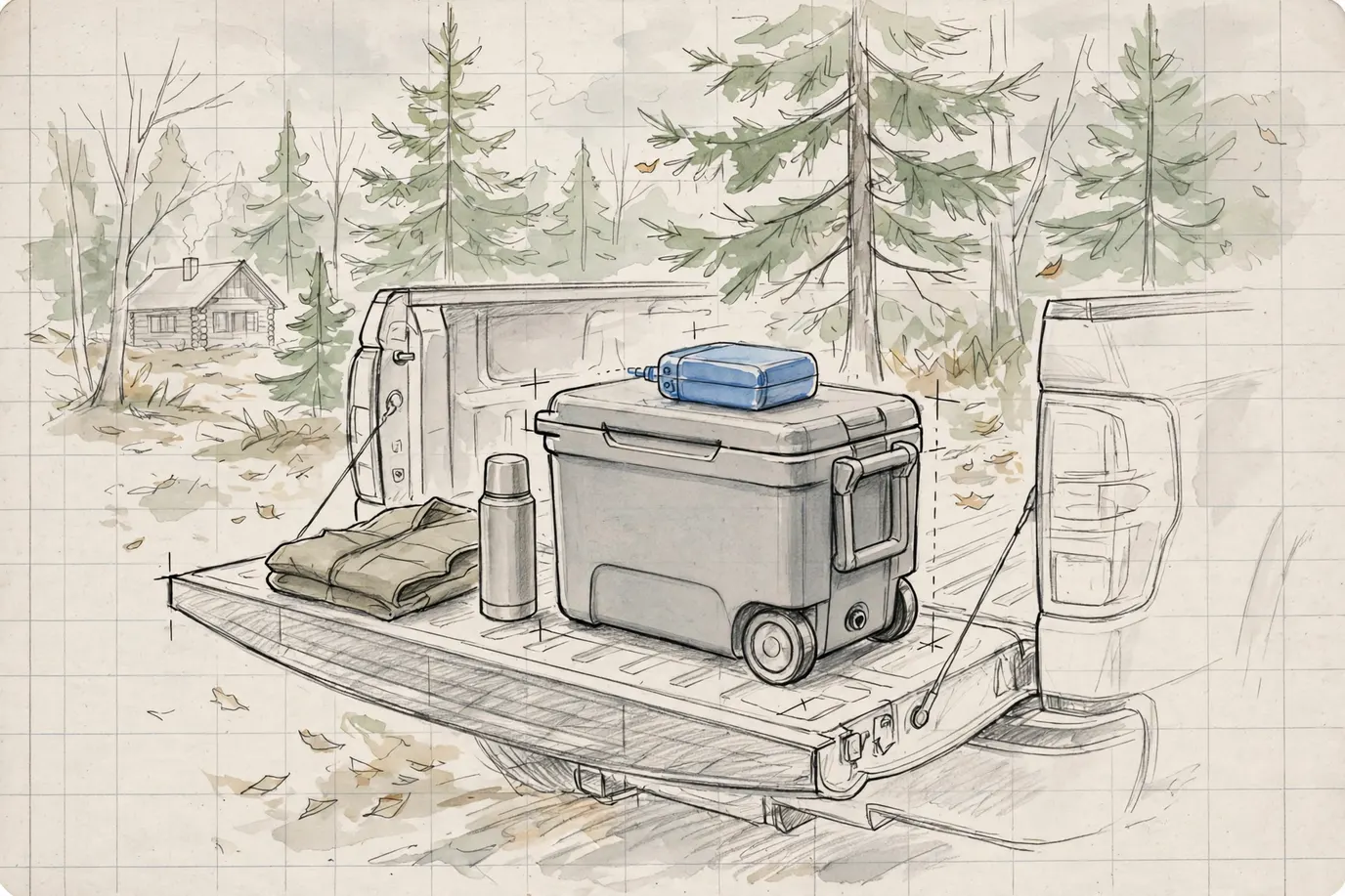
A battery powered cooler is an electric fridge-cooler that carries its own power, so it keeps running in the field, the blind or the beach with no cord at all. The battery is the whole point and the whole decision: how it attaches, how long it lasts at a real temperature and how you get it charged again. Most use a compressor, so they can hold fridge or freezer temperatures. Walt asked me where the cord goes. There isn't one. He looked a little betrayed.
We earn a commission if you buy through our links, at no cost to you. Disclosure
| Model | Capacity | Cooling | Lowest temp | Zones | Amazon |
|---|---|---|---|---|---|
Iceco GOPACK12 with 250Wh BatteryElectric cooler More specs
| 13 qtlisting | Compressorlisting | 21 Flisting | — | Check price |
BougeRV 12V Refrigerator CRH20 21QT BatteryElectric cooler More specs
| 21 qtlisting | — | -4 Flisting | — | Check price |
BougeRV Car Refrigerator CRX3 23 QuartElectric cooler More specs
| 23 qtlisting | Compressorlisting | -4 Flisting | — | Check price |
BougeRV Car Refrigerator CRX3 30 QuartElectric cooler More specs
| 30 qtlisting | Compressorlisting | -4 Flisting | — | Check price |
Anker SOLIX EverFrost 2 40 LElectric cooler More specs
| 42 qtlisting | — | -4 Flisting | — | Check price |
BougeRV 12V Refrigerator CRD2 V2 43QT BatteryElectric cooler More specs
| 43 qtlisting | — | -4 Flisting | Duallisting | Check price |
BougeRV 12V Refrigerator CRD2 V2 52QT BatteryElectric cooler More specs
| 52 qtlisting | — | -4 Flisting | Duallisting | Check price |
BougeRV 12V Refrigerator RockyV3 55QT BatteryElectric cooler More specs
| 55 qtlisting | — | -4 Flisting | Duallisting | Check price |




What’s in this listPowered coolers with a built-in or attachable battery, as stated by the maker or the Amazon listing. “—” means neither the maker nor the Amazon listing states it.
What sets a battery powered cooler apart
A plain electric cooler needs a cord in a socket to keep cold. A battery powered cooler keeps going when you unplug it, because the battery rides with the box. That one change moves the cooler from the truck to anywhere you can carry or roll it: the ground blind, the far end of the beach, the deer camp porch with no outlet.
Everything else about plug-in coolers (12V and wall power, compressor vs thermoelectric, how the group is sorted) sits on the electric cooler page. This page is about the battery part.
Nearly every model I read about pairs the battery with a compressor, not a thermoelectric chip, and there's a good reason. One maker's support page puts its example thermoelectric cooler at about 94 amp-hours a day and its example compressor cooler under 24. A compressor shuts off once it hits the set temperature and restarts when the inside warms up a bit. A thermoelectric module just keeps drawing. On a battery, that difference decides everything.
The table on this page lists powered coolers with a built-in or attachable battery, as the maker or the Amazon listing states it. It shows cooling type, lowest temperature, capacity, zones, DC input, wall power and whether solar input is listed. Battery size isn't a table column, so read it off the maker's spec sheet before you compare runtimes.
Specs that decide a battery powered cooler
Real talk: the cooler half of these is fairly standard. The battery half is where they split.
Know which kind of battery you're buying
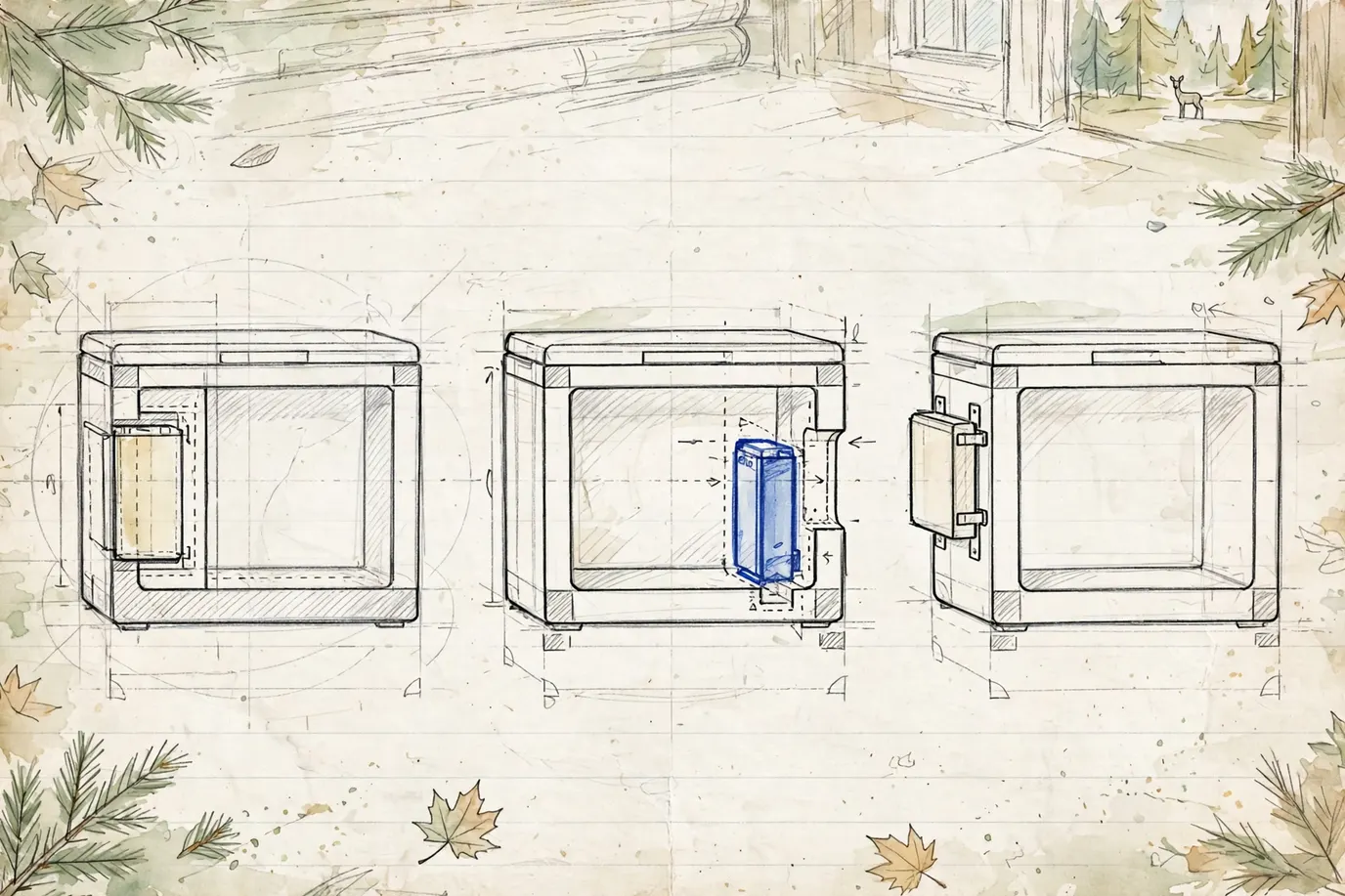
There are three ways makers attach the power, and the table's built-in battery column lumps them together:
- Built-in battery: sealed in the wall. Clean and simple, but when it's flat, the cooler waits by an outlet.
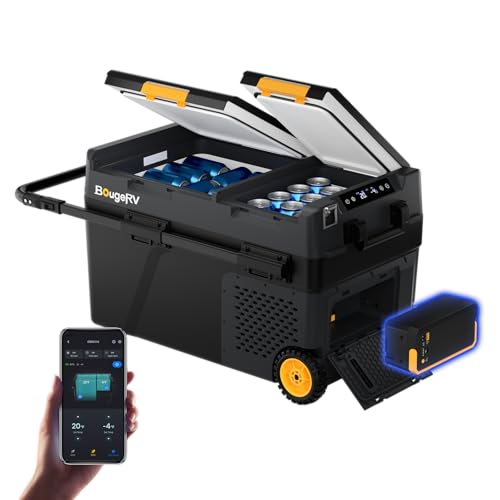
- Swappable battery: slides into a slot. One maker's newer line has two battery compartments, so you can carry a second pack and swap it in.
- Attachable battery pack: clips onto the outside. One maker's freezer takes a magnetic battery that attaches to a panel on the cooler.
Swappable and attachable packs have one big advantage at camp. You can carry the battery inside to charge while the cooler stays out in the cold. If a cooler feels heavy for its size, a lot of that is battery.
Read the runtime claim, then read the fine print under it
Every runtime number comes with test conditions, and they're friendly ones. One maker rates its 40-liter cooler at about 52 hours on one battery and 4.3 days on two. The fine print: empty cooler, Eco mode, a 77°F room and a 39°F set temperature. Another maker states up to 42 hours at 39°F for its smallest box, tested at 77°F ambient.
An empty box in a 77°F room is a nice place to be a battery. Real use means food going in warm, the lid opening, and a truck bed in the sun. So use the claim to compare models against each other, not to plan your weekend to the hour. (Renee says I plan everything to the hour. Renee is a 15-minute-margin person.)
A bigger box on the same battery runs shorter
Here's one most folks miss. Another maker sells the same 299Wh battery in three sizes of cooler. At 39°F inside and 77°F outside, its smallest box is rated at 42 hours, the middle one at about 36 and the biggest at 27. Same battery, more air to keep cold, less time.
So don't buy 20 quarts more than you need "just in case." The extra space costs you runtime every hour it's running. The electric cooler page has more on sizing.
Do the battery math yourself in two steps
One maker's FAQ gives a runtime formula: divide the battery's usable capacity in amp-hours by the cooler's average draw in amp-hours per hour.
Quick math with that maker's own numbers. Its 25-liter compressor model averages 0.92 amp-hours per hour at 12V, measured in 90°F air with 39°F inside. A 40 amp-hour lithium iron phosphate battery, which the same FAQ says is nearly 100% usable, divided by 0.92 gives about 43 hours. The FAQ puts lead-acid at 50% usable, so a 40 amp-hour lead-acid battery gives you 20 usable amp-hours and about 22 hours. Same box, same heat, half the time.
If your battery is rated in watt-hours, divide by 12 to get amp-hours at 12V. A 288Wh pack is about 24 amp-hours. That's the arithmetic behind the maker's own conversion of 47 watts at 12V into 3.92 amp-hours an hour.
Charging inputs decide how you refill it
Look for how many ways in. The makers I read list wall power, the car's 12V socket, a solar panel and USB-C on some models. One lists a full recharge in about 4 hours from the wall or the car, 3.6 hours from a 100W solar panel and 5.8 hours over 60W USB-C.
Solar input in the table means the maker or the listing states it; we don't guess from a bundle photo. Mind the panel's voltage too, since each cooler accepts a set range. Panel sizing and sun math are on the solar cooler page.
Cooling range, modes and zones still matter
Battery or not, it's a fridge. The lowest temperature column tells you how cold it can set. The makers I read list ranges down to -4°F, which is freezer territory. The FDA puts the fridge line at 40°F and the freezer at 0°F, so a cooler that sets to -4°F can hold frozen meat, if the battery holds out.
Many battery coolers add power modes. One maker describes Eco (fan off, slowest cooling, longest battery life), Smart (the default) and Max (fan on, fastest cooling, shorter runtime). Zones are the other choice: a dual-zone model keeps a fridge side and a freezer side at once, and the zones column says which you're getting.
The battery doubles as a phone charger, which is a trap
Some battery coolers have USB ports. One maker lists two USB-A ports and a USB-C port that charges in and out. Handy for a headlamp or a phone at camp.
Here's the trap. Every phone you charge comes out of the cooler's runtime. At deer camp, that's a real argument. (Walt doesn't have this problem. Walt's phone is in the truck, turned off, where Walt believes phones belong.)
Weight and wheels, because you'll carry the battery too
Batteries are heavy. The weight column shows the maker's stated weight, and it's worth comparing with and without the battery when the maker lists both. Wheels and a pull handle start to make sense fast. One maker's 40-liter model rolls on 6-inch wheels with a retractable handle. For a ground blind a quarter mile in, that's the difference between bringing it and not.
Which battery powered cooler fits which job
Rechargeable cooler for day hunts and the ground blind
A small battery cooler is the cordless lunch-and-water box for a full day in the woods. Pre-cool it at home, load it cold, set it no colder than the food needs and one battery should cover the day.
Battery powered fridge for the cabin with no outlet
At a camp with no power, the battery cooler becomes the fridge. This is where a swappable or attachable pack earns its keep. Charge one battery in the truck on the drive to town while the other runs the cooler. A two-battery setup, rated for days by one maker, is the closest thing to a real fridge without wires.
Battery powered refrigerator vs a cooler plus a power station
A separate portable power station can run any 12V fridge, and it powers lights and phones too. A built-in battery is neater, with fewer cords, but it only feeds the one box. If you already own a power station, a plain compressor fridge may be the smarter buy.
When to skip the battery altogether
If you're always near a car socket or a wall outlet, the battery is weight and cost you're carrying for nothing. A car fridge or a regular compressor fridge does the same cooling.
Charging and caring for the battery
The battery is lithium on every model I read about, often lithium iron phosphate (LFP). Safety guidance from the fire services is short and worth following.
Lithium-ion batteries can overheat or catch fire if damaged or charged wrong. Use the maker's charger and cord, buy products listed by a nationally recognized testing laboratory, and stop using a battery that swells, smells, leaks, gets very hot or makes odd noises.
A few more from the NFPA and the U.S. Fire Administration:
- Don't charge it on a bed or a couch
- Don't keep charging after it's full
- Don't charge below 32°F or above 105°F
- Plug chargers straight into an outlet, not an extension cord or power strip
- Recycle old batteries at a battery drop-off, never in the trash
That 32°F line matters at deer camp. If the porch thermometer reads below it, bring the pack inside to charge, or charge it in the warm truck on the drive.
Between trips, store the cooler clean and dry, and follow the maker's guidance on how charged to leave the battery. Wipe the inside with a damp cloth. Don't hose it out; the battery and electronics are in there.
Skip the battery powered cooler if this is you
If your camp has a generator or a hookup, skip the battery and buy the cooler. If your trips are long and remote, a big ice chest from the coolers page and a bag of ice may still be the simpler answer. If you'd never remember to charge it, a cordless cooler is just a heavy cooler.
My one opinion on this page: compare battery coolers by the runtime test conditions before the battery size. The fine print above is why. A rating taken empty, in Eco mode, at 77°F tells you how two models compare under the same test. It doesn't tell you about a warm load of groceries on a sunny tailgate.
Walt still asks where the cord goes. I've started telling him it's in the cabin, charging.
Brands in this list
Related
Questions people ask
How long does a battery powered cooler last on one charge?
It depends on the battery, the box size, the set temperature and the weather. Makers state runtime under test conditions. One maker's 288Wh cooler is rated at about 52 hours, tested empty in Eco mode at a 77°F room. Another maker's same-battery lineup drops from 42 to 27 hours as the box grows. Expect less in real use.
Is a rechargeable cooler the same as a battery powered fridge?
Mostly, yes. Rechargeable cooler, battery powered fridge and battery powered refrigerator all describe an electric cooler with its own battery. Nearly all use a compressor, so they cool like a small fridge, and many go below freezing. A few small thermoelectric boxes with batteries exist, but they cool only a set amount below the outside air.
Can I charge a battery powered cooler with a solar panel?
Many can, when the maker lists a solar input. One maker lists a 100W panel input and a 3.6-hour recharge from empty, and its newer line accepts 12 to 30V from the panel. Some only solar-charge with the battery installed in the cooler. Check the stated input range before you buy a panel.
Can I charge the battery in freezing weather?
Check the maker's manual first. The NFPA's lithium-ion battery tips say not to charge batteries below 32°F or above 105°F and to keep them at room temperature when possible. At a cold camp, charge in the heated cabin or the running truck cab, not on the porch.
Does a cooler with battery also work plugged in?
Yes, the ones I've read about run on wall power and a car socket as well as the battery, and the battery usually charges while plugged in. That makes the battery a bridge between outlets, not the only power source. On one model, USB-C is the slowest way to refill it, so start the trip full.
Sources
- Anker SOLIX: EverFrost 2 40L electric cooler (product page and FAQ) — accessed 2026-10-22
- Anker SOLIX: EverFrost powered cooler (battery life and recharge tables) — accessed 2026-10-22
- Anker: Introduction to EverFrost powered cooler 30/40/50 — accessed 2026-10-22
- ICECO: JP Pro wheeled freezer with magnetic battery (product page) — accessed 2026-10-22
- Dometic: CFX3 25 product page and FAQ (battery run time and usable capacity) — accessed 2026-10-22
- Dometic: What is the most energy efficient cooler? — accessed 2026-10-22
- NFPA: Lithium-ion battery safety tip sheet — accessed 2026-10-22
- U.S. Fire Administration: Lithium-ion battery safety for electronic devices — accessed 2026-10-22
- FDA: Are you storing food safely? — accessed 2026-10-22