Camp Gear · Gear type
Wall Tent
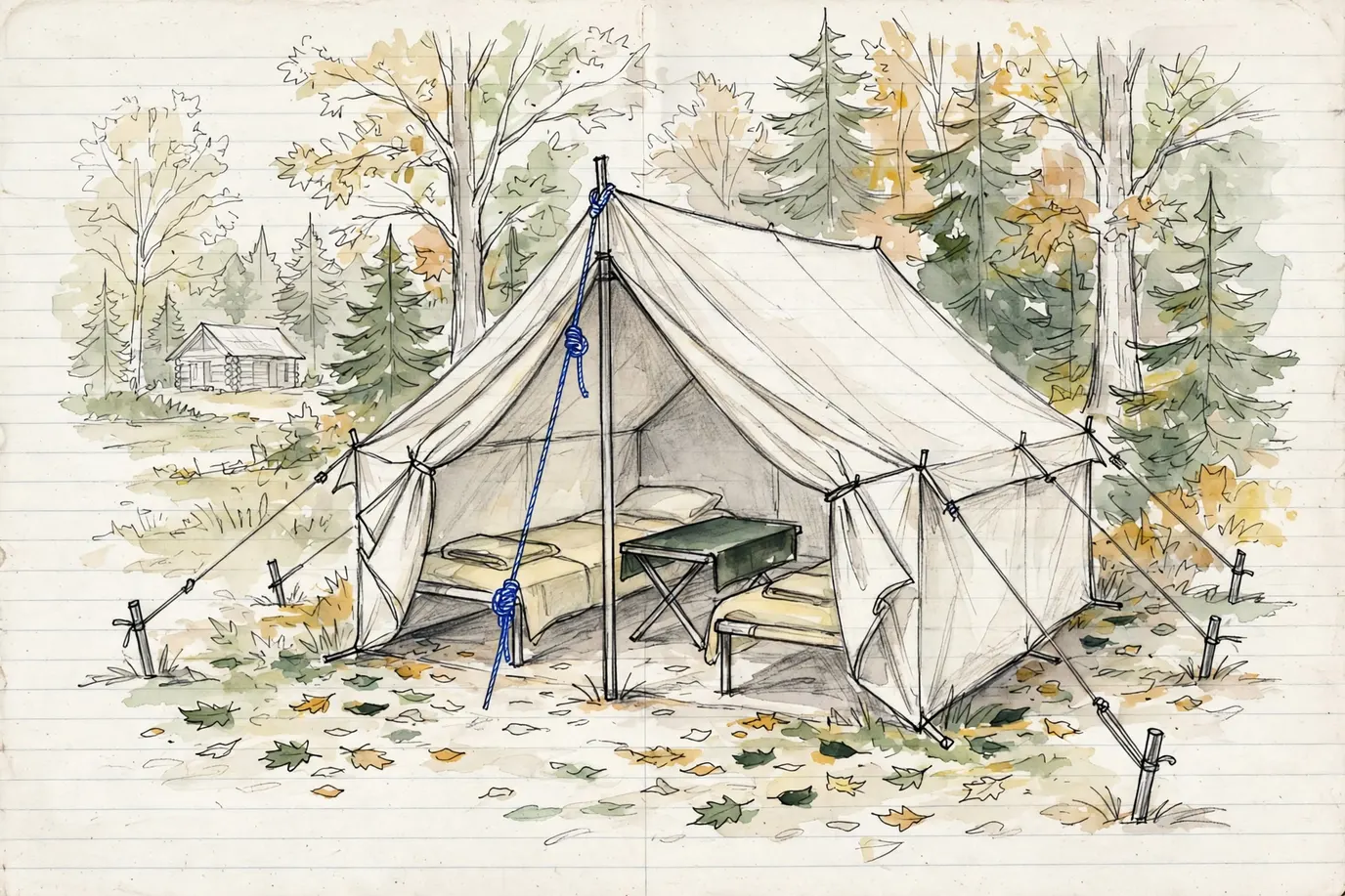
A wall tent is a room you can take apart: straight canvas walls, a peaked roof on a ridge, and a frame that holds it square. It's built for a camp that stays up for days, with cots, a table and often a stove inside. Pick the floor size for those things first, then the frame, then the canvas. Here's the thing. Nobody throws a wall tent in the trunk on a whim. It travels like lumber, because half of it is.
We earn a commission if you buy through our links, at no cost to you. Disclosure
| Model | Sleeps | Amazon |
|---|---|---|
Whiteduck Alpha Canvas Wall Tent Waterproof 4 Season Outdoor Camping &Tent More specs
| — | Check price |
Whiteduck Alpha Canvas Wall Tent Waterproof 4 Season Outdoor Camping &Tent More specs
| — | Check price |
Whiteduck Alpha Pro Canvas Wall Tent Waterproof 4 Season Outdoor CampiTent More specs
| 10 personslisting | Check price |
Whiteduck Alpha Pro Canvas Wall Tent Waterproof 4 Season Outdoor CampiTent More specs
| 10 personslisting | Check price |


What’s in this listWall tents, as described by the maker or the Amazon listing. “—” means neither the maker nor the Amazon listing states it.
What makes a wall tent different
A wall tent is the box of the tent world. The walls go straight up, the roof slopes from a ridge, and the floor is a plain rectangle. That shape is the whole point. You can stand at the middle, set a cot tight against a wall and still sit up on it, and park a table where a dome tent would have a slope.
The numbers from one maker's chart show the scale. White Duck Outdoors builds its wall tents with 5-foot walls, in sizes from 8 by 10 feet up to 16 by 24 feet, and calls them a fit for semi-permanent setups. The same chart lists total weights from 146 lb for the smallest kit to 461 lb for the largest. That's not a tent you carry. That's a tent you unload, and the weight column in the table is worth reading before you plan where the truck parks.
The general tent basics (floor, rainfly, seams, what "sleeps 6" means) are on the camping tent page. What follows is what changes when the walls stand up straight and the camp stays a week.
The table on this page lists tents their maker or listing describes as wall tents. Its columns give the sleeping count, the floor in feet and square feet, the height under the ridge, the canvas or fabric, the frame, any built-in stove jack and the weight, taken from the maker first and, except for weight, from the Amazon listing where the maker is silent (marked as listing values). A dash means neither states it.
Size a wall tent for cots, a stove and a table
Here's where people get it wrong. The person rating on a wall tent assumes everybody sleeps on the floor, shoulder to shoulder. White Duck's chart lists its 10 by 12 at 8 people and notes that the 120 square feet fits eight people averaging 6 feet tall only if they sleep side by side. Nobody at a hunting camp sleeps like that for a week. They sleep on cots, and they want a table.
The same maker gives the numbers you need for the real plan:
- A cot: about 17 to 24 square feet each
- A wood stove: plan for 36 to 40 square feet of floor, depending on the stove
- Walking room: whatever is left, and you'll want some
Rule of thumb: a 12 by 14 floor is 168 square feet. Set aside 40 for a stove and you have 128. Four cots at 24 square feet each take 96 of that. That leaves 32 square feet for a table, boots, bow cases and the man who gets up at 4 a.m. It works. It's snug.
My one opinion on this page: buy a wall tent for the cots and the stove you'll actually bring, not for the number printed on the bag. The reason is that arithmetic above. The printed number counts sleeping bags on the floor, and a camp with a stove and cots loses close to half of that floor before anyone unrolls a bag.
White Duck also points out the other side. Going up a few feet in each direction turns 120 square feet into 320, and a bigger space takes more heat to keep warm. Its largest tents may need two stoves. Measure twice.
What to look at when you pick a wall tent
These are the specs that decide it, roughly in the order I'd check them.
Floor size is width by length, and area is the number to compare
Wall tent sizes are named by floor dimensions, like 12 by 14 or 14 by 16. The table splits that into floor length and floor width, plus floor area in square feet, so you can compare a long narrow tent with a squarer one. For cots, the narrow side matters. A cot laid across the width needs the width to be longer than the cot, plus room to swing your legs off it.
Wall height and center height decide where you can stand
The walls set where you can sit up on a cot; the ridge sets where you can stand. White Duck's line uses 5-foot walls. The table shows center height, which is the tallest point under the ridge. A taller center gives you room to stand and dress, and more air above your head for a stove to heat. A shorter one heats faster. Pick for the tallest person in camp, not the average one.
Canvas weight is printed in ounces
Canvas is sold by weight per square yard, so the number is in ounces. Montana Canvas makes its Traditional wall tent from 10 oz canvas and its Premium from 12 oz, which it describes as heavier and slightly thicker, with extra insulation and durability. Heavier canvas also means a heavier bag to lift into the truck. The table's fabric column says whether the maker lists cotton canvas, a poly-cotton blend or a synthetic. More on the material itself is on the canvas tent page.
Frame type: steel, aluminum or a ridge pole you cut
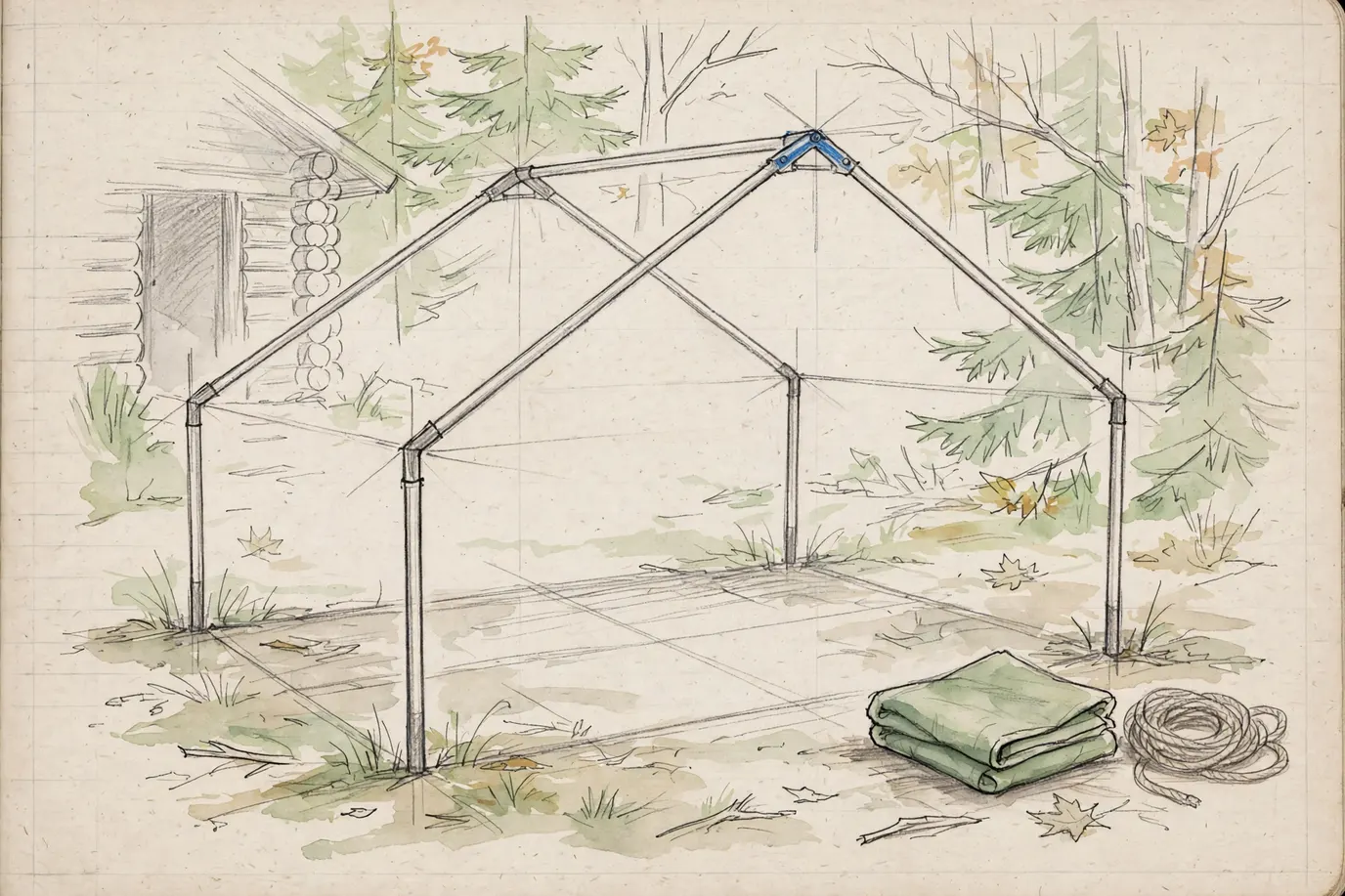
A wall tent needs a frame, and the table's pole column shows what the maker supplies. Montana Canvas lays out the choice plainly. Internal steel or aluminum frames suit camps you can drive to. Lodgepole frames suit hunters who pack in and build their own on site. If shipping a full metal frame is the problem, it suggests an angle kit (just the corner and ridge fittings) and 1-inch electrical conduit from a hardware store.
For a lodgepole ridge, Montana Canvas prefers a pole at least 4 inches across at the small end, sticking out at least 18 inches past each end of the tent. (Some of us cut it straighter than others. I'm told the photos speak for themselves.)
A stove jack is either built in or it isn't
The table marks whether the maker builds in a stove jack, the fireproof collar the chimney pipe passes through. Montana Canvas notes that a factory fly comes with a cutout and a flap for the jack. If you plan to heat the tent with wood, start with a tent that has one. Sizing the jack, pipe height and clearances are covered on the hot tent page, and I won't repeat it here.
Doors and windows set the airflow
Montana Canvas recommends a zippered back door for cross ventilation in hot weather. It also says zippered doors keep warm air in better than tie doors in cold weather. White Duck's chart gives its smaller tents 2 windows and its largest 6. The table shows door count where the maker or the listing states it. Two doors at opposite ends turn an early-season afternoon from oven to porch.
Seasons only count when the maker says so
Seasons appear in the table only as the maker words them. Heavy canvas sounds like a winter tent, but a rating is a maker's claim about one model. No claim, no assumption.
Canvas wall tent or synthetic, floor or no floor
Canvas, poly-cotton or synthetic
A canvas wall tent is the classic one, and most of what people search for is canvas. Cotton canvas swells when wet, which is why makers ask you to season it before the first trip. Poly-cotton blends and synthetic wall tents exist too, and the table's fabric column tells you which you're looking at. Whichever you choose, treat the maker's care sheet as part of the tent.
Sewn-in floor or sod cloth
Many wall tents skip the sewn-in floor for a sod cloth. Montana Canvas describes it as a strip of 10 to 12 inch vinyl sewn to the bottom of the walls. You lay dirt, snow, rocks or branches on it to seal the gap at the ground. A floor keeps out mud and mice; a sod cloth lets you set a stove on bare ground. Montana Canvas says never to put a stove on a canvas or synthetic floor, and to use a floor with a cutout or zippered area at the stove instead.
With a fly or without
A fly is a second roof pitched over the canvas one. Montana Canvas says to leave an air space between the fly and the tent to increase airflow and cut condensation, and that a fly helps snow slide off. Leaving a tent up for months in direct sun without a fly is one of the two things it says shorten a tent's life.
Pitching a wall tent the first time
Kodiak Canvas's setup guide is honest about the first try: plan for two people and roughly four to six hours. Experienced owners can often do it in under two. Four to six hours is a Saturday-afternoon fix only if Saturday starts at breakfast.
- Pick the ground. Flat, free of sharp rocks and roots, with the door facing away from the prevailing wind. The National Park Service adds the important one: look up, and don't camp under dead branches.
- Lay the ground tarp first. Kodiak says it protects the floor from abrasion and moisture wicking up from the soil.
- Build the roof frame flat, with leg poles on one side only, so that side stands at roughly 5 to 6 feet.
- Unzip every door, then drape the canvas over without forcing it. Montana Canvas says to keep the zipper open whenever the tent goes on or off the frame, to save it from strain.
- Fit the remaining legs and raise it. Montana Canvas adjusts the legs until the center of the endwall just touches the ground.
- Stake it square. Kodiak drives stakes through the bottom grommets at 45 degrees, angled away from the tent. A 10 by 12 to 10 by 14 tent typically takes 16 to 24 stakes.
- Guy it out. Stakes at least 5 feet from the sidewall, lines tensioned to "a slight give." Recheck after rain, because canvas expands when wet.
Montana Canvas also suggests a V-shaped trench around the tent to divert runoff, and grommets over canvas stake loops, which weaken when wet. Practice in the yard first. The neighbors will talk either way.
Season it, dry it and store it dry
Season before the first trip
Montana Canvas says the thread is designed to seal after the tent has been wetted down and completely dried a couple of times, and to expect leaks until then. Kodiak's routine: soak it with a garden hose, let it dry completely, repeat two or three times.
Watch for pink
Mildew starts as pink discoloration, according to Montana Canvas, and it says to act fast. Its fix is a mold and mildew stain remover, or half a cup of cleaning vinegar per gallon of water, on a warm sunny day, then a thorough rinse. Pink spots are not a decorating choice.
Clean gently and never pressure wash
For an overall wash, Montana Canvas uses mild laundry detergent, a soft brush and a garden hose rinse. It says never to use a high-pressure washer on the tent.
Fold it only when it is bone dry
Montana Canvas puts it bluntly: every crease and crevice must be 100% dry before the tent is folded for storage. Storing it wet is the other of the two things it says shorten a tent's life. Broke camp in the rain? Set it up again at home. A wall tent folded wet in November is a science project by April.
Heat and carbon monoxide inside a wall tent
Federal safety guidance is short on this: the CPSC tells campers to keep portable heaters and lanterns out of use while they sleep in a tent. Carbon monoxide symptoms (headache, dizziness, weakness, nausea, sleepiness, confusion) can pass for a cold or the flu. If you heat a wall tent, use a wood stove set up through a factory stove jack, follow the stove maker's manual, and read the hot tent page before the first fire.
Who should skip a wall tent
A wall tent is the wrong buy if:
- You camp one or two nights at a time and move often
- Your camp is a walk-in with no truck nearby and no pack stock
- You camp alone and don't want a four-hour pitch by yourself
- You have nowhere to dry canvas between trips
For a fast weekend, a dome tent or a cabin tent on poles goes up in a fraction of the time. Jess's take, after watching us raise ours: "It's a shed you can fold. Very slowly." She's not wrong, and she still takes the cot closest to the stove.
Cots are on the camping cot page. Good luck out there, and bring more stakes than the chart says.
Related
Questions people ask
What is a wall tent?
A wall tent is a rectangular tent with vertical side walls and a peaked roof, usually canvas, pitched over an internal metal frame or a ridge pole cut on site. One maker's line has 5-foot walls in every size from 8 by 10 to 16 by 24 feet. Wall tents are meant for camps that stay put for days.
Is a canvas wall tent waterproof out of the box?
Not completely. Montana Canvas says its thread is designed to seal once the tent has been wetted down and fully dried a couple of times, and to expect leaks until then. Kodiak Canvas gives the same routine: soak it with a hose, let it dry, repeat two or three times before the first wet trip.
How many people can sleep in a wall tent?
Fewer than the label says if you use cots. One maker lists a 10 by 12 wall tent at 8 people, but that assumes everyone sleeps side by side on the floor. The same maker puts a cot at 17 to 24 square feet and a stove at 36 to 40, so do the floor math with your own cots.
Do I need a metal frame for a wall tent?
Not always. Montana Canvas says internal steel or aluminum frames suit camps near a road, while a lodgepole frame suits hunters who pack in and cut poles on site. Some owners buy only an angle kit and use 1-inch electrical conduit from a hardware store to save shipping.
Can I put a wood stove in any wall tent?
Only in one built for it. Look for a stove jack sewn in by the maker, and a fly with a matching cutout. Montana Canvas says never to set a stove on a canvas or synthetic floor. The full stove routine is on the hot tent page.
Sources
- White Duck Outdoors: What wall tent size should you buy? A guide to the most common sizes — accessed 2026-10-22
- Montana Canvas: Helpful hints — accessed 2026-10-22
- Montana Canvas: Wall tents (Traditional 10 oz and Premium 12 oz canvas) — accessed 2026-10-22
- Kodiak Canvas: Canvas wall tent setup, step-by-step pitching guide — accessed 2026-10-22
- National Park Service: Finding and setting up a campsite — accessed 2026-10-22
- U.S. Consumer Product Safety Commission: Portable heaters and camping equipment — accessed 2026-10-22