Brand · Archery & Bowhunting
Slick Trick Broadheads
Slick Trick broadheads are short, all-steel fixed-blade heads with four blades, plus crossbow versions, stainless Pro Series heads, replacement blades and one hybrid mechanical. The short version: the model name tells you the cutting diameter, and the grain tells you the weight. Pick the cut, then the weight your arrow or bolt needs, then check whether the listing is complete heads or blades only. (Uncle Walt read GrizzTrick as a bear warning. He checked the cabin door twice.)
We earn a commission if you buy through our links, at no cost to you. Disclosure
Slick Trick on Amazon US
11 models- Broadhead
Slick Trick Mag Blades 1-1/8
- Cutting diameter
- 1.125 in
- Blade thickness
- 0.035 in
- Heads per pack
- 4
- Broadhead
Slick Trick 1-1/4 GT 2 Blade
- Cutting diameter
- 1.25 in
- Blades
- 2
- Blade thickness
- 0.035 in
- Broadhead
Slick Trick 1-1/8 Xbow
- Cutting diameter
- 1.125 in
- Blade thickness
- 0.035 in
- Heads per pack
- 4
- Broadhead
Slick Trick GrizzTrick Magnum Pro
- Weight
- 100 gr
- Cutting diameter
- 2.5 in
- Blade thickness
- 0.035 in
- Broadhead
Slick Trick Magnum 1 1/8
- Weight
- 125 gr
- Cutting diameter
- 2.25 in
- Blade thickness
- 0.035 in
- Broadhead
Slick Trick ViperTrick 1 1/16
- Weight
- 100 gr
- Cutting diameter
- 1.9375 in
- Blade thickness
- 0.035 in
- Broadhead
Slick Trick 1 1/8 Crossbow
- Weight
- 100 gr
- Cutting diameter
- 2.25 in
- Blade thickness
- 0.035 in
- Broadhead
Slick Trick Standard 1 Inch
- Weight
- 100 gr
- Cutting diameter
- 1 in
- Heads per pack
- 4
- Broadhead
Slick Trick Viper Trick 1 1/16
- Weight
- 100 gr
- Cutting diameter
- 1.9375 in
- Heads per pack
- 3
- Broadhead
Slick Trick Assailant
- Weight
- 100 gr
- Type
- Hybrid
- Cutting diameter
- 2.625 in
- Broadhead
Slick Trick Torch Rear Deploy
- Type
- Mechanical
- Blades
- 2


What Slick Trick makes for bowhunters
Slick Trick makes broadheads and the parts that go with them. On this site the brand covers one product type, broadheads, and the grid shows:
- Four-blade fixed heads: the Standard, Magnum, ViperTrick and GrizzTrick families
- Crossbow heads: the XBOW and crossbow-marked listings
- Pro Series heads in stainless steel
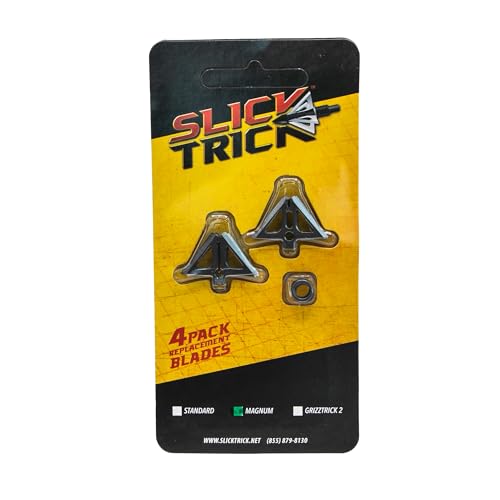
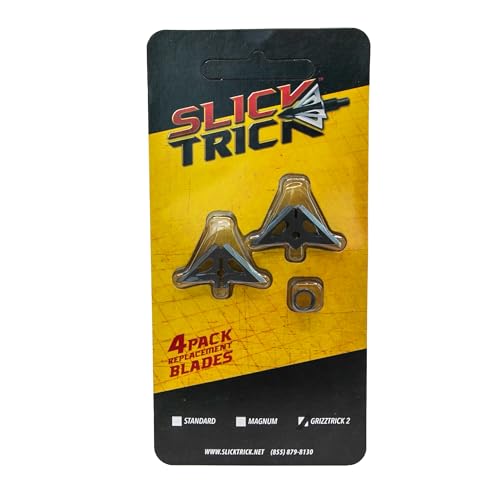
- Replacement blade packs for the fixed heads
- The Assailant, a hybrid mechanical head, per its listing
The maker's own site lists more heads than the grid does, including one-piece and turkey heads and mechanical models. Those aren't in the listings here, so I'll stick to what is.
The grid changes as listings come and go. So this page is about the families and what separates them, not about how many packs are listed this week.
How Slick Trick broadheads are built
Slick Trick's own pitch is short: the original all-steel broadhead, run by archers for archers. Here's what the maker's pages actually specify on its main fixed heads:
- Ferrule: steel, which the maker calls Super Steel (the ferrule is the body the blades sit in)
- Blades: .035-inch steel on the Magnum, ViperTrick, GrizzTrick 2 and XBOW, and on most Standard weights
- Tip: four-edge, which the maker calls bone splitting
- Blade lock: the maker's patented Alcatraz system, an interlocking blade design held by the ferrule
- Weights: 100 and 125 grains on the bow heads, plus 150 grains on the XBOW
Grain, if you're new to this, is a small weight unit: 437.5 grains to the ounce. A 100-grain head weighs a little less than a quarter of an ounce.
The Why Slick Trick page also says steel won't bend or distort over time with standard use and that the blades resist corrosion. Those are the maker's claims, and I'm passing them on as that.
The four-blade families, by cut
Total cut: read this before you compare
Slick Trick measures its four-blade heads in a way that confuses people at first, me included, for about a minute. Each head has two pairs of blades. The maker lists the width of each pair, then adds them up as "total cut". So the Magnum is 1 1/8 inches plus 1 1/8 inches: a 2 1/4-inch total cut.
That's why the grid shows a single width on some listings and the total on others. A Magnum listing can say 1 1/8 or 2 1/4 and mean the same head. Quick math before you compare with a three-blade head from another brand: find out which number each listing is giving you.
Standard: the compact one
The Standard has a 1-inch blade width and a 2-inch total cut, per the maker. It also comes in an 85-grain version with .030-inch blades, alongside the 100 and 125. The maker says the 1-inch four-blade design outcuts larger 1 1/8-inch three-blade designs by 18%. That's the maker's comparison, not mine. The 100-grain Standard is in the grid.
Magnum: one size up
The Magnum steps up to 1 1/8 inches per blade pair and a 2 1/4-inch total cut, in 100 or 125 grains. The grid has Magnum listings in both silver and black, and a crossbow-marked one. If you're comparing a Magnum and an XBOW, they share the 2 1/4-inch total cut on paper. The difference is the weight options and what the maker says each is built for.
ViperTrick: two different widths
The ViperTrick breaks the pattern. Its two blade pairs aren't the same width: 1 1/16 inches plus 7/8 inch, for a 1 15/16-inch total cut. The maker calls it a cut-on-contact design that keeps the strength of a one-piece head with the ability to replace blades. The grid has it in a 4-pack and a 3-pack, both listed at 100 grains.
GrizzTrick 2: the widest fixed head
The GrizzTrick 2 is 1 1/4 inches plus 1 1/4 inches, a 2 1/2-inch total cut, and the maker calls it the largest cutting diameter in the line. The maker also pitches it for long-range shooters. The grid's GrizzTrick listing bundles several heads under one page, with the main variant at 100 grains.
Here's what actually changes as you go up in cut: the path the head opens gets wider, and the head itself gets bigger. GOHUNT's broadhead article puts it plainly: match the cutting diameter to the game you hunt, and remember that fixed blades show any flaw in your setup.
Crossbow heads
The XBOW is Slick Trick's dedicated crossbow head: 1 1/8 plus 1 1/8 inches, a 2 1/4-inch total cut, and 100, 125 or 150 grains. The maker says it's designed to quickly stabilize short crossbow bolts and for today's fast crossbows. It doesn't publish a speed rating, so neither do I.
In the grid, several listings are marked for crossbows, including the 1 1/8 Crossbow 4-pack and one Magnum listing. Your crossbow maker's manual comes first: read what broadhead weight and type it names before you pick a pack. The crossbow broadheads page covers what to check across brands.
Crossbow seasons and broadhead rules vary by state. Check your state wildlife agency.
Pro Series: stainless steel
The Pro Series heads are the stainless-steel versions. The maker lists a Pro Series Magnum and a Pro Series ViperTrick, both in 100 and 125 grains, and calls them 100% stainless and corrosion resistant. The grid's GrizzTrick listing also covers Pro Series variants.
If your heads ride in a quiver through rain, sleet and a week of damp cabin air, that's where stainless earns its spot. If they live in a dry case until opening morning, the standard heads carry the same blade thickness and cut on the maker's pages.
Replacement blades and "blades" listings
Slick Trick sells replacement blade 4-packs for the Standard (100/125 and 85-grain), the Magnum, the ViperTrick, the GrizzTrick 2 and the XBOW, per its replacement-blades page.
Here's the catch in the grid. Some listing titles name blades: "Mag Blades", "GT 2 Blades", "Xbow Blades". The maker's own blade packs carry similar names. So before you order, read the listing and make sure it's complete heads with ferrules, not blades only. Blades without a ferrule are a very sharp pile of nothing. (Uncle Walt would file that under "spare parts". He'd be right, technically.)
Bowhunter's broadhead prep article makes the point for replaceable-blade heads: the blades are disposable, so the ferrule is the part to check. A bent ferrule wobbles no matter how new the blades are.
The Assailant: a hybrid mechanical
The Assailant is the odd one in the grid. Its listing calls it a hybrid mechanical broadhead, gives a 100-grain weight and a 2 5/8-inch cut, in a 3-pack. The maker's current site doesn't show it, so the listing is the only source here.
A hybrid pairs fixed blades with expandable ones. Archery Business described one design as two fixed blades and two blades that open on impact. GOHUNT's article says mechanical heads use some of the arrow's energy to open, so they're usually not recommended for lightweight setups. Mechanical and hybrid heads aren't legal for every hunt, so check your state wildlife agency. The mechanical broadheads page covers the type.
How to choose within the Slick Trick lineup
Bow or crossbow first
Bow heads come in 100 and 125 grains. The XBOW adds 150. If you shoot a crossbow, start with the crossbow-marked listings and your crossbow maker's chart. If you shoot a vertical bow, start with the four-blade families. The fixed blade broadheads page lays out the type across brands.
Then the grain weight
Match the grain to what your arrow or bolt is set up for. Changing head weight changes how the arrow flies, and that's a retune, not a swap. Bowhunter suggests weighing each head on a digital scale and comparing it to the maker's listed weight.
Then the cut
- Standard: 2-inch total cut, the most compact
- ViperTrick: 1 15/16-inch total cut, two different blade widths
- Magnum and XBOW: 2 1/4-inch total cut
- GrizzTrick 2: 2 1/2-inch total cut, the widest fixed head
Then steel and pack
Standard steel or Pro Series stainless. Then pack size and color. And then, for the third time on this page, check that the listing is heads and not blades.
Tuning and practice with fixed heads
My one opinion on this page: shoot the exact head you'll hunt with before the season, not just your field points. The reason is checkable. Bowhunter recommends shooting only broadheads for two weeks before opening day, with a few practice heads set aside for it. GOHUNT says fixed blades tend to show any flaw in your setup, which is exactly what you want to find in September.
Bowhunter's prep steps, in order:
- Spin-test each broadhead-tipped arrow and watch for wobble at both ends
- Swap the head if it wobbles, to find out whether the head or the arrow is the problem
- Align fixed blades with your vanes
- Weigh each head against the maker's listed grain weight
- Shoot at your longest realistic distance, and listen for extra noise
- Don't shoot fixed heads in tight groups; you'll damage arrows and heads
Think of a fixed head like the lid on a pot. If the pot is a little off, the lid rattles. A field point is a lid that fits anything.
Handling and storage
Keep broadheads covered whenever you're carrying or storing them. Oregon's wildlife agency puts it in one line: make sure your broadheads are safely covered, in a sturdy case or quiver. Only nock an arrow when it's safe to shoot.
Slick Trick facts
Here's what I could verify from the maker's own pages:
- Founder: Gary Cooper, named on the maker's About page as founder and inventor, and described there as considered by some the pioneer of modern fixed-blade designs
- Owner: The Outdoor Group of Henrietta, New York, which acquired Slick Trick in May 2014, per the maker's About page
- Copyright line: The Outdoor Group, LLC, on the maker's site
The founding year, where the heads are made and the warranty terms aren't stated on the maker's pages, so they're left out here.
Write the head, the grain and the total cut on the inside of the case lid. Next September you'll know what you bought without opening the quiver.
Where Slick Trick shows up
Questions about Slick Trick
Are Slick Trick broadheads good?
What the maker states is checkable: steel ferrules, .035-inch steel blades on its main fixed heads, a four-edge tip and its Alcatraz blade lock, with 100- and 125-grain versions and a 150-grain crossbow head. Whether a head suits you depends on your arrow weight, your bow or crossbow and the cut you want. Shoot it before the season and see how it flies from your setup.
Who makes Slick Trick broadheads?
Slick Trick's About page names Gary Cooper as the founder and inventor of its broadheads. It says The Outdoor Group of Henrietta, New York, acquired Slick Trick in May 2014, and the maker's site footer carries The Outdoor Group, LLC copyright. The maker doesn't state a founding year, so this page doesn't give one.
What does total cut mean on a Slick Trick broadhead?
Slick Trick adds the width of its two blade pairs. The Magnum is listed as 1 1/8 inches plus 1 1/8 inches for a total cut of 2 1/4 inches. Some listings give the single width, others the total, so the grid can show either number for similar heads. Read which one a listing means before you compare it with another brand.
Can you use Slick Trick broadheads on a crossbow?
Slick Trick makes a dedicated crossbow head, the XBOW, in 100, 125 and 150 grains. The maker says it's designed to stabilize short crossbow bolts. Several listings in the grid are marked for crossbows. Check your crossbow maker's broadhead weight and type recommendations before you buy, because they come first.
Can you replace the blades on Slick Trick broadheads?
Yes. The maker sells replacement blade packs for the Standard, Magnum, ViperTrick, GrizzTrick 2 and XBOW heads, including 85-grain Standard blades. Some listings in the grid name blades in the title, so read whether a listing is complete broadheads or blades only before you order.
Sources
- Slick Trick: Broadheads (home and product lineup) — accessed 2026-10-28
- Slick Trick: About us — accessed 2026-10-28
- Slick Trick: Why Slick Trick — accessed 2026-10-28
- Slick Trick: Standard broadhead — accessed 2026-10-28
- Slick Trick: Magnum broadheads — accessed 2026-10-28
- Slick Trick: ViperTrick broadhead — accessed 2026-10-28
- Slick Trick: GrizzTrick 2 broadhead — accessed 2026-10-28
- Slick Trick: XBOW crossbow broadhead — accessed 2026-10-28
- Slick Trick: Pro Series Magnum stainless steel broadhead — accessed 2026-10-28
- Slick Trick: Replacement blades — accessed 2026-10-28
- GOHUNT: Broadhead breakdown, the pros and cons of fixed blade and mechanical broadheads — accessed 2026-10-28
- Archery Business: Two new-for-2019 hybrid broadheads — accessed 2026-10-28
- Bowhunter: Get broadheads ready for opening day — accessed 2026-10-28
- Oregon Department of Fish and Wildlife: Bow shooting safety — accessed 2026-10-28