Brand · Fire & Lighting
Klarus Flashlights, Headlamps and Camp Lanterns
Klarus is a flashlight brand from Shenzhen, China, and on this site it covers three types: flashlights, headlamps and camp lanterns. The flashlights are most of the grid, from the small E-series lights to the long-throw XT11GT Pro and EP12. Next to them sit the HM1 and HM5 headlamps and three lanterns: the foldable CL2, the magnetic WL3 and the RS10 spotlight-lantern. Pick hand, head or table by where the light has to go, then match the output to the job. (Renee asked why a lantern needs a magnet. I said for the truck. She found it on the fridge.)
We earn a commission if you buy through our links, at no cost to you. Disclosure
klarus on Amazon US
22 models- Flashlight
klarus G15
- Max output
- 4,200 lumens
- Beam distance
- 616 ft
- Flashlight
klarus XT11GT Pro
- Body
- Aluminum
- Max output
- 3,300 lumens
- Beam distance
- 1,345 ft
- Flashlight
klarus E5
- Max output
- 600 lumens
- Flashlight
klarus EP12
- Max output
- 2,000 lumens
- Beam distance
- 2,460 ft
- Max runtime
- 11 hours
- Flashlight
klarus XT11GT Pro
- Body
- Aluminum
- Max output
- 3,300 lumens
- Beam distance
- 1,345 ft
- Flashlight
klarus FlatTac X1
- Body
- Aluminum
- Max output
- 4,200 lumens
- Beam distance
- 574 ft
- Flashlight
klarus E5 Plus
- Max output
- 650 lumens
- Red light
- Yes
- Flashlight
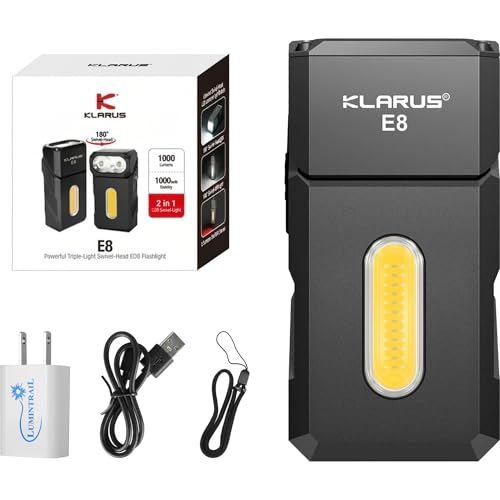
klarus E8
- Body
- Aluminum
- Max output
- 1,000 lumens
- Beam distance
- 361 ft
- Flashlight
klarus X2
- Body
- Aluminum
- Max output
- 3,000 lumens
- Max runtime
- 40 hours
- Flashlight
klarus P2
- Body
- Aluminum
- Max output
- 1,000 lumens
- Beam distance
- 886 ft
- Flashlight
klarus E5 Ultra
- Max output
- 850 lumens
- Beam distance
- 427 ft
- Red light
- Yes
- Flashlight
klarus FlatTac X2
- Body
- Aluminum
- Max output
- 3,000 lumens
- Max runtime
- 40 hours
- Flashlight
klarus E8
- Body
- Aluminum
- Max output
- 1,000 lumens
- Beam distance
- 361 ft
- Flashlight
klarus EP12
- Max output
- 2,000 lumens
- Beam distance
- 2,460 ft
- Max runtime
- 11 hours
- Flashlight
klarus XT11GT Pro V3
- Body
- Aluminum
- Max output
- 3,300 lumens
- Beam distance
- 1,345 ft
- Flashlight
klarus XT2CR Pro
- Body
- Aluminum
- Max output
- 2,300 lumens
- Beam distance
- 787 ft
- Headlamp
klarus HM1
- Max output
- 440 lumens
- Max runtime
- 70 hours
- Power
- Rechargeable
- Headlamp
klarus HM5
- Max output
- 800 lumens
- Max runtime
- 105 hours
- Power
- Rechargeable
- Headlamp
klarus HM1
- Max output
- 1,000 lumens
- Beam distance
- 886 ft
- Max runtime
- 70 hours
- Lantern
klarus CL2
- Format
- Collapsible
- Max output
- 750 lumens
- Power
- Rechargeable
- Lantern
klarus WL3
- Max output
- 1,500 lumens
- Power
- Rechargeable
- Lantern
klarus RS10 Big Spotlight Lantern
- Max output
- 800 lumens
- Power
- Rechargeable




What Klarus makes, and what this page covers
On this site, Klarus covers three product types: flashlights, headlamps and lanterns. Every Klarus light in the grid that states its power is rechargeable, which makes Klarus a USB-cable brand here. No AA, no AAA, no fuel.
Klarus's own site lists flashlights, camping lights, headlamps, power banks and accessories. This site covers the first three. Stand-alone power banks aren't a type this site lists, so they're not in the grid.
The lineup in the grid splits like this:
- Flashlights: the XT and FlatTac lights, the E series, the G15, the EP12 and the P2 penlight
- HM1 headlamps: rechargeable, with a motion sensor on the listings
- HM5 headlamp: rechargeable, the long-runtime lamp of the pair
- CL2 lantern: foldable, rechargeable, with a power supply feature
- WL3 lantern: a magnetic work light that doubles as a camp light
- RS10: a spotlight with a lantern side, per its listing
The grid filters by type and changes as listings come and go. So I'll write about the lines and what separates them, not how many of each are listed this week. Most of the numbers here come from Amazon listings, and the grid marks those values. Where Klarus's own site states a number, I say so.
Lineup notes: Klarus flashlights
The brand gets searched as "Klarus flashlight" more than anything else, and flashlights are now most of the Klarus grid. The values come from Amazon listings, and the grid marks them.
XT11GT Pro and XT2CR Pro: the tail-switch lights
The XT lights are aluminum-bodied, with a tail switch, a strobe mode and USB-C charging, and their listings call them tactical. The XT11GT Pro shows up in a few listings, including a V3. It lists output in the thousands of lumens and a beam of about a quarter mile, one of the longest in the Klarus grid. The XT2CR Pro is the lower-output sibling with a built-in battery pack and the longest low-mode runtime listed among the Klarus flashlights, well over a hundred hours.
The tactical flashlight guide explains what the label usually means on a spec sheet.
FlatTac X1, FlatTac X2 and X2
The FlatTac lights are aluminum, with a tail switch, and their listings call them tactical. Both list several thousand lumens. The X1 lists USB-C charging and a strobe mode, and the X2 a built-in battery pack in a body about four inches long. The plain X2, a separate model, lists similar output, USB-C and a strobe. Read the listing title closely; the names are one letter apart.
E5, E5 Plus, E5 Ultra and E8: the small everyday lights
The E lights sit at the low-output end, from several hundred lumens up to about a thousand on the E8. The E5 Plus, E5 Ultra and E8 add a red light, which is the mode I'd want walking into a stand. The E8 lists an aluminum body and a low-mode runtime of a few days.
G15, EP12 and P2
The G15 lists several thousand lumens, a strobe and a body under five inches long. The EP12 is the throw light: a zoomable head and a beam close to half a mile, with a listed runtime of about half a day at most. The P2 is a penlight, a slim pen-shaped light, with an aluminum body, a tail switch and USB-C charging.
(Renee asked why one brand needs this many flashlights. I said the X2 and the FlatTac X2 are different lights. She said that wasn't the question.)
Flashlights from every brand are on the handheld spotlight page, and the best tactical flashlight and brightest flashlight lists rank them by stated rules.
Lineup notes: Klarus headlamps
Klarus HM1: the motion-sensor lamp
The HM1 shows up in two forms in the grid. Both are rechargeable, and both listings describe a motion sensor, which lets you wave a hand in front of the lamp to switch it on and off.
- HM1, 440 lumens: listed with a 70-hour top runtime
- HM1, 1,000 lumens: listed with an 886-foot beam and the same 70-hour figure, bundled with a small pen light per its listing
Here's what actually changes between them: output and reach. The 440-lumen lamp is plenty for camp chores. The 1,000-lumen version reaches further down a trail or a field edge. Same sensor idea, same charge-it-on-Sunday plan.
The wave sensor earns its keep when your hands are greasy, bloody or full. It's less useful when you're gesturing at Walt across the fire.
Klarus HM5: the long-runtime lamp
The HM5 in the grid lists 800 lumens and a 105-hour top runtime, rechargeable. Klarus's own page for the 1,900 mAh HM5 adds what the listing doesn't:
- IPX6 water rating
- 90 grams with the battery, about 3.2 oz
- 103-meter longest beam, about 338 feet
- Combined flood and spot beam
- Two-year warranty
Klarus's headlamp page also shows HM5 versions with a 1,200 mAh battery and one that takes three AAA batteries. The grid version is the rechargeable one; read the listing title to be sure which you're looking at.
At 3.2 oz, the HM5 is light enough that you forget it's on your head, which is both the goal and the reason it ends up in the truck cup holder.
Lineup notes: Klarus lanterns
Klarus CL2: the foldable tent light
The CL2 lists 750 lumens, a collapsible build and a rechargeable battery. Its listing title adds seven light modes and a 10,000 mAh battery that works as a power supply for a phone in a pinch.
Folded, it packs small. Opened, it lights a tent or a picnic table. That's the job description for a camp lantern, and the CL2 is the one in the Klarus grid built for exactly that.
Klarus WL3: the magnetic work light
The WL3 is the brightest Klarus light in the grid, listed at 1,500 lumens. Its listing calls it a magnetic work light with a 13,500 mAh battery and six modes, for work, power outages, car repair and camping.
The magnet is the feature that matters at deer camp. Truck hood, tailgate, the steel shelf over the cabin sink. It's a lantern that holds its own place. Renee's fridge counts too, apparently.
Klarus RS10: spotlight and lantern in one
The RS10 lists 800 lumens and a rechargeable battery. Its listing describes a big spotlight with a lantern side, a red flood mode and an 8,000 mAh battery. Think of it as the light you point across the field to find the truck, then set on the table once you're back.
It sits in the lantern type on this site because of that flood side. The spotlight half is still a spotlight; don't point it at anyone's face around the fire.
How to read Klarus spec numbers
Lumens are total light, beam distance is reach
Lumens measure the total light coming out. Beam distance is how far the beam reaches before it drops to 0.25 lux, under the ANSI/PLATO FL 1 standard Streamlight explains. A light can be bright and short or dim and long, so read both.
Black Diamond's guide puts 150 to 250 lumens as enough for reading or walking in the dark, and 30 to 60 meters of beam as enough for setting up camp or cooking. Every Klarus headlamp in the grid goes well past that. The extra is for scanning a field edge or a long trail.
Runtime ends at 10 percent
Under the same ANSI standard, runtime is measured until output drops to 10% of where it started. So a "105-hour" figure is a low-mode number, not hours of full brightness. Turbo modes on any brand run far shorter. Read the mode table in the manual, not just the headline.
Flood or spot
Princeton Tec's guide puts it simply: flood beams spread wide for close work like camp setup and cooking; spot beams reach far for scanning terrain, and they drain the battery faster. The HM5's combined beam does a bit of both. The RS10 splits the two into separate sides.
How to choose within the Klarus lineup
Hand, head or table first
A flashlight lights what you point at. A headlamp lights what you look at. A lantern lights the room. If you'll be moving with full hands (walking to the stand, gutting, hauling), it's a headlamp. If you need reach across a field or a tight beam under the truck, it's a flashlight. If you'll be sitting (cards, supper, the tent at night), it's a lantern. Most camps want one of each per person, and Walt wants one of each that he doesn't have to charge.
Then output and runtime
For headlamps, the HM1 at 440 lumens covers camp chores; the 1,000-lumen HM1 and the 800-lumen HM5 reach further. If the trip runs long between charges, the HM5's runtime figure is the one to look at.
For lanterns, the CL2 is the tent light, the WL3 the bright work light with a magnet, and the RS10 the reach-plus-table option. More options from other brands are on the camping lantern and rechargeable lantern pages.
Then think about where you'll charge
Black Diamond's guide sorts headlamps by power. Built-in lithium batteries charge over USB and suit people who use a lamp often and can plug it in between trips. Lamps that take AAA batteries let you swap cells in the field, which suits long trips far from an outlet.
Every Klarus light in this grid that states its power is the first kind. That's fine for a cabin with a generator or a truck with a USB port. For a week in a wall tent with no outlet, count the charges you'll need before you go, and remember the lanterns can share theirs with a phone.
Then the features that fit your habits
- Motion sensor: the HM1, for dirty-hands work
- Magnet: the WL3, for trucks and steel shelves
- Phone charging: the lanterns, per their listings
- Red mode: the RS10 lists a red flood mode
On red light: the National Park Service explains that bright white light breaks down rhodopsin, the pigment your eyes need for night vision, which takes 20 to 40 minutes to build back. A dim red light doesn't do that. If you're up before the stand, red is how you keep your night eyes. Headlamps with red modes from other brands are on the red light headlamp page.
My one rule for rechargeable lights
My opinion on this page: with an all-rechargeable brand, pack one light from somewhere that runs on spare batteries. The reason is checkable in the grid. Every Klarus light here that states its power is rechargeable, and when the battery is flat, the only fix is a cable and a power source. Klarus itself sells an HM5 that takes three AAA batteries, per its site, so the idea isn't foreign to the brand. The headlamps page has AAA lamps from other makers.
Charging and battery safety
Klarus lights in the grid run on lithium batteries. The U.S. Fire Administration's advice for lithium-ion batteries:
- Don't charge below 32°F or above 105°F
- Use certified products and handle batteries with care
- Stop using a battery that smells, swells, leaks, changes color or gets too hot
A cabin in November can drop below 32°F overnight. Charge your lights inside where it's warm, not on the truck seat.
One more safety line. A battery lantern is the light that belongs inside a tent. The CPSC warns never to use fuel-burning lanterns or heaters while sleeping in tents, campers or vehicles, because of carbon monoxide.
Klarus facts
Klarus lists its office in the Longhua District of Shenzhen, Guangdong, China. Its site describes its range as flashlights, camping lights, headlamps, power banks and accessories, and its HM5 pages state a two-year warranty for that headlamp.
Hand, head or table, then output, then the one feature you'll use every night. Charge them all before the drive, and pack batteries for the one that doesn't need a cable.
Where klarus shows up
Questions about klarus
Are Klarus flashlights good?
What can be checked is in the specs. The Klarus flashlights in the grid list outputs from several hundred lumens on the E-series lights to several thousand on the XT and FlatTac lights, and nearly all are rechargeable over USB-C per their listings. Klarus's own HM5 page adds an IPX6 rating and a two-year warranty for that headlamp. Whether one suits you depends on size, beam and how you charge.
What is the Klarus XT11GT Pro?
It's an aluminum-bodied rechargeable flashlight that its listing calls tactical: a tail switch, a strobe mode and USB-C charging, with output in the thousands of lumens and a beam of about a quarter mile, one of the longest among the Klarus lights in the grid. A V3 listing appears in the grid too, so check the version on the listing.
Where is Klarus from?
Klarus lists its office in the Longhua District of Shenzhen, Guangdong, China, on its own site. The same site describes its range as flashlights, camping lights, headlamps, power banks and accessories. The grid on this page links to the Klarus flashlight, headlamp and lantern listings on Amazon US.
What is the difference between the Klarus HM1 and HM5?
The HM1 listings describe a rechargeable headlamp with a motion sensor, at 440 lumens with a 70-hour top runtime, plus a 1,000-lumen version with an 886-foot beam. The HM5 lists 800 lumens and 105 hours. Klarus's HM5 page gives 90 grams with the battery and IPX6. Pick by output, runtime and whether you want the wave-on sensor.
Can a Klarus lantern charge my phone?
Some can, per their listings. The CL2 listing describes a 10,000 mAh battery as a power supply for emergencies, and the WL3 and RS10 listings give 13,500 and 8,000 mAh batteries. Every charge you send to a phone comes out of the lantern's own runtime, so plan for both.
Sources
- Klarus: About Klarus — accessed 2026-10-28
- Klarus: Headlamp series — accessed 2026-10-28
- Klarus: HM5 (1900 mAh) ultra-thin lightweight headlamp — accessed 2026-10-28
- Klarus: HM5 (3x AAA) ultra-thin lightweight headlamp — accessed 2026-10-28
- Streamlight: ANSI information — accessed 2026-10-28
- Princeton Tec: Flood or spot? Choosing the right headlamp lighting mode — accessed 2026-10-28
- Black Diamond: Headlamp guide — accessed 2026-10-28
- National Park Service: Dark adaptation of the human eye and the value of red flashlights — accessed 2026-10-28
- U.S. Fire Administration: Lithium-ion battery safety — accessed 2026-10-28
- U.S. Consumer Product Safety Commission: Portable heaters and camping equipment — accessed 2026-10-28