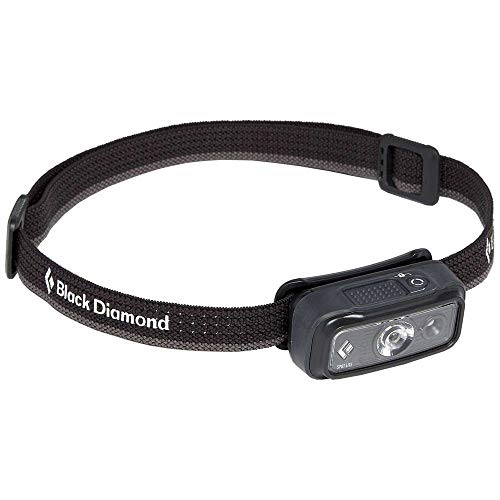
What Black Diamond makes for hunters and campers
Black Diamond is a climbing company first. Its about page says it grew out of Chouinard Equipment, took the Black Diamond name in 1989 and moved to Salt Lake City. On this site, though, it's here for two things:
- Headlamps: from small AAA lamps to rechargeable high-output models
- Lanterns: the Moji, Apollo, Voyager, Orbiter, Zip and Volt families
That climbing background shows up in the features. The maker's headlamp pages talk about lockouts for a pack, waterproof ratings and lamps that run on more than one kind of battery. Those are the same things that matter on a 5 a.m. walk to a stand in November rain.
The grid above shows what's listed on Amazon right now, filtered by type. It changes as listings come and go, so I'll write about the families and what separates them, not about how many of each are listed this week. Most specs come from the Amazon listings, and the grid marks those values. Blank means the listing doesn't say.
The Black Diamond headlamp lineup
Black Diamond names its headlamps with a word and a number. The number is the maximum output in lumens (light output, the total amount of light the lamp puts out). The word is the family. Here's how the families in the grid line up, from small to big.
Astro and Cosmo: the AAA starters
The Astro 300 and Cosmo 350 list AAA power. The Cosmo lists a red light; the Astro's listing doesn't. The maker's Astro 300 page describes a dual-fuel design that takes alkaline AAA cells or a rechargeable BD 1500 pack, a digital lockout, Brightness Memory and an IPX4 rating, which the maker says means it stands up to rain and sleet from any angle.
These are the lamps for the glovebox, the spare in the blind bag and the kid at camp who needs a light of his own. Basic and plenty.
Spot: the middle of the range
The Spot is the family most people mean when they search "Black Diamond Spot." The grid has three versions:
- Spot 350: AAA power, red light
- Spot 400-R: a built-in rechargeable battery, red light
- SpotLite 200: the light end of the family, specs not listed yet
The maker's current Spot 400 page lists the features the family is known for. PowerTap lets you tap the side of the lamp to jump between full and dimmed output. Brightness Memory turns the lamp back on at the level you left it. A digital lockout stops it switching on in a pocket. The page adds a battery meter and red night vision that comes on without cycling through white first.
That last one matters more than it sounds. Any lamp that flashes full white before it gets to red has just lit up the whole hollow you were trying to sneak into.
Storm: more modes, more weather
The Storm sits a step above the Spot:
- Storm 400: AAA power, red and green light
- Storm+ 750: a built-in rechargeable battery, red light, the higher top output of the two
The maker's Storm page describes red, green and blue light modes, a digital lockout, a battery power indicator and an IP67 rating, which it says means sealed against dust and able to handle immersion in a meter of water for 30 minutes. If you hunt where it rains sideways, that's the line to look at first.
Icon, Onsight and Distance: the top end
Three lamps sit above the Storm:
- Icon 700: AA power instead of AAA, red light
- Onsight 375 Honnold Edition: a climber-named lamp, only its output listed
- Distance 1500: the brightest lamp in the grid, with a removable rechargeable cell
The Distance is built for people who move fast in the dark. Most of us at deer camp walk in at the speed of a 63-year-old with a bad knee and a thermos, which is to say Walt's speed. A lamp in the middle of the range covers that. The top end is for long drags, big woods and searching.
Wiz Kid: the youth lamp
The Wiz Kid lists a built-in rechargeable battery and low output, 40 lumens. It's a kid's lamp, sized for a kid's head and a kid's tent. Low output isn't a flaw here. A youth lamp that blinds the whole camp at dinner gets confiscated by dessert.
The Black Diamond lantern lineup
Moji: the small hanging lanterns
The Moji family is palm-size. In the grid:
- Moji: dimming and a hanging hook
- Moji+: 200 lumens
- Moji R+: 200 lumens, dimming and a built-in rechargeable battery
A Moji hangs from a tent loop or sits in the middle of the table. It lights the cards, not the county.
Apollo and Voyager: the mid-size lanterns
The Apollo comes in two versions in the grid. One lists AA power, 80 lumens and a long runtime of 60 hours; the other lists a rechargeable battery and 250 lumens. The Voyager comes in two outputs, 75 and 140 lumens, with power sources not listed. These are table-and-tent lanterns, a step up from the Moji.
Orbiter: the big camp lanterns
The Orbiter 450 and 650 list rechargeable batteries; the 450 lists adjustable brightness. The maker's Orbiter 650 page describes a 5,200 mAh lithium-ion battery, USB-C charging in and out plus a USB-A charge-out port, an IPX4 rating, folding legs, a double-hook hang loop and a campfire light mode. Charge-out means the lantern can top up a phone or a headlamp.
Zip and Volt
The Zip lanterns appear in two colors, and the Volt is listed too, both without specs in their listings, so the grid shows dashes for them.
Lantern types are on the camping lantern page, the rechargeable lantern page and the battery operated lantern page.
How to choose within the Black Diamond lineup
Pick the power source first
Every lamp in the grid lists one of three setups:
- AAA or AA cells: the Astro, Cosmo, Spot 350, Storm 400 and Icon 700
- Built-in rechargeable: the Spot 400-R, Storm+ 750 and Wiz Kid
- Removable rechargeable cell: the Distance 1500
My one opinion on this page: a rechargeable headlamp is great until the night you forgot to charge it. Pack one that takes spare batteries, or carry the spares for the one you have. Several of the maker's AAA lamps also take a BD 1500 rechargeable pack, per its product pages, which is a nice middle road. The rechargeable headlamp page covers the trade across brands.
Then the output
The number in the name is the max. You'll use the max for a few minutes at a time, for blood-trailing, finding the trail at a fork, or checking whether that shape is a stump. The rest of the night you're on a low setting. Exhibit A: I've never once tied a boot on full power, and I've tried. Buy for the low setting you'll live on, and enough top end for the few minutes you need it.
Then red light, and how it comes on
The maker calls its red mode night vision, and it's easier on everyone else in the blind than white. Most lamps in the grid list one. The Storm 400 lists green as well. What matters as much as having red is getting to it without white first, and the maker's Spot page says its red comes on without cycling through white. Check the manual for the lamp you buy. Red-light picks across brands are on the red light headlamp page.
Then lockout and weather
A lockout keeps the lamp off in your pack, so the battery is still full when you reach the truck. The maker describes a digital lockout on its Astro, Spot and Storm pages. For weather, its pages list IPX4 on the Astro (rain from any angle), IPX8 on the Spot 400 and IP67 on the Storm. More on reading those ratings is on the headlamps page.
Charging and battery care
Follow the manual here. Charge rechargeable lamps with the cable type the maker specifies. If a lamp takes AAA cells or a rechargeable pack, don't mix old and new cells in the same lamp.
For a week at camp, the routine that works is simple: one lamp on your head, one spare in the pack, and the lantern charging from the truck during the drive. Check the battery meter before the lamps go in the closet for the winter, and again before opening day.
Keep a lit lantern on a stable table or hook, away from the tent walls and the stove. An LED lantern is the right light inside a tent. A fuel lantern is not.
Black Diamond vs Petzl
These two come up in the same searches because they share a background: both make climbing gear as well as headlamps. On this site the differences are in the mix:
- Black Diamond's grid: headlamps and camp lanterns, with AAA, AA and rechargeable lamps
- Petzl's page: headlamps
Black Diamond's about page says it took its name in 1989 and moved to Salt Lake City. Petzl's 2025 pro catalog says the company introduced its first headlamp in 1973 and lists its production sites in Crolles, Eybens and Rotherens in France and Rawang in Malaysia. If you want a lantern from the same brand as your headlamp, that's Black Diamond's side of the grid. For headlamps, compare the power source, red light and lockout of the exact models. The Petzl brand page has its lineup.
Black Diamond facts
Here's what I could verify from the maker and its parent company:
- Roots: grew out of Chouinard Equipment, which Yvon Chouinard started in 1965, per Black Diamond's about page
- Name: Black Diamond since 1989, when Peter Metcalf, Maria Cranor and the Chouinard Equipment employees took over and moved to Salt Lake City
- Parent company: Clarus Corporation lists Black Diamond among its brands
- Warranty: all Black Diamond lighting products are covered by a three-year warranty policy, per its product pages
Lockout on, spares in the pack, red light for the last hundred yards. The stand will still be there. So will the deer, with any luck.