Brand · Archery & Bowhunting
Scott Archery Releases
Scott Archery makes bow releases: the small tool that holds a compound bow's string at full draw and lets it go when you trigger it. On this site that's the whole Scott lineup, in four families: index-finger wrist-strap releases, handheld thumb releases, hinge or back-tension releases, and youth releases. The short version: pick the family by how you want to fire the shot, then the jaw, then the fit. (Uncle Walt still shoots with fingers. He calls a release "a trigger for people who've given up." He's outvoted.)
We earn a commission if you buy through our links, at no cost to you. Disclosure
Scott Archery on Amazon US
6 models- Bow release
Scott Archery Ascent Micro Hinge 3
- Type
- Hinge back tension
- Jaw / hook
- Sear
- Adjustable trigger
- Yes
- Bow release
Scott Archery Verge Hybrid Hinge
- Type
- Hinge back tension
- Jaw / hook
- Hook
- Adjustable trigger
- Yes
- Bow release
Scott Archery Apex Core Thumb
- Type
- Handheld thumb
- Adjustable trigger
- Yes
- Fingers
- 3/4
- Bow release
Scott Archery Vibe
- Type
- Wrist strap index
- Jaw / hook
- Dual caliper
- Adjustable trigger
- Yes
- Bow release
Scott Archery Vibe
- Type
- Wrist strap index
- Jaw / hook
- Dual caliper
- Adjustable trigger
- Yes
- Bow release
Scott Archery Quickshot Jr
- Type
- Wrist strap index
- Jaw / hook
- Single caliper


Alternatives to Scott Archery
- Bow release · Trophy Ridge
Trophy Ridge Spot-On
- Type
- Wrist strap index
- Jaw / hook
- Single caliper
- Adjustable trigger
- Yes
- Bow release · Tru-Fire
Tru-Fire Sear-X
- Hand
- Ambidextrous
- Type
- Hinge back tension
- Jaw / hook
- Sear
- Bow release · Lwano
Lwano X1 Thumb Release
- Hand
- Ambidextrous
- Type
- Handheld thumb
- Adjustable trigger
- Yes
- Bow release · TRUGLO
TRUGLO Ready-Shot 3 Finger
- Hand
- Ambidextrous
- Type
- Handheld thumb
- Adjustable trigger
- Yes
- Bow release · Sharrow
Sharrow 360 Rotatable Thumb Release
- Hand
- Ambidextrous
- Type
- Handheld thumb
- Adjustable trigger
- Yes
- Bow release · Lwano
Lwano 360 Wrist Release
- Hand
- Ambidextrous
- Type
- Wrist strap index
- Jaw / hook
- Single caliper
- Bow release · Lwano
Lwano Adjustable Wrist Strap Release
- Hand
- Ambidextrous
- Type
- Wrist strap index
- Jaw / hook
- Single caliper
- Bow release · Tru-Fire
Tru-Fire Patriot
- Hand
- Ambidextrous
- Type
- Wrist strap index
- Adjustable trigger
- Yes
- Bow release · SAS
SAS Adjustable Caliper Release
- Hand
- Ambidextrous
- Type
- Wrist strap index


How alternatives are pickedSame type of gear from other brands, closest first: same price tier as Scott Archery’s own listings at our last check, then the most maker-published specs. No popularity, no paid placement.
What Scott Archery makes for bowhunters
Scott Archery is a release company. On this site, every Scott product in the grid above is a bow release, and the maker's own site is organized the same way: index-finger releases, handheld releases, back-tension releases, youth releases, and replacement parts and straps. There are no Scott bows in the grid, and the maker's site doesn't list bows.
A release, if you're new to this, clips to the string (usually to a small rope loop on the string called a D-loop) and holds it at full draw. You fire it with a trigger, a thumb button or a turn of the hand, depending on the type. Compared with fingers on the string, a release lets the string go the same way every time. The bow release page covers the type across brands.
Scott's family names on its site are a good map, so I'll use them:
- Index finger: a wrist strap plus an index-finger trigger
- Handheld: held in the hand, fired with the thumb
- Back tension: hinge and tension releases with no conventional trigger
- Youth: smaller straps and simpler mechanics for young archers
The grid filters by these release types, and it changes as listings come and go. So I'll describe the families and what separates them, not how many of each are listed this week. When the brand has few listings live, the theme adds "Alternatives to Scott Archery" from other brands below its own.
Lineup notes: the Scott Archery release families
Index-finger wrist-strap releases
This is the release most hunters start with. Archery 360 describes the wrist-strap style as a release on a padded strap around your drawing wrist, fired by squeezing a trigger with your index finger. The strap carries the load, so your fingers aren't holding the string while you wait at full draw.
Scott's buyer's guide calls the index-finger family simple, fast and secure, and usually the least expensive of its releases. The maker names the Quick-Shot, S1, Verge and Ghost as examples. In the grid, the index-finger Scott releases are the youth models covered below; the maker's site lists more adult models than the grid shows.
The Verge: a wrist strap with a hinge-style hook
The Verge sits between families, and the listings reflect that. Its Amazon listing classes it as a hinge back-tension release with a hook jaw. Scott's own page describes it as a back-tension-style wrist strap release with an index-finger design: a slim open hook, an auto-return design, a pivoting swivel connector, an adjustable two-finger trigger with several finger positions, single-sear mechanics with adjustable travel, and an optional pre-shot click. Its NCS strap is described as fitting all hand sizes.
On paper, that's a release you fire with a trigger but that's built around the feel of a back-tension shot. In practice, read the maker's instruction sheet before you decide which family it belongs to in your head. (I filed it under both in my notes. Then I drew an arrow between the two columns, which is how you know it's a good notes page.)
Handheld thumb releases: the Apex Core
A handheld release has no strap. You hold it in your string hand with three or four fingers, and Archery 360 explains that you fire it by pressing a button with your thumb. It also notes that the back of your hand rests more fully against your jaw, which helps a consistent anchor.
The Apex Core is the Scott thumb release in the grid. The maker describes it this way:
- Fingers: comes with 3- and 4-finger extensions
- Adjustments: trigger tension and travel, plus up to 50 degrees of angle adjustment on the finger extensions
- Thumb barrel: adjustable position, with interchangeable barrels available
- Build: lightweight aluminum, tapered handle, ambidextrous design, closed hook
Scott's buyer's guide calls the handheld family more deliberate, with a steeper learning curve and no strap. It names the STB, Pursuit and Summit as other handheld models on its site.
Hinge and back-tension releases
A hinge release has no button and no trigger. Archery 360 describes the shot: at full draw you take your thumb off the thumb post, shift pressure toward your middle and ring fingers, and keep pulling until the release rotates and fires. The shot comes as a surprise, and that's the point. It's harder to flinch at a shot you can't time.
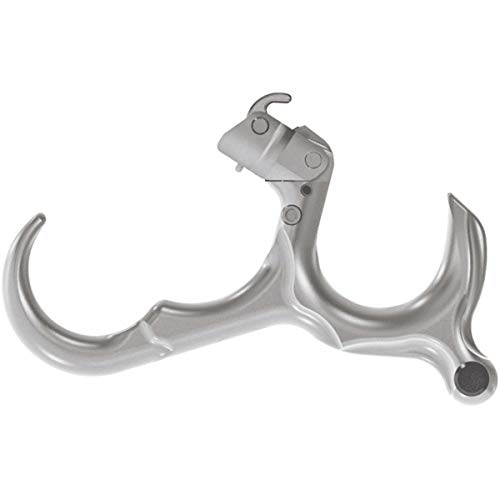
The Ascent Micro Hinge 3 is the hinge release in the grid, with a sear jaw and an adjustable setting per its listing. On the maker's site, the back-tension collection lists the Longhorn Expert, Select and Fusion, and Scott says the line was developed with tournament archers over more than a decade.
Scott's guide is direct about this family: it's the most effective tool it sells for target panic, it has the steepest learning curve, and it needs practice at a blank bale (a target at close range with no aiming point). Many archers, the guide says, own two releases: one for hunting and a hinge for practice. One body note: a hinge teaches your back muscles to do the work your trigger finger was stealing. Your shoulder blades will have opinions about it in week one.
Youth releases: the Vibe and the Quickshot Jr.
Two Scott youth releases are in the grid, and the maker describes them in more detail than most:
- Quickshot Jr.: single-caliper jaw, roller-sear trigger, youth leather buckle strap, and a rope connector that adjusts in length as a kid grows
- Vibe: caliper-style double jaw, roller-sear trigger with auto return and adjustable travel, NCS connector, youth strap
Scott's guide says a youth release should have simple mechanics, a youth-sized strap and an adjustable connector. The adjustable rope is the practical part. Kids grow between seasons, and a release that's too long or too short changes where the hand anchors. The best compound bow for beginners list covers the bows these go with.
How to choose within the Scott lineup
Decide how you want to fire first
Trigger finger, thumb or hinge. That one choice puts you in a family, and everything else is detail.
My one opinion on this page: for a hunting release, pick one that stays on your wrist. Archery 360's reason is the one I'd give: the wrist strap takes the load off your fingers while you hold at full draw waiting for a deer to step out, and a hunting shot often means holding longer than you planned. A thumb release or a hinge can be a fine hunting release too, and Scott's guide says so. The wrist strap just makes the long hold easier.
Then the jaw
The grid's jaw field sorts the lineup:
- Single caliper: one moving jaw, as on the Quickshot Jr.
- Dual caliper: two jaws that close around the loop, as on the Vibe
- Hook: an open hook, as on the Verge per its listing
- Sear: the hinge-style mechanism on the Ascent
Scott's guide says an open hook loads quickly onto a D-loop and lets go smoothly, and that a closed caliper is more secure and friendlier to beginners.
Then the adjustments
Most Scott releases in the grid list an adjustable trigger. Scott's guide gives a starting point: short, crisp travel; tension heavy enough that you fire on purpose, not by accident; and a thumb barrel where your thumb falls onto the button at full draw. The maker's FAQ says trigger travel is set with the set screw at the base of the trigger assembly.
Then the fit
Scott's guide says fit matters more than the spec sheet, and that a release that doesn't fit is hard to shoot well. A rope connector adjusts the length; the NCS strap, Scott says, fits all hand sizes. Try a release on your own wrist and at your own anchor before you settle on one.
Learning a new release safely
A new release can fire before you expect it to. Archery 360's advice for a hinge is to start with a shot trainer or a loop of string tied as a trainer, and to set the release stiff at first so it takes a lot of rotation to fire, then make it more sensitive slowly. Only draw a bow with an arrow on the string and the bow pointed at a safe backstop. Never dry-fire a bow.
Care and warranty basics
Scott lists a limited lifetime warranty on all its releases. Normal wear, like a worn wrist strap, isn't covered, and some discontinued models are on an end-of-life list and can't be serviced. Scott decides on repair, replacement or refund, and if an item isn't covered it quotes a repair. Its FAQ adds that older threaded triggers may be sent as replacement parts while stock lasts, while newer fully machined triggers have to be sent in for repair.
Replacement straps aren't listed on the maker's website; its FAQ says to call or email customer service for them. Check the strap and the rope connector before each season. A frayed loop is a cheap fix in August and an expensive one in November.
Alternatives and other brands
The grid shows Scott's releases first. Below them, the theme lists releases from other brands when Scott has few listings live. Some of those brands have their own pages here, including Trophy Ridge, Tru-Fire and TRUGLO. For release types side by side across all brands, the bow release page is the place to start, and the compound bow arrows page covers what goes on the other end of the string.
Who's behind Scott Archery
Here's what Scott says about itself on its own site:
- Experience: over 40 years working on bow releases
- Made in: the United States; its buyer's guide says the releases are designed, machined and assembled there, with U.S.-based quality control and customer service
- Back-tension line: developed with input from tournament archers over more than a decade
This page doesn't cover a founding year, a founder or the company's owner.
Trigger, jaw, fit. Write the setting you like on a piece of tape on the release, because by next September neither of us will remember it.
Where Scott Archery shows up
Questions about Scott Archery
Is Scott Archery a good release brand?
What the maker states can be checked: Scott says its releases are designed, machined and assembled in the United States, and it lists a limited lifetime warranty on all Scott releases. Whether one suits you depends on how you want to fire: index finger, thumb or hinge. The grid on this page shows release type, jaw type and trigger adjustment per model.
Which Scott Archery release is best for hunting?
Scott's own buyer's guide points hunters to an index-finger release for speed and security, or a well-tuned handheld release for those who want more control. It suggests a hinge mainly as a practice tool for beating target panic. Archery 360 adds that a wrist strap reduces finger fatigue when you hold at full draw waiting for a shot.
What warranty do Scott Archery releases have?
The maker lists a limited lifetime warranty on all Scott releases. Normal wear, such as a worn wrist strap, isn't covered, and some discontinued models are on an end-of-life list and can't be serviced. Repairs start with a request on the maker's product repair page, and Scott decides between repair, replacement or refund.
Where are Scott Archery releases made?
Scott's buyer's guide says its releases are designed, machined and assembled in the United States, with U.S.-based quality control and customer service. Its Why Scott page describes the releases as made in America and says the company has worked on bow releases for over 40 years.
Does Scott Archery make youth releases?
Yes. The maker's youth line includes the Quickshot Jr. and the Vibe. Scott describes the Quickshot Jr. as a single-caliper release with a youth leather buckle strap and an adjustable rope connector, and the Vibe as a caliper-style double-jaw release with a youth strap. Both are in the grid.
How do you adjust trigger travel on a Scott release?
Scott's FAQ says trigger travel is set with the set screw at the base of the trigger assembly: turning it in or out changes how far the trigger moves before the release fires. The maker links a step-by-step video, and hinge models have their own adjustment instructions, which vary by model.
Sources
- Scott Archery: Home page and release categories — accessed 2026-10-28
- Scott Archery: Why Scott — accessed 2026-10-28
- Scott Archery: How to choose the right archery release — accessed 2026-10-28
- Scott Archery: FAQs — accessed 2026-10-28
- Scott Archery: Customer service and warranty — accessed 2026-10-28
- Scott Archery: APEX CORE handheld thumb release — accessed 2026-10-28
- Scott Archery: Verge release — accessed 2026-10-28
- Scott Archery: Vibe youth release — accessed 2026-10-28
- Scott Archery: Quickshot Jr. youth release — accessed 2026-10-28
- Scott Archery: Back tension releases — accessed 2026-10-28
- Archery 360: Which release aid is right for you? — accessed 2026-10-28
- Archery 360: How to use a hinge release — accessed 2026-10-28