Blinds & Tree Stands · Gear type
Tripod Deer Stand
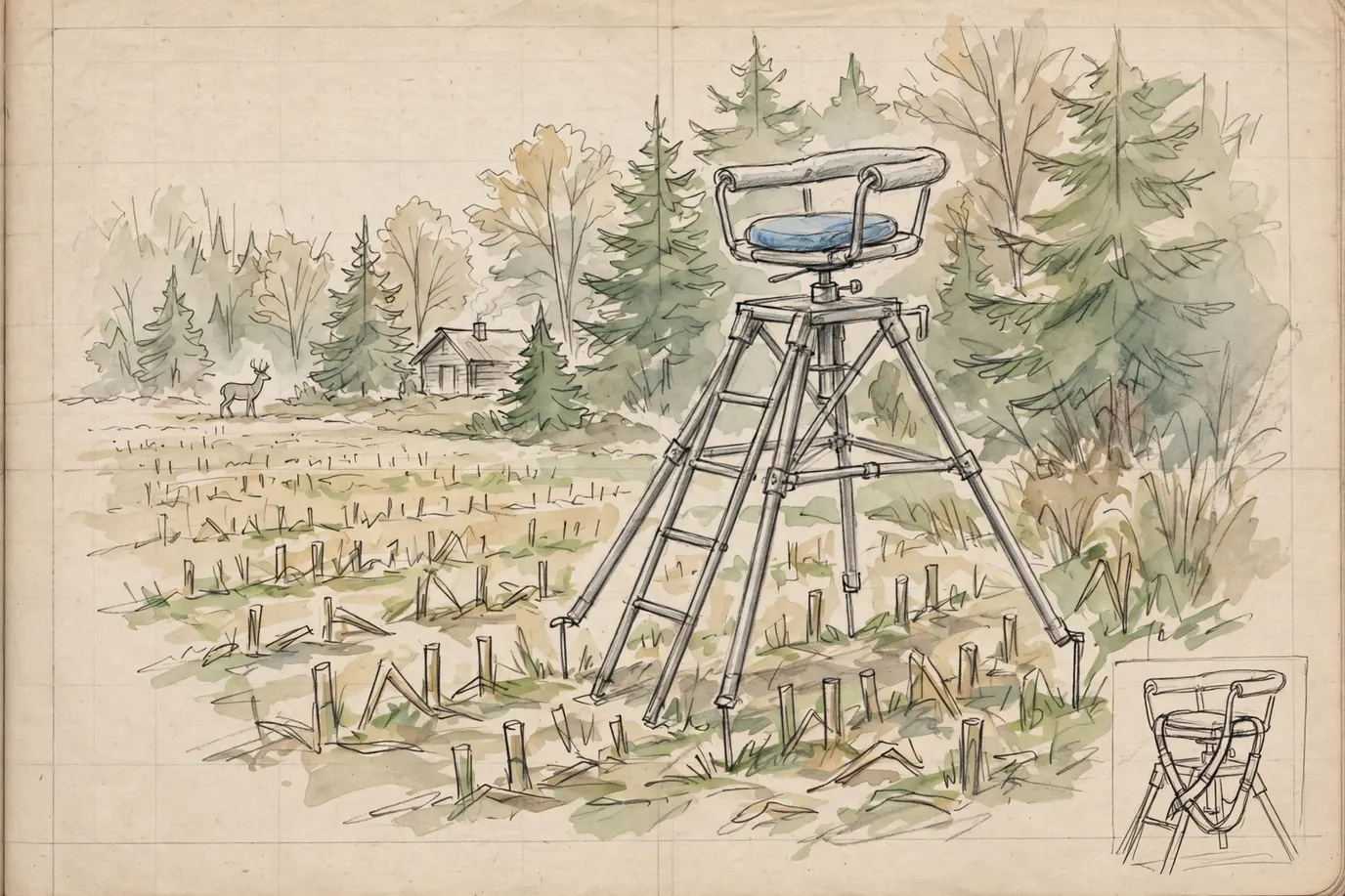
A tripod deer stand is a raised seat on three legs that stands up on its own, no tree required. That's the whole reason to own one: it puts you above the cover in a cornfield, a cutover, a fence row or a food plot where there's nothing worth strapping a stand to. Pick it by height, by how wide and level the legs sit, and by a swivel seat that stays quiet. Plain and simple: a tripod trades the tree for stakes, so the stakes matter.
We earn a commission if you buy through our links, at no cost to you. Disclosure
| Model | Material | Capacity | Weight capacity | Type | Amazon |
|---|---|---|---|---|---|
Thunderbay 6 Foot Tripod TowerLadder stand More specs
| Steellisting | 2 personslisting | 500 lblisting | Tripodlisting | Check price |
Muddy Hunting Quad Pod Stand 10 ftLadder stand More specs
| — | — | 500 lblisting | Quad podlisting | Check price |
Big Game Pursuit Tripod TreestandLadder stand More specs
| Steellisting | — | — | Tripodlisting | Check price |
Guide Gear 12-Foot Tripod Deer StandLadder stand More specs
| Steellisting | 1 personslisting | 300 lblisting | Tripodlisting | Check price |
Muddy 12 ft Tripod Deer StandLadder stand More specs
| Steellisting | — | 300 lblisting | Tripodlisting | Check price |
Muddy 12' Quad PodLadder stand More specs
| Steellisting | — | 500 lblisting | Quad podlisting | Check price |
Big Game Apex 1-Person Tripod StandLadder stand More specs
| Steellisting | 1 personslisting | 300 lblisting | Tripodlisting | Check price |
Big Game The Defender TripodLadder stand More specs
| Steellisting | 1 personslisting | 300 lblisting | Tripodlisting | Check price |
Muddy Liberty Steel Tripod StandLadder stand More specs
| Steellisting | 1 personslisting | 300 lblisting | Tripodlisting | Check price |
Guide Gear 20-Foot Tripod StandLadder stand More specs
| — | 1 personslisting | 300 lblisting | Tripodlisting | Check price |


What’s in this listTripod and quad-pod stands, as described by the maker or the Amazon listing. “—” means neither the maker nor the Amazon listing states it.
What makes a tripod deer stand different
Every other stand on this site borrows its strength from a tree. A tripod doesn't. Three legs make a wide base on the ground and come together under a small platform with a seat, and one leg usually doubles as the ladder.
That's why tripods live where trees don't. Bowhunter magazine's writer took one into weedy fields and cornfields, where deer could spot a hunter on the ground long before he saw them. One maker lists open fields, meadows, fence rows and food plots as tripod country.
If you have good, straight trees, a ladder stand covers the shared basics of rungs, rails and straps, and it gets you higher. This page is about standing up in a field with nothing to lean on. (Three legs is the minimum for anything to stand on its own. Ask any camp stool.)
The table on this page lists stands the maker or the listing describes as a tripod or quad-pod. It shows the type, height and whether it's measured to the seat or the rail, weight capacity, how many hunters it holds, stand weight, material, platform size, seat width, and whether it has a 360-degree swivel seat, a shooting rail that flips back, or a blind in the box. The maker's figures come first and the Amazon listing fills in where the maker is silent (the table marks listing values); a dash means neither states it. Weight is always the maker's own figure.
What to look at when you pick a tripod deer stand
Rule of thumb: on a tripod, the ground is half the stand. Read the specs with the spot you'll set it in already in mind.
Read height as eye level above the cover
Tripods run lower than tree stands, and you can't climb higher than the legs. Among maker specs, one steel tripod lists 12 feet to the shooting rail and a larger model lists 16 feet to the rail. Bowhunter's writer, shopping years ago, couldn't find one under 10 feet until he tried a tripod with a 6-foot seat. As with ladder stands, makers state height either to the seat or to the rail; the table records which.
Low isn't automatically bad. Bowhunter's writer found most tripods "the ideal height" for cornfields, and the point is to see over the stalks, not to hide in the sky. What changes is how much you can move. You're closer to the deer's eye level, so Bowhunter's writer says to keep movement to a minimum. Bowhunter's writer got picked off by a deer while turning in his seat.
So measure your cover, not your ego. If the crop or the brush stands 8 feet tall, a stand that puts your eyes a few feet over it does the job.
Leg spread and platform size are the stability specs
A tripod is only as steady as the triangle its feet make, and the platform is where your boots live. Foot platforms vary a lot: one maker lists a 19-inch round platform on its 12-foot tripod and a 42-inch one on its 16-foot model, and another lists 20 inches on a 12-foot stand and 36 inches on a 13-foot one. The table's platform column gives the foot area as the maker or the listing states it, either as two numbers or a round size.
Adjustable feet matter on real ground. One maker sells its larger tripod with fully adjustable legs for uneven ground, and one maker's manual gives each leg an adjustable foot so you can raise or lower that corner of the stand. That's for small dips, not hillsides. Every tripod manual I read asks for firm, level ground and warns that a slope, or one leg on a rock or root, can make the stand tilt or shift as you climb.
Stake every leg, every time
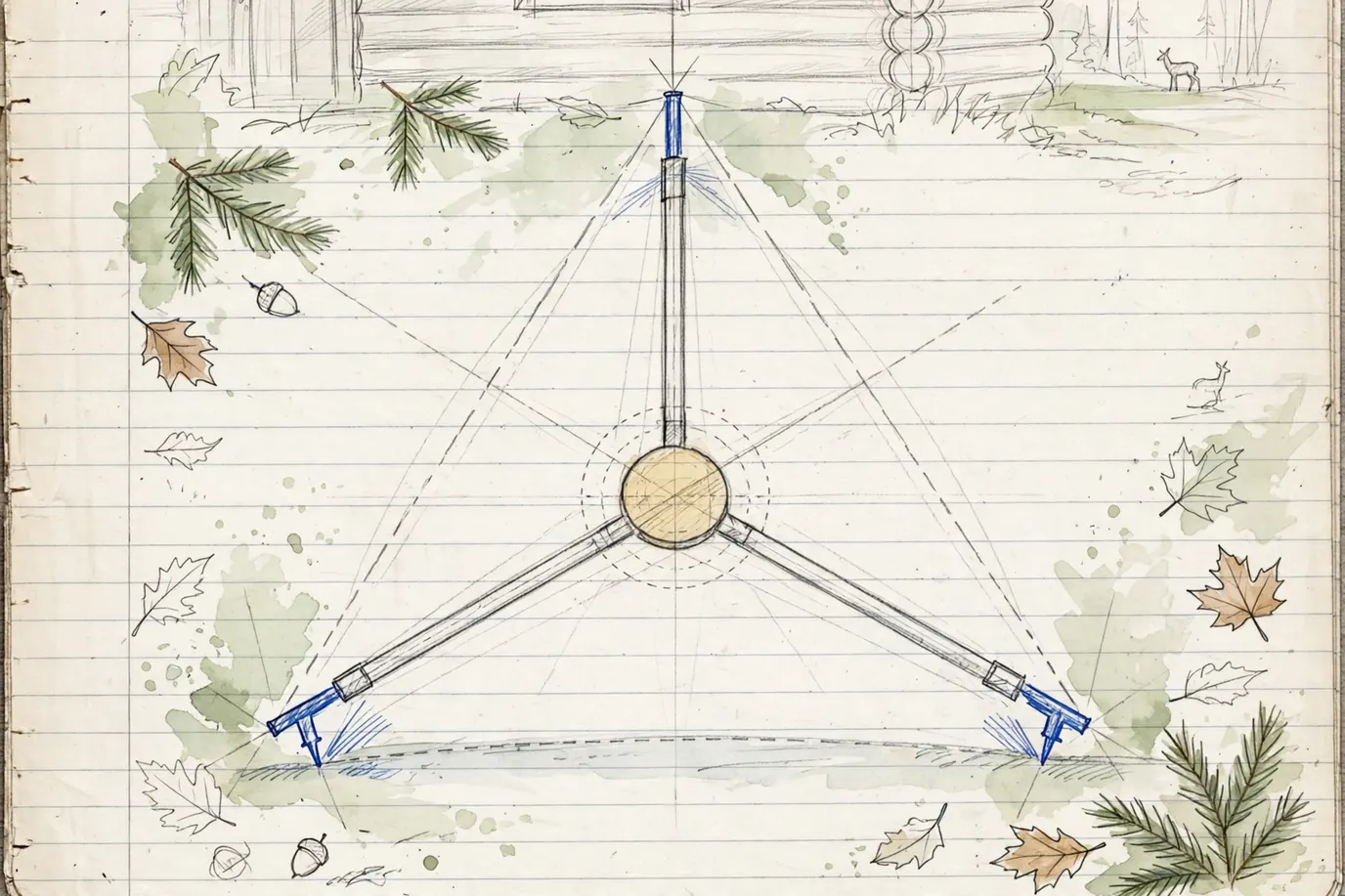
This is the part of a tripod that replaces the tree straps. One manual says to use the supplied stakes before every use, even if you haven't added a leg extension. It says to drive each stake completely into the ground, angled toward the center of the tripod. Another has you push an anchor pin through a hole in each foot once the stand is where you want it.
A tripod that isn't staked has nothing holding it upright except its own weight and the dirt under it. Stake it before you clip into anything.
A 360 swivel seat is the reason to sit there
Most tripods put the seat on a swivel, and the table marks the ones whose maker or listing says it turns a full 360 degrees. In a field, deer can come from any side, and turning the seat beats turning your body. Bowhunter's writer counts the full 360-degree view as one of the tripod's main advantages.
The catch is noise. A swivel only helps if it turns quietly, and a squeaky one is a dinner bell in reverse. Check the swivel's hardware every season, and keep the stand out of the weather when you're not hunting.
Seat width shows up for some stands in the table; read it if you plan to sit all morning in the cold.
Pick a shooting rail by what you're shooting
A padded rail around the front of the seat is common on tripods. On the maker pages I read, both of one maker's models let the seat and shooting rail swivel 360 degrees together, and another maker's larger tripod has a padded, flared-out rail. For a rifle or crossbow, that rail is your rest.
Bowhunters have a different question: can you draw? Bowhunter's writer stood up on the leg steps to draw on the tripod he tested. One maker says its taller model's padded rail is removable and flips back. The table marks which stands have a rail that flips back. If yours doesn't, practice drawing in it on the ground before the season.
Weight capacity includes you and everything you carry
The capacity and weight capacity columns go together. Every single-seat tripod spec I read, from both makers, lists a 300-pound weight rating. One tripod manual says its limit is your combined weight with all hunting gear and accessories; another prints that the total includes all gear.
Do the arithmetic dressed for the last week of the season, with your pack, before you compare. That number has to fit under the rating, not on top of it.
Stand weight decides whether it's portable
Tripods range from something you shoulder into a field to something you set once and leave for the season. Bowhunter's writer liked a tripod of about 40 pounds, light enough to carry on his shoulder and fit in a truck bed, and he still found the carry hard on his body. Maker specs climb fast from there: 66 and 67 pounds for two 12-foot steel tripods, 115 for a 13-foot model, 132 for a 16-foot one. One maker says its legs fold together for transport and storage, and another calls its 12-foot tripod easy to fold up for transport.
The table's weight column is the stand's own weight, as the maker states it. Material is there too; every maker spec I read for this page lists steel.
Blind kits, skirts and height extensions
Many tripods are sold bare, and the table marks the few that include a blind or enclosure. One maker's tripod comes with a fabric skirt tied around the rail and platform. Makers also sell tripod blind kits, roof kits and height extensions for specific models as separate accessories.
A skirt hides your feet and hands, which helps a stand that sits closer to eye level. If you add either one, use the maker's kit for that model; tripod manuals say never to attach anything the maker hasn't authorized in writing.
Tripod or quad-pod
A quad-pod is the same idea on four legs. Makers list tripods and quad-pods together, and one sells blind kits and roof enclosures for its quad-pods in the same category.
Here's how I'd split it:
- Tripod: lighter, quicker to move, three stakes, most often an open seat with a rail
- Quad-pod: four legs, a wider and heavier base, more often wearing a blind kit or roof
- Tower or box blind: a roofed shooting house on legs, set for the season; see tower deer stands and box blinds
Where a tripod works best
Bowhunter's writer set his between corn rows without breaking stalks, says a tripod works along fence lines and open fields if you put it where it's hidden, and says to watch the wind. Back the stand into whatever cover the field gives you.
Jess's take: "A tripod is a ground blind that decided to stand up." She's half right. It sees like a tree stand and hides like a lawn chair, which is why the cover behind it matters as much as the stand.
Who should skip a tripod
Skip it if your woods have plenty of straight trees; a ladder or hang-on stand gets you higher. Skip it if your ground is all slope; tripod manuals warn against sloping or uneven ground. And skip it if you'll walk a long way to every sit and won't take a helper; the manuals call for more than one person to stand it up.
Hemlock Run is mostly oak, hemlock and hillside, so the camp doesn't own one. If we ever hunt flat farm country, the logbook will need a new column.
How to set up a tripod deer stand
The tripod manuals I read agree on this order. Where yours differs, follow yours.
- Find firm, level ground. No slope, no rock or root under a foot, and never near power lines, transformers or generators, per one maker.
- Assemble on the ground. One manual says hand-tighten all bolts first, then go back and tighten them with a wrench once everything is on.
- Stand it upright with helpers. One manual calls for at least three people to install or remove the stand; another says four if you've added a leg extension kit.
- Stake or pin every foot before anyone climbs.
- Step firmly on the first rung to set the ladder. Don't jump or bounce on the platform or ladder.
- Climb with three points of contact: two hands and a foot, or two feet and a hand.
- Pull your bow or gun up on a haul line once you're seated. Never climb with gear in your hands.
Before every hunt, check that the leg and ladder sections are seated, retighten the bolts, and look for bends, cracks and rust. One manual says not to leave the tripod outside when you're not using it, because weather and animals damage it, and to store it indoors. Stand rules on the land you hunt, public or leased, vary by state; check your state wildlife agency.
Wear a harness on a tripod too
My one opinion on this page: wear a harness every time your boots leave the ground, no exceptions, and a tripod is no exception. TMA's guidelines say to wear a full-body fall-arrest harness every time you leave the ground, including climbing up and down, and its standards cover tripod and tower stands along with treestands. The tripod manuals say the same. With no tree, attach the harness only where and how your stand's maker says to. Keep a phone or whistle within reach even while hanging in the harness, and leave word where you're sitting. Fit and types are covered on the tree stand harness page.
That's a tripod. Three legs, three stakes, one quiet seat. Check all three before you climb.
Brands in this list
Related
Questions people ask
How tall are tripod deer stands?
The maker specs I read run from 12 feet to 16 feet to the shooting rail, and Bowhunter's writer once tested one with a seat only 6 feet up. Makers state height either to the seat or to the rail, so read which one the spec means. Some makers also sell leg extensions that add height to a specific model.
Is a tripod tree stand the same as a tripod deer stand?
Yes. People search for a tripod tree stand, but a tripod doesn't use a tree at all. It's a freestanding seat on three legs, usually with a short ladder built into one leg. Makers often list it in their tree stand range anyway, next to ladder stands and quad-pods.
Do you have to stake down a tripod stand?
The manuals I read say yes. One says to use the supplied stakes before every use, even without a leg extension, and to drive them fully into the ground at an angle toward the center of the tripod. Another has you push an anchor pin through each foot once the stand is in position.
Can you bowhunt from a tripod stand?
Yes, with a check first. Bowhunter's writer used the steps on the legs to stand up and draw, resting his bottom limb on the seat between his legs while he waited. Practice drawing from your own stand, sitting and standing, before the season. A shooting rail that flips back or lifts out of the way helps. Bowhunter magazine notes tripods suit cornfields, where tall rows hide the stand.
How many people does it take to set up a tripod deer stand?
One tripod manual I read says a minimum of three people for installing or removing the stand, and has two helpers stand it upright. Another says to use four people when the stand is fitted with a leg extension kit. Follow the number in your own stand's manual.
Sources
- Muddy Outdoors: Nomad tripod (maker spec sheet) — accessed 2026-10-22
- Muddy Outdoors: The Liberty tripod (maker spec sheet) — accessed 2026-10-22
- Bowhunter: Tripod stands for open country — accessed 2026-10-22
- Big Game Treestands: Tripod hunting stands — accessed 2026-10-22
- Muddy Outdoors: Tripod and quad-pod stands — accessed 2026-10-22
- Muddy Outdoors: Extensions and blind kits — accessed 2026-10-22
- Primal Vantage: Tree Top 15' Deluxe Tripod instruction and safety manual — accessed 2026-10-22
- Summit Treestands: Classic Deluxe Tripod Top instructions — accessed 2026-10-22
- Treestand Manufacturers Association: Treestand Safety Guidelines — accessed 2026-10-22
- Treestand Manufacturers Association: Standards — accessed 2026-10-22