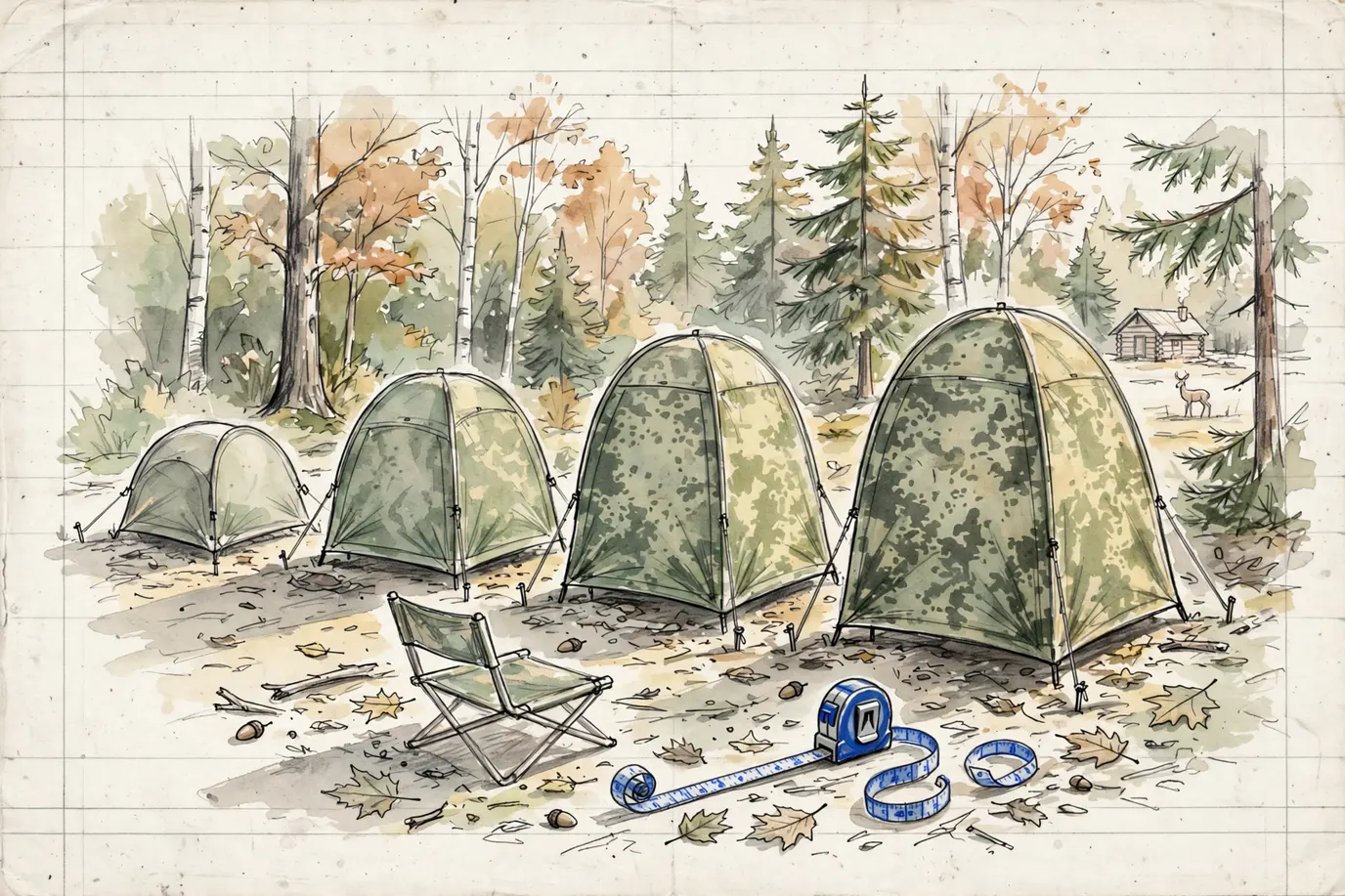
Picks on this list, by what the data says
Each label below comes from a number or a word in the maker's or the listing's specs. A label says what a blind is, not that it wins anything. The list is re-checked every week, so labels can move from one blind to another.
Barronett Grandview: the tallest and the biggest crew on this list
At 82 inches of center height by the listing, the Grandview is the tallest blind here. It's also the only one listed for 4 people. The listing says the walls are see-through and the windows are silent, and the camo pattern is Bloodtrail Backwoods. The trade is weight. At 24 lb by the maker's figure, it's the heaviest blind on this page by close to 10 lb. That's a blind for a short walk from the truck, or for a spot you set once in August and leave.
Barronett Prowler 300: the lightest by the maker's figure
The Prowler 300 weighs 14 lb by the maker's figure, the lightest here, though the next two are within half a pound. It's a hub-style pop-up with an 80-inch center height by the listing, the second tallest on this page. The listing gives it a 2-person capacity, the smallest here, and lists shoot-through mesh, the only blind on this list with that feature stated. The camo is Bloodtrail Woodland. Two hunters, or one bowhunter with room to draw, is the honest way to read it.
Ameristep Inferno: the only one listed as insulated
The Inferno is the only blind on this list that its listing calls insulated, and the name says so too. It's a hub-style pop-up for 3 people by the maker, weighing 14.4 lb by the maker's figure. The listing gives a 72-inch center height, a 66 x 66 inch footprint, silent windows and a Mossy Oak DNA XL camo pattern. It's the one blind here in the higher of the two price tiers on this page. If you sit late-season mornings, that's the spec to look at.
Rhino Blinds Rhino 180: the most stated specs, and a 180-degree view
The Rhino 180's numbers all come from the maker: 3 people, 14.3 lb, a 66-inch center height and a 58 x 58 inch footprint, the smallest footprint stated on this list. The maker says the walls are see-through, the windows are silent and the view is 180 degrees, and it's the only blind here with a view angle stated. The camo is Realtree Edge. The 66-inch center height is the lowest on this page, so sit-down shooters will be fine and tall standing archers should measure first.
How to choose the best ground blind for your setup
The rule behind this list uses three fields: center height, capacity and weight. They're also the three numbers that decide most ground blind choices, so I'll take them in that order. After that come footprint, windows, walls and fabric.
Center height decides whether the bow fits
Center height is how tall the blind is in the middle, where the hubs pull the roof up highest. The corners are lower. Bowhunter's ground blind tips say the blind has to be tall enough that your bow limbs never hit the ceiling while you draw or shoot, and that traditional archers need to pay closer attention because their limbs are longer. Rule of thumb: sit in the chair you'll use, draw your bow in the garage and have somebody measure from the floor to the top limb. Then add a few inches for the day you lean forward.
On this list, center heights run from 66 to 82 inches. That spread decides whether you can stand to shoot or only sit.
Jess's take: "Measure the bow at full draw, not hanging on the wall. The top limb goes somewhere new when you pull." She has a spreadsheet column for this. I have a tape measure and a chair.
Capacity is people sitting, not people shooting
Capacity is the number of people the maker or the listing says fit inside. Read it as people sitting still. A bowhunter at full draw takes up more room than a person drinking coffee, and Bowhunter points out you need space behind you so your elbow doesn't hit the back wall when you draw. Realtree's tips go further and say bigger is better, because a larger blind gives you room to draw and to organize your gear.
On this list, capacity runs from 2 to 4. With a kid along, take the bigger number. If you hunt alone with a bow, a 2-person blind is a 1-person blind with a place for the pack.
Weight is what you carry in, and out again
A blind weighs the same going in at 5 a.m. as it does coming out at dark, except it's usually wet coming out. Weight here is always the maker's own figure. Three blinds on this list sit between 14 and 14.4 lb, and one weighs 24 lb. That 10-lb gap matters most on a half-mile walk uphill. If you plan to move the blind during the season, buy for the walk. If you set it once and leave it, buy for the room.
Footprint and hub-to-hub width are not the same thing
The footprint is the size of the blind on the ground. Hub-style blinds bow outward at the walls, so the room at shoulder height is wider than the footprint. Two blinds here list a footprint: 66 x 66 inches and 58 x 58 inches. Fold a tarp to that size on the garage floor, put your chair on it and see where your feet and pack go.
Windows: quiet, adjustable and below your arrow
The listings and makers for three blinds on this list say the windows are silent. That matters, because you'll open and close them while deer are near. Bowhunter's tips add three useful points:
- Keep only the shooting window open; light from behind or the sides shows your shape
- The arrow flies a few inches below your line of sight, so the bottom of the window has to sit well below it
- Distances look strange through a window, so range your shooting lanes ahead of time
Realtree's tips say to watch for the broadhead hitting the blind at the shot and to check the arrow's path before you release. A broadhead that catches the window frame is a safety problem, not a story. Check it from your chair before the season.
See-through walls and shoot-through mesh
Some blinds use a fabric you can see out of but deer can't easily see into. On this list, the maker says the Rhino 180 has see-through walls, and the listing says the Grandview does too. Shoot-through mesh is a different thing: a mesh panel over a window that an arrow can pass through. On this page, only the Prowler 300's listing states it. Shoot only through mesh the maker says is for that, and only the way the maker says to use it.
Insulation and the camo pattern
Only one blind here, the Inferno, is listed as insulated. Insulation helps with late-season cold and wind, but it doesn't make a blind airtight, and a heater inside any blind brings its own rules (see the safety section below). Camo patterns vary from blind to blind. The MeatEater setup article makes the useful point: a pop-up hub blind is easy to spot, so the natural cover you add around it does more than the print on the fabric.
How to set up a ground blind so deer accept it
A new blind is new furniture in a deer's living room. Bowhunter says to set it up several weeks ahead so animals get used to it. MeatEater says by summer if you can, because a blind sits at deer eye level and gets noticed more than a tree stand.
Pick the spot before you pick the blind
MeatEater's advice is to tuck the blind 5 to 10 yards back into cover next to an opening, off to the side of where deer approach, not right in front of them. Use terrain like a steep drop, thick cover or water to keep deer from getting downwind. Clear dead leaves and sticks off the ground inside, because dry leaves under a chair are loud. Mind the sun, too. Realtree and Bowhunter both say to note where it rises and sets, so it doesn't shine through your main window and light you up.
Stake every loop and tie it off
Bowhunter suggests trading the thin stakes in the bag for heavy tent stakes, or bent rebar in an L shape, and anchoring every loop along the bottom. Tie ropes from the outer hubs to trees or brush. Where there's nothing to tie to, drive stakes about 6 feet out and angle the ropes steeply. If a limb hangs over the blind, tie the roof's peak to it. That's a Saturday-afternoon job, and it beats a Sunday-morning search.
Brush it in, but keep sticks off the fabric
Use branches, cornstalks or whatever grows right there. MeatEater suggests leaves that hang on long, like white oak, scarlet oak and evergreens, and warns against using material that doesn't match the spot. Bowhunter adds one more thing: keep sticks and saplings from rubbing the fabric, because wind will wear holes in it.
Set your ground blind up weeks before the season
Set your ground blind up weeks before the season. That's my one opinion on this page, and it's backed by both Bowhunter and MeatEater: deer notice a new pop-up at eye level, and time is what makes it part of the woods. A good blind set the night before is a dark box in a strange place. An average one set in August is just there, like the old fence post.
Safety in a ground blind
Put blaze orange on all sides of the outside of the blind. The Let's Go Hunting safety article says closed windows can hide the orange you're wearing, so the blind itself has to show it. Some states and public lands require a minimum; check your state wildlife agency.
If you run a propane heater or stove inside, keep at least one window cracked for cross-ventilation. Carbon monoxide can build up in a closed blind.
Who should skip this list
If your spot has a good straight tree over the trail and you're comfortable with a harness and a climb, a tree stand may suit you better, and this list isn't for you. If you hunt the same field edge every year and want walls, a roof and a door that stays put, look at a hunting blind page instead of a pop-up. And if what you need is a seat for a blind you already own, skip ahead to the hunting blind chair page. A new chair fixes more sore backs than a new blind does.
How this list is built
The rule is in the box above, and here it is in full. A blind gets on this list when it's a ground blind and its maker or its Amazon listing states three things: capacity, center height and weight. Weights always come from the maker's own page, because the weight a store field shows isn't reliable enough to plan a walk around. Other values come from the maker first; where the maker is silent, they come from the Amazon listing, and on this page most of the center heights do. Then the blinds are sorted by center height, tallest first.
The order follows that rule and the numbers in the data, never a preference for any brand. There are no ratings or review counts behind these picks, and nobody at Hemlock Run has sat in any of these blinds. The labels describe what each blind is, not which one is better. The list is re-checked every week, so a blind can drop off when its data changes and a new one can come on when its numbers fill in. If a spec is missing, it isn't mentioned, and in the table it shows as a dash.
Measure your bow, measure your chair, then measure the walk. The blind that fits all three is the one that gets used.